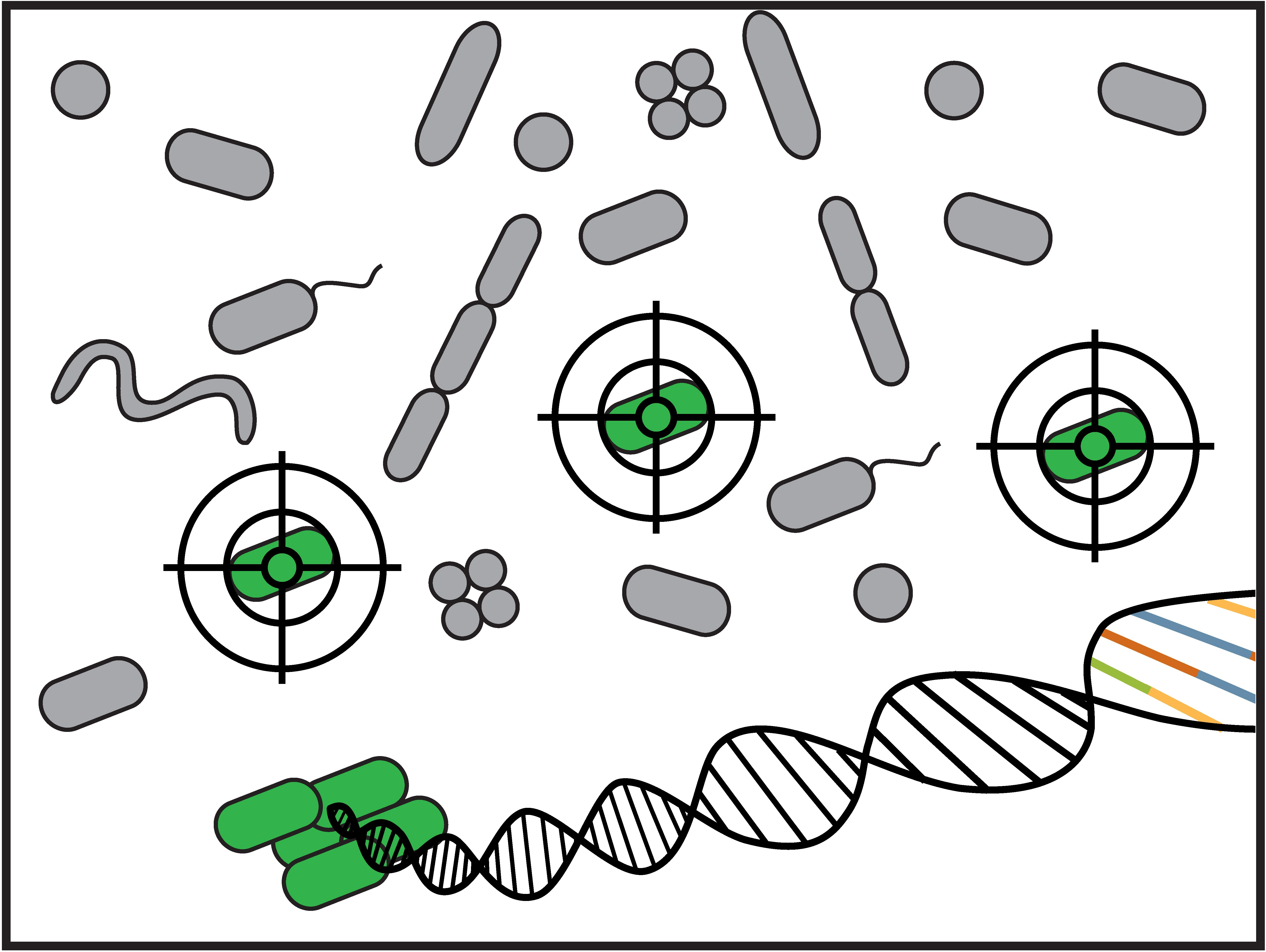
Genomic analysis of bacterial communities can often be tricky, particularly in environments with many uncharacterized species. Let’s say you are interested in a specific species, because you repeatedly find its 16S rRNA sequence in your amplicon datasets and you want to learn more about its capabilities and its role in the environment. But this species does somehow not like the culturing medium you are using or the conditions you try to grow it in. So you decide to take a culture-independent approach and sequence a metagenome. You get some genome bins, but you are unsure, whether they represent the species you are interested in, because they lack the 16S rRNA gene sequence as the link to your amplicon data.
This was the situation we found ourselves in when we began our project. In our research group we are studying the succession of bacteria thriving during and after phytoplankton blooms in the North Sea. We extensively use fluorescence in situ hybridization (FISH) as it allows for counting the relative abundances of bacterial clades based on 16S rRNA sequences and using FISH, we recurrently detected a flavobacterial clade named “Vis6”, which resisted laboratory cultivation. Having the 16S rRNA based probe at hand and the flow cytometer with cell sorter down the corridor, we thought about combining these two methods for a targeted genomics approach. The pipeline we had in mind introduces a 16S rRNA based FISH signal into the cells of a species of interest within a bacterial community. These cells are then sorted based on that FISH signal by fluorescence activated cell sorting (FACS), resulting in an enrichment of very limited diversity (ideally on the species level) for subsequent genomic sequencing. Genome annotation then provides clues about the capabilities and functions of the targeted species in the given environment.
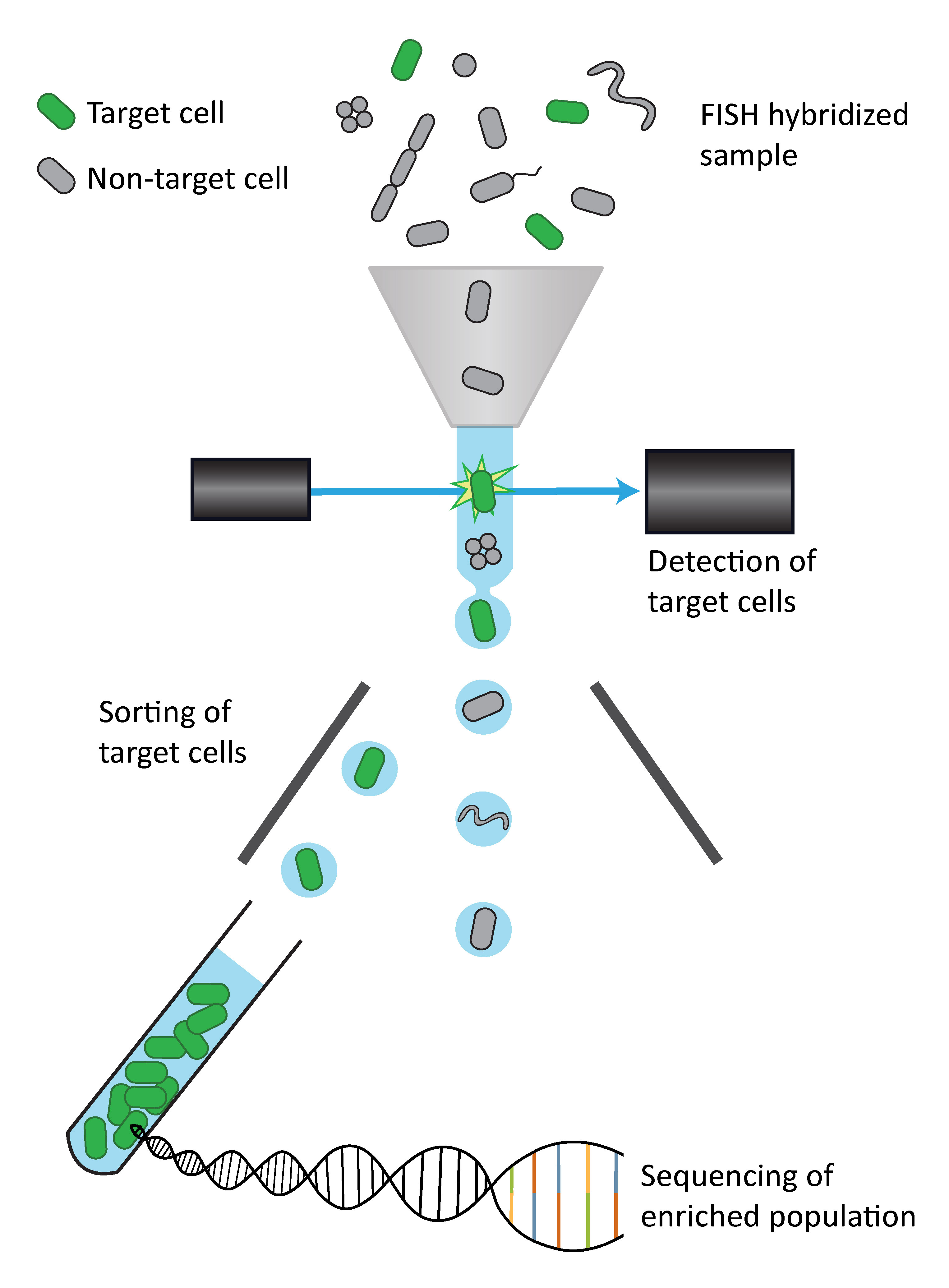
So far, so good, but we were facing two major challenges: 1.) A very bright FISH signal was needed for the detection and sorting of targeted cells using flow cytometry and 2.) Sufficient unimpaired DNA material was required for high quality genome sequencing. Our lab (Max Planck Institute for Marine Microbiology) had its expertise in FISH methods and we teamed up with DOE’s Joint Genome Institute (JGI) who brought along the sequencing expertise, in particular from little starting material. Our work consisted of a lot of troubleshooting using laboratory cultures, but eventually we developed a FISH&FACS protocol that provided high FISH signal intensities without impairing the sequencing quality by testing and validating the most suitable cell fixation approach and assessing the optimal number of sorted cells.
With this optimized pipeline at hand, we sampled seawater from the North Sea and hybridized it with our Vis6-specific FISH probe. The sorted cell enrichments were genome sequenced and the resulting mini-metagenomes of reduced diversity yielded good quality metagenome assembled genomes (MAGs). Due to the encoded 16S rRNA gene sequences and further supported by the FISH probes used, we were able to assign the taxonomic identity to the MAGs. Gene annotations of these MAGs revealed that Vis6 is a putative polysaccharide and protein degrader.
We see the main application of our pipeline in filling a gap that metagenomics and single cell genomics leave in the field of culture independent species descriptions and a valuable addition to the toolkit of cultivation-independent genomics. Metagenomes are challenged by highly complex samples and the bins are often lacking the 16S rRNA genes as a taxonomic marker. While single cell genomes most often have this taxonomic link, they are generally hampered by low genome completeness. Both methods retrieve highly abundant species more often than species of lower abundance. With a targeted genomic approach, such as the FISH&FACS pipeline we describe in our paper, specific groups or species can be genomically interrogated, opening a window into the rare biosphere, even of highly complex samples.

Follow the Topic
-
Microbiome
This journal hopes to integrate researchers with common scientific objectives across a broad cross-section of sub-disciplines within microbial ecology. It covers studies of microbiomes colonizing humans, animals, plants or the environment, both built and natural or manipulated, as in agriculture.

Related Collections
With Collections, you can get published faster and increase your visibility.
Oncobiome
This collection of papers delves into the burgeoning field of oncobiome research, exploring the intricate relationship between cancer and the microbiome. The oncobiome encompasses the diverse microbial communities residing in and on the human body, which influence cancer development, progression, and treatment responses. By examining these interactions, our aim is to unravel the complex mechanisms through which the microbiome impacts oncogenesis and therapeutic outcomes.
This compilation highlights cutting-edge research, offering insights into potential diagnostic markers and novel therapeutic strategies, thereby advancing our understanding of cancer biology and paving the way for innovative, microbiome-targeted cancer treatments.
This is a cross-journal collection between:
Experimental Hematology and Oncology
Articles will undergo the standard peer-review process of the journal to which they are submitted and are subject to either the BMC editorial policies or those of BJC Reports. Articles will be added to the Collection as they are published. The Editors have no competing interests with the submissions which they handle through the peer review process. The peer review of any submissions for which the Editors have competing interests is handled by another Editorial Board Member who has no competing interests.
Publishing Model: Open Access
Deadline: Ongoing
The Apple Microbiome
Microbiome and Environmental Microbiome are calling for submissions to our Collection on the Apple Microbiome.
With world apple production estimated at 84 million tons, the microbiome of the apple has significant implications for agriculture, food security, and human health. Understanding the complex interactions between apple plants and their associated microbial communities can lead to improved crop management strategies, enhanced fruit quality and longevity, and sustainable agricultural practices. Recent advances have highlighted the role of specific bacteria and fungi in promoting plant health and resilience against specific pathogens. Moreover, detailed profiling of these microbial communities, revealing their diversity and functional potential facilitate exciting future developments, such as the identification of beneficial microbial consortia for biocontrol and the formulation of tailored probiotic treatments for both plants and humans. By advancing our collective understanding in this area, we can work towards a more sustainable and resilient agricultural system.
Topics of interest include but are not limited to:
-Microbial diversity and function associated with apples
-Effects of soil health and rhizosphere interactions on apple production
-Impact of climate change on the apple microbiome
-Role of the apple microbiome in fruit quality
-Microbiome-driven strategies for disease resistance
This collection is open for submissions from all authors on the condition that the manuscript falls within both the scope of the collection and the journal it is submitted to.
All submissions in this collection undergo the relevant journal’s standard peer review process. Similarly, all manuscripts authored by a Guest Editor(s) will be handled by the Editor-in-Chief of the relevant journal. As an open access publication, participating journals levy an article processing fee (Microbiome, Environmental Microbiome). We recognize that many key stakeholders may not have access to such resources and are committed to supporting participation in this issue wherever resources are a barrier. For more information about what support may be available, please visit OA funding and support, or email OAfundingpolicy@springernature.com or the Editor-in-Chief of the journal where the article is being submitted.
Publishing Model: Open Access
Deadline: Sep 30, 2026