Floriculture and Sustainable Development
Published in Sustainability, Economics, and Law, Politics & International Studies

This article is based on research undertaken through a grant titled Petals of Progress from International Growth Center, supported by the UK Foreign and Commonwealth Office to the London School of Economics and Political Science. The project lead researcher is Dr. Shabbir Ahmed from the University of Queensland, Australia and the implementation partner was Agahe Pakistan who hosted the project's report and policy motivation workshop.
The global floriculture market is valued at roughly USD 60–75 billion in 2025 and projected to approach USD 100–120 billion by the early-to-mid 2030s, driven by rising disposable incomes, e-commerce flower delivery, and gifting occasions such as Valentine's Day and Mother's Day that together account for well over half of annual florist revenues. Production is concentrated in a handful of hubs — the Netherlands and other parts of Europe, Kenya and Ethiopia in East Africa, Colombia and Ecuador in Latin America, and increasingly China and India — from which cut flowers, potted plants, and ornamental nursery stock are shipped worldwide through extensive cold-chain logistics networks.
This scale brings real environmental costs particularly with heavy pesticide usage that has been well-studied. At the same time, floriculture offers environmental and social benefits — providing livelihoods for millions of smallholder and greenhouse workers in developing economies, driving innovation in renewable-powered greenhouses, biological pest control, and water-efficient irrigation, and supporting urban green space and pollinator habitat through ornamental horticulture. The tension between these costs and benefits has pushed parts of the sector toward certification schemes, carbon-neutral logistics, and renewable energy adoption, particularly in Europe and among major exporters seeking to align with climate commitments.
In this context, we considered the prospects of upscaling the floriculture sector for fresh and dried cut flowers in Pakistan, particularly in a region where there have been even greater pollution-intensive industries such as tanneries. Floriculture in Pakistan is typically analyzed within the framework of production, in which efforts are directed at maximizing output and the area under cultivation. our findings indicate that the sector's key constraints lie beyond production, as producers generally have adequate knowledge of cultivation and production practices. However, their efforts are not fully realized due to weak market linkages, limited bargaining power, and inefficient value-chain mechanisms that restrict value creation and capture.
These weaknesses in the value chain are not experienced by everyone in the same way. Those farmers with stronger market connections, negotiating power, logistics capacity, and loss-absorption capability are better positioned to retain their value than others. The high percentage (85%) of intermediary sales makes farmers less able to bargain for prices. In addition, weak market integration, poorly developed supply chain management, an ineffective transport system, and the complete absence of a cold chain are other issues that contribute to post-harvest losses and product quality. The combination of these factors results in producers receiving low prices despite high productivity. Thus, overcoming such problems should be achieved by reorienting the floricultural sector from focusing on production alone to enabling value capture as well. This could be achieved through increased coordination along the chain through collective marketing, logistical efficiencies, cold chain management, direct marketing, and more efficient processing.
Benefit sharing
Our survey findings reveal substantial differences in farmers' profit margins. Figure 1 (panel A) shows average annual net revenue by farm size category. Large-scale farmers earn almost five times as much as small-scale farmers, indicating substantial benefits from economies of scale and greater access to resources. Profits also differ substantially on the basis of the types of flowers being grown. Figure 1 (panel B) shows average net revenue by dominant flower type. Profits obtained from tuberose and roses are much higher compared to those of marigolds and gladiolus because of price differences. The research findings indicate significant differences in profitability across the floriculture industry in Pakistan. Profitability depends not only on production but also on market access and input availability. Thus, sectoral growth does not always translate into higher incomes for producers.
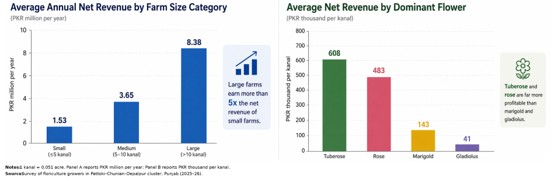
Figure 1: Floriculture productivity analysis from research
Climate risks noted by farmers
Climate-induced hazards are a key limitation to the profitability and sustainability of the floriculture industry in Pakistan. According to the survey results, frost accounted for the largest share (41%) of climate hazards, followed by heat waves (27%), flooding (23%), and drought (17%). While many agricultural products may be resistant to certain hazards, in floriculture, plants are quite sensitive to climatic factors, and even short-term frost can cause flower damage, affect stem quality, change colours, and shorten the lifetime of cut flowers. Poor quality directly affects the product's marketability, as it is sold based on its attractiveness and quality.
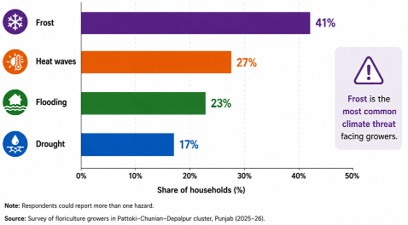
Figure 2: Climate impacts
Moreover, climate risks negatively affect scheduling and marketing. Frost and temperature changes can negatively affect flowering and timing, preventing growers from synchronizing their flowers with market standards. Delayed harvest, poor-quality goods, and higher post-harvest losses reduce the number of flowers that meet market standards and can be sold at the optimal price, or at all. Thus, not only does climate change affect yield, but it also affects the farmer's income.
Capturing value for sustainable development
Although productivity will continue to matter, enhancing farmers' capacity to earn profits is more promising for increasing earnings. This means that a value capture approach will involve strengthening linkages, reducing post-harvest losses, and ensuring that commodities move efficiently from farms to end users. There will be a need for improved collective marketing practices to increase bargaining power, while simultaneously investing in cold chain infrastructure and logistics to minimize quality losses.
Additionally, there is room for more value-added activities. The small-scale businesses involved in garland-making and other value-added items demonstrate that floriculture can add value off the farm and provide livelihood opportunities for rural women. This, in conjunction with improved access to business development services, financial resources, and information, will result in the industry moving from value leakages to value creation.
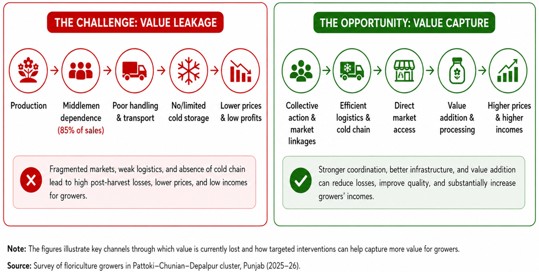
The findings suggest that isolated interventions are unlikely to deliver lasting improvements in grower incomes. Investments in cold-chain infrastructure, for example, will have limited impact if farmers continue to face constraints in accessing finance, training, and markets. Similarly, improved access to credit may not translate into higher returns if post-harvest losses and market inefficiencies remain unaddressed. A more integrated approach that combines better logistics, stronger market linkages, business support services, and opportunities for value addition is likely to generate the greatest benefits for growers. An integrated model will improve average profit levels and reduce the high degree of income inequality that prevails within the sector.

Saleem H. Ali is the Blue and Gold Distinguished Professor of Energy and the Environment at the University of Delaware (joint tenured appointments in Geography and the Joseph Biden School of Public Policy); Senior Fellow at Columbia University's Center on Sustainable Investment; Lead for Critical Minerals at United Nations University (INWEH), and Honorary Professor at the University of Queensland (Australia). He is also a member of the United Nations International Resource Panel and served 2 terms on the Scientific and Technical Advisory Panel of the Global Environment Facility. His latest book is Sustainability: A Very Short Introduction. Other works include Earthly Order: How Natural Laws Define Human Life (Oxford University Press, 2022) and Soil to Foil: Aluminum and the Quest for Industrial Sustainability (Columbia University Press, 2023). Twitter @saleem_ali
Follow the Topic
What are SDG Topics?
An introduction to Sustainable Development Goals (SDGs) Topics and their role in highlighting sustainable development research.
Continue reading announcement