




A sulfur puzzle after wildfire
Wildfires are often discussed in terms of what they release into rivers and lakes: carbon, nutrients, metals and other materials. For us, however, this study began with a more specific puzzle: where do the enhanced sulfur-containing molecular signatures observed in wildfire-affected waters actually come from?
The story began in January 2024, when I was examining our Fourier transform ion cyclotron resonance mass spectrometry data and noticed an unexpected pattern: sulfur-containing molecular formulas became more abundant after irradiation of dissolved black carbon. Our earlier analyses of biomass-derived materials had already made us question whether direct combustion alone could account for the strong sulfur-containing signatures associated with wildfire.
Later that spring, a field study published in Environmental Science & Technology reported enhanced sulfur-containing molecular signatures in wildfire-affected rivers together with fire-derived dissolved black carbon. Although this study did not trigger our original observation, it strengthened the environmental relevance of the question we were already asking: could some organic sulfur be formed after fire-derived carbon enters the aquatic environment?
At that stage, we had no clear mechanism. The observation came first; the hypothesis followed.
Following clues and testing an idea
I began searching for processes that could connect inorganic sulfate with newly formed sulfur-containing organic molecules. An important clue came from persulfate-based advanced oxidation. A 2024 study published in Water Research by Fang and colleagues showed how persulfate-based oxidation could reorganize natural organic matter and generate sulfur-containing products. This raised a possibility: could radical-mediated sulfur incorporation help explain what we were seeing?
In June 2024, decided to test this idea using electron paramagnetic resonance. Irradiation of dissolved black carbon-containing systems produced radical-like signals associated with sulfate. The result was encouraging, but it immediately exposed an obvious problem: we had not added persulfate. Our system contained ordinary sulfate.
That sent us back to the literature. We then came across a study by Cope and colleagues published in PNAS, which showed that sunlight irradiation of sulfate-rich aqueous aerosols produced organosulfates, with sulfate-radical chemistry proposed to explain their formation. Their concentrated aerosol system was very different from our dilute freshwater conditions, but it changed how we thought about sulfate: under suitable photochemical conditions, sulfate might not always remain a passive background ion.
Because dissolved black carbon strongly absorbs light and is photochemically active, we began to ask whether it could enable related sulfate-associated chemistry in freshwater. Our mass spectrometry results, the advanced oxidation literature, atmospheric aerosol photochemistry and the first EPR observations were beginning to point in the same direction.
From an intriguing signal to a systematic study
By July 2024, we had a detailed discussion on the emerging mass spectrometry and EPR evidence, and agreed that the phenomenon was worth investigating systematically. What had begun as an unexpected sulfur signal was becoming a broader question about how wildfire-derived dissolved black carbon might reorganize sulfur chemistry in water.
From September 2024 onward, we began designing and progressively carrying out a series of experiments to test the emerging hypothesis more systematically. We examined how sulfate availability and dissolved black carbon concentration shaped the radical-like response, and whether these changes were accompanied by molecular and bulk sulfur transformation. Gradually, the EPR, mass spectrometry and dissolved organic sulfur measurements began to converge on the same picture.
Peer review prompted us to examine more carefully whether the observed radical-like signals could be specifically assigned to sulfate radicals. The evidence strengthened our confidence that sulfate was involved, but did not justify attributing the entire reaction network to a single radical species. We therefore adopted the term “sulfate-associated radical-like signals” to reflect what the experiments supported without overstating the mechanism. For us, this was an important reminder that scientific progress also means knowing where the evidence stops.
From wildfire input to a light-initiated process
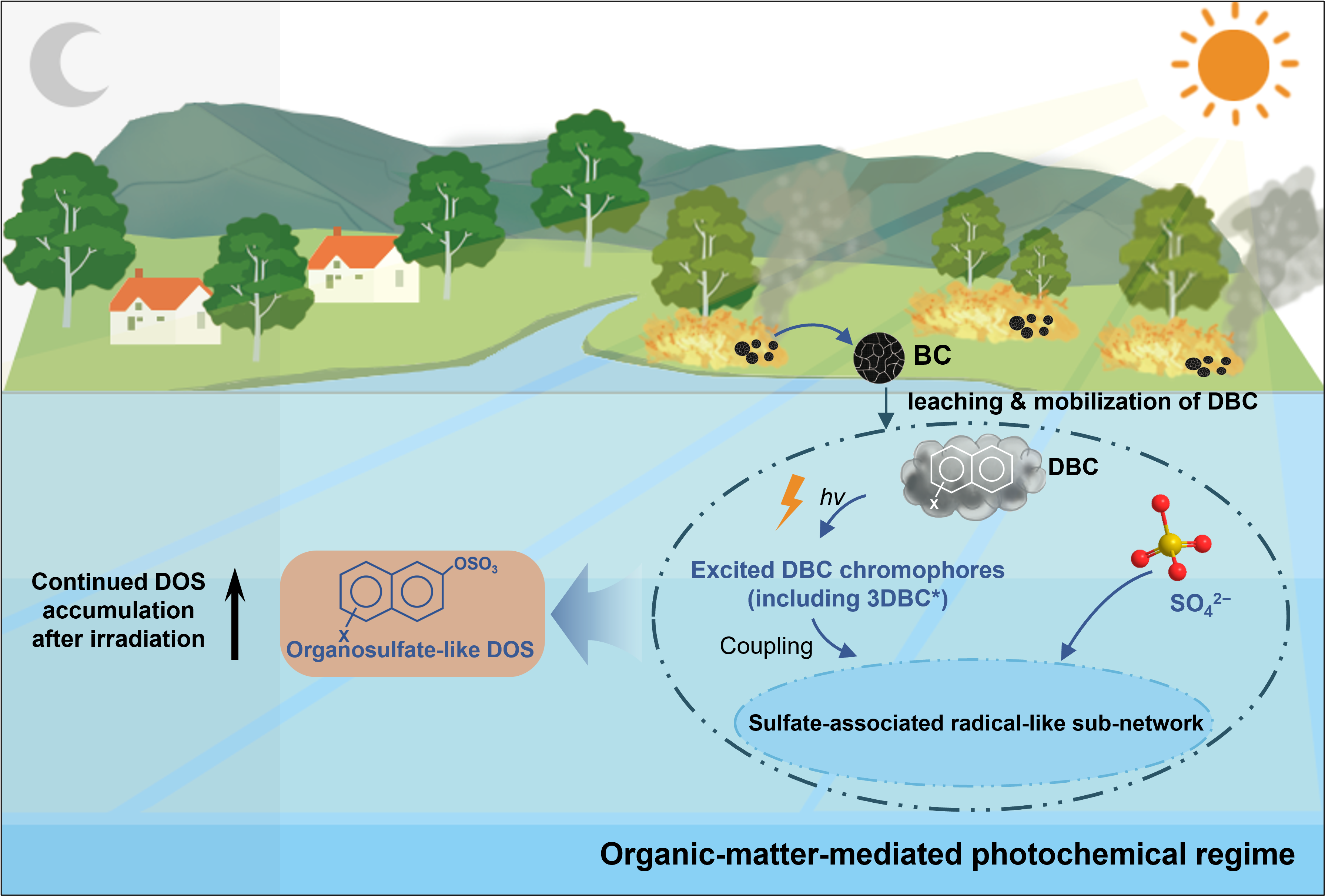
Perhaps the most unexpected observation came after irradiation was supposed to be finished. When pre-irradiated samples were transferred into darkness, dissolved organic sulfur continued to accumulate. We do not interpret this as evidence that the same photogenerated radicals simply persisted in darkness. Rather, irradiation appeared to initiate a sequence of chemical transformations that could continue after the light was removed. Turning off the lamp did not immediately turn off the chemistry.
This observation brought us back to the puzzle that began with an unexpected molecular pattern in January 2024. Sulfur-containing organic matter observed after wildfire may not be explained solely by material produced during combustion and transported into rivers. Our study suggests another possibility: wildfire-derived dissolved black carbon can remain chemically active after entering water and promote secondary sulfur transformation during subsequent photochemical processing.
This changed how we think about wildfire effects on aquatic systems. Wildfire does not only alter what enters the water; it may also alter what happens chemically after those materials arrive. Many questions remain about how strongly these processes operate under natural sunlight and across the diversity of real waters, but for us, the study opened a new way of viewing wildfire-derived dissolved black carbon—not simply as a transported carbon pool, but as a chemically active participant linking carbon photochemistry with sulfur cycling. Perhaps the most intriguing lesson is that some chemical consequences initiated by sunlight may extend beyond the period of illumination itself.
Follow the Topic
-
Communications Earth & Environment
An open access journal from Nature Portfolio that publishes high-quality research, reviews and commentary in the Earth, environmental and planetary sciences.

Related Collections
With Collections, you can get published faster and increase your visibility.
Ecological resistance and resilience under global change
Publishing Model: Open Access
Deadline: Apr 07, 2027
Hazards in Mountain Regions
Publishing Model: Open Access
Deadline: Nov 02, 2026