Food Insecurity in Plain Sight: Evidence from Italy's Cities and Regions
Published in Healthcare & Nursing, Social Sciences, and Sustainability



It started with a simple, unsettling question
Around 2020-2021, at the height of a global pandemic that was reshaping everyday life, we found ourselves looking at Italy through a different lens. Not from the perspective of national averages or aggregate statistics, but from the street level — the municipalities, the parts of the city where vulnerability clusters in ways that headline figures simply cannot capture. The question for us was straightforward: do we actually know how many people in Italy are food insecure, and where exactly they are?
The honest answer was: not really. And that gap (the absence of a granular, locally applicable measurement) was the starting point of this research.
What does it even mean to measure food insecurity?
Food insecurity is not something you can observe directly, like height or weight. It is a latent construct (e.g., an experience of anxiety, constraint, and deprivation that lives inside people's lives, not in material objects you can count). People worry about not having enough. They skip meals. They run out of food before the next monthly paycheck arrives. These are experiences, not things.
We became fascinated by the challenge posed by measurement scientists. The Food Insecurity Experience Scale (FIES), developed by the FAO and refined through the work of Carlo Cafiero and Sara Viviani — two colleagues whose classes and research shaped our thinking deeply — was built with precisely this ambition. Grounded in the Rasch probabilistic model, the FIES transforms people's responses to eight simple questions about their food experiences into a rigorous, calibrated measure of food insecurity severity. Crucially, a well-functioning Rasch model guarantees invariance: the measure should not depend on who is being measured or where — it should hold across different contexts.
That theoretical elegance is also a practical demand. Before you can compare estimates across populations or territories, you must first demonstrate that the scale is working consistently — that the eight questions are being understood and answered in a coherent, ordered way. Only then can you place different samples on the same reference scale and make meaningful comparisons.
Zooming in: Italy, the regions, and Rome
The strength of the FIES has been demonstrated globally and at national level across dozens of countries. But what happens when you want to go sub-national — when you want to understand food insecurity not for Italy as a whole, but for its macro-regions, or for a single large and deeply unequal city like Rome?
This was the missing piece we identified. High-income countries like Italy present a particular challenge: national food insecurity prevalence is relatively low, which means the most vulnerable populations can easily disappear inside aggregate statistics. But vulnerability doesn't spread uniformly across a territory: it concentrates in certain neighbourhoods, in certain socio-demographic groups, in certain municipalities where the cost of a healthy diet far exceeds what many households can afford.
We collected original survey data from a sample of over 3,400 respondents across Italian regions and separate samples in Rome throughout the years. We then applied the FIES methodology — testing whether the scale functioned validly in both contexts before estimating prevalence and exploring which groups were most at risk.
What we found
The scale performed well. Our exercise confirmed that the FIES items held their expected severity ordering in both samples, which gave us confidence that the estimated figures were meaningful rather than artefacts of measurement error.
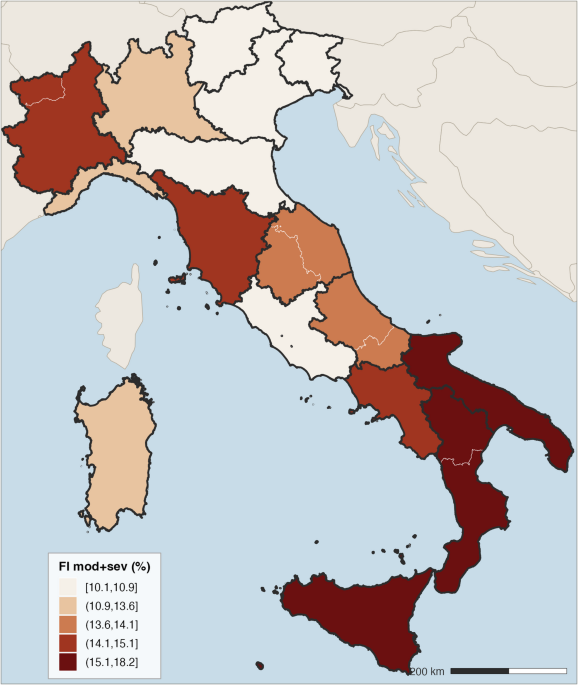
We estimated moderate-to-severe food insecurity at around 13.5% in the regional sample and 7.1% in Rome. These are not population-level prevalence figures — the samples were not designed to represent Italy's population as a whole — but they are consistent with complementary territorial data documenting substantial variation across municipalities and socio-demographic groups. Single-person households, families with children, those with lower education and precarious employment: the familiar geography of vulnerability.
Perhaps more important than the numbers themselves is what they demonstrate methodologically. A globally validated, experience-based measure can be deployed at sub-national level in a high-income country, and the results can complement — without replacing — official statistics. They can inform where interventions are needed and what form they should take.
Why this matters beyond Italy
Food insecurity in wealthy countries is often invisible — hidden behind national figures that mask local realities, and behind the assumption that hunger is a problem elsewhere. Our experience in Italy suggests that locally applicable, rigorous measurement tools are not a luxury but a necessity for policy design that actually reaches the people who need it most.
The mapping exercise we began out of curiosity — out of looking at our own garden and asking what was really going on — has become a broader argument for investing in granular, validated measurement at the local level. National statistics will always have their place. But the piece of the puzzle that was missing, and that we hope this work helps to supply, is the ability to see the fine-grained texture of vulnerability that only local measurement can reveal.

I’m a PhD Candidate in Development Economics at Sapienza University of Rome, and a research fellow at the Food Insecurity and Poverty Observatory Lab.
My broader research interests lie in the micro-level determinants and channels of climate adaptation, with particular attention to risk perception, gendered dynamics, and local risk management mechanisms.
In 2024, I visited the Paris School of Economics (PSE) within the Development Group. In 2025, I am visiting the Nova School of Business and Economics, hosted by the NOVAFRICA center.
Follow the Topic
-
Scientific Reports
An open access journal publishing original research from across all areas of the natural sciences, psychology, medicine and engineering.
-
A Collection of original research articles on urban and peri-urban food security, including studies assessing the extent and drivers of insecurity, as well as evidence-based alternatives towards sustainable and accessible food systems.

Your space to connect: The Psychedelics Hub
A new Communities’ space to connect, collaborate, and explore research on Psychotherapy, Clinical Psychology, and Neuroscience!
Continue reading announcementRelated Collections
With Collections, you can get published faster and increase your visibility.
Computational biology and mathematical modelling of biological systems
Publishing Model: Open Access
Deadline: Jul 18, 2026
Water pollution and advanced treatment processes
Publishing Model: Hybrid
Deadline: May 31, 2026
Please sign in or register for FREE
If you are a registered user on Research Communities by Springer Nature, please sign in