Food security under climatic extremes in the Asia-Pacific region
Published in Earth & Environment, Sustainability, and Agricultural & Food Science

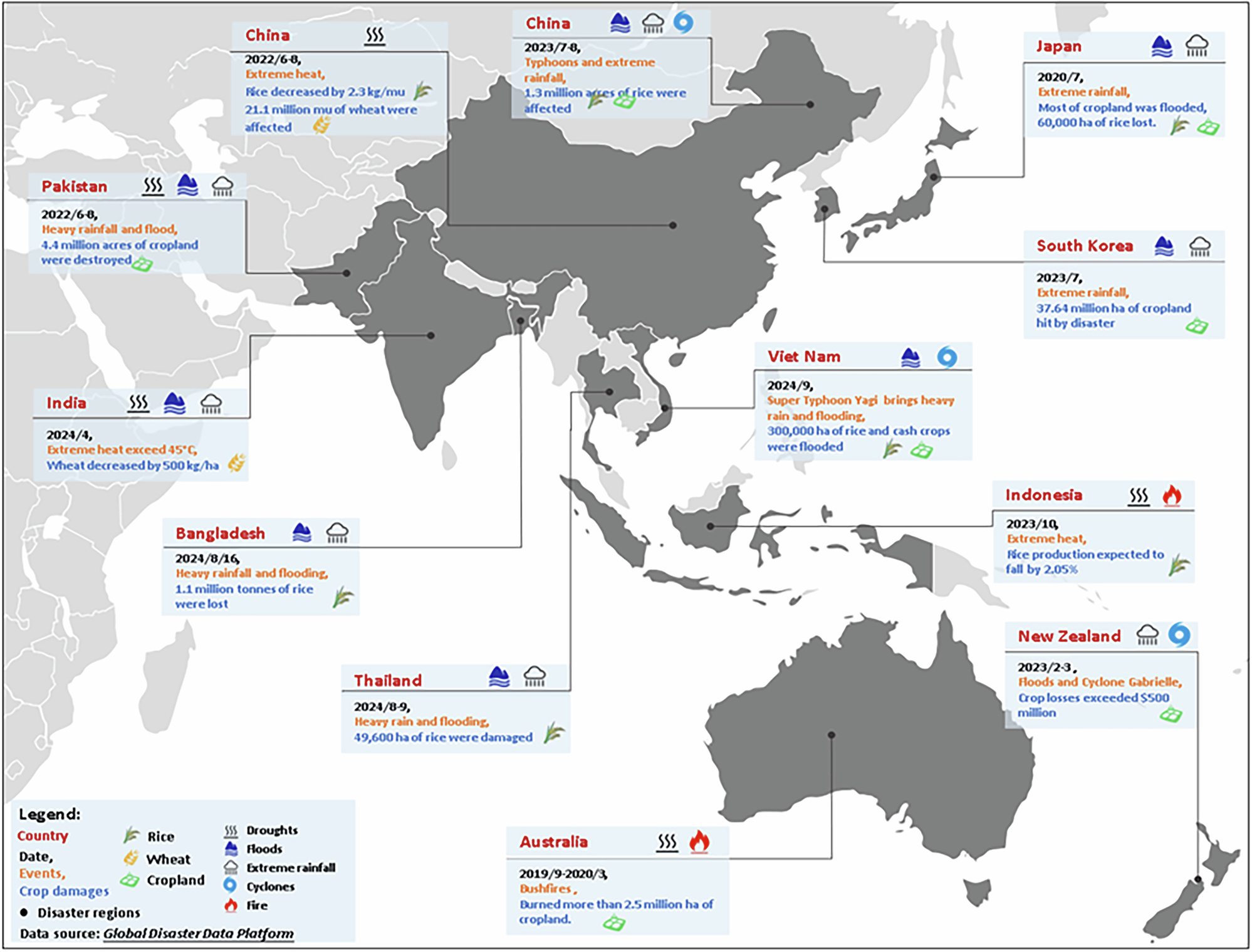
Over the past decade, climate extremes and associated weather events have impacted crop production and food security in the Asia-Pacific Region, which comprises half the global population.
In the future, the extent, frequency, and magnitude of such climatic extreme events are expected to intensify globally, compounded by human-induced factors such as war and the over-use of fertilisers, pesticides, and other agricultural chemicals.
Unfortunately, climate change and human-induced impacts are likely to further undermine food security in the Asia-Pacific region by reducing agricultural production, arable land availability, and trade and food prices. Without significant intervention, projections indicate production of major crop yields could fall by 17% globally by 2050s.
Safeguarding future food security requires sustaining crop productivity through climatic extremes by means of effective adaptation options and farmer-led, resilient practices for heat stress and water shortages.
To achieve these, the Asia-Pacific Region must leverage accurate climate models and secure significant funding to modernise irrigation and flood defences. These practices will enable the implementation of targeted adaptation measures that mitigate the interannual yield variability of major crops like rice, wheat, maize, and soybean.
The promotion of smart agriculture, including biotechnology for drought-resistant crops and enhanced climate warning systems, remains a vital goal.
Nevertheless, significant practical limitations persist. This was tragically illustrated when extreme flooding in Pakistan (2021) and North China (2023) exceeded the design capacity of flood protection infrastructure, demonstrating that technological advances alone cannot always counter unprecedented climate extreme events.
Food security is jeopardised by import dependencies on countries facing their own climate threats. A stark example is China’s heavy reliance on Brazilian soybeans. China currently imports more than 40% of soybeans from Brazil and also relies heavily on dairy imports from New Zealand to feed its 1.4 billion people.
The strong connection between climate disruptions in exporting countries and food security in importing nations was illustrated by the April 2023 flooding in the southern Brazilian state of Rio Grande do Sul.
The event damaged more than 25% of Brazilian soybean crops, causing 2.71 million tons of crop losses, and 3,711 farmers were affected, with an immediate and significant impact on global soybean trade.
The Asia-Pacific (AP) region is defined here as the 21 APEC economies because APEC is the primary forum for facilitating economic cooperation across the AP region.
Although the APEC does not include every Asian country with a Pacific coastline, it comprises the majority of nations whose collective interactions dominate the regions’ economic affairs. We examine the effects and impacts of extreme climate events in the past decade on food security in the AP region. We recommend and discuss four foci for the development of solutions:
(i) Taking action on climate adaptation;
(ii) Coordinated, rules-based regional food-aid mechanisms;
(iii) Protecting domestic production and conserving soils,
and (iv) Advancing zero-carbon farming practices.
Follow the Topic
-
npj Climate Action
This journal considers research that explores all aspects of mitigating the hazardous effects of global climate change.

Related Collections
With Collections, you can get published faster and increase your visibility.
Carbon Dioxide Removal
Publishing Model: Hybrid
Deadline: Jan 16, 2027
Managing cascading and non-linear climate risks
Publishing Model: Hybrid
Deadline: Apr 17, 2027