FRANCOIS XAVIER BAIGNOUD CENTER FOR HEALTH AND HUMAN RIGHTS – HEALTH AND HUMAN RIGHTS JOURNAL (HHR JOURNAL) – HARVARD UNIVERSITY - DREXEL UNIVERSITY DORNSIFE SCHOOL OF PUBLIC HEALTH
Published in Social Sciences
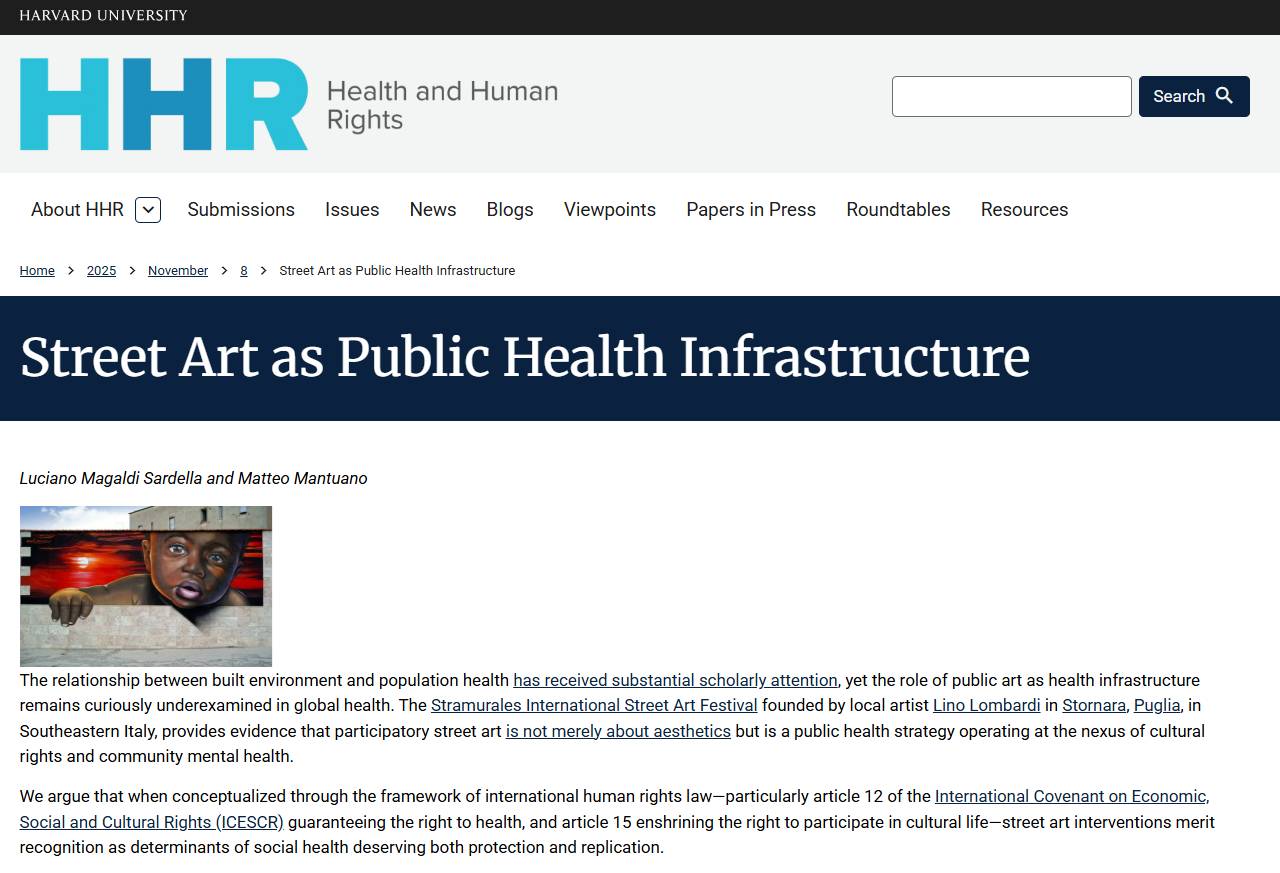
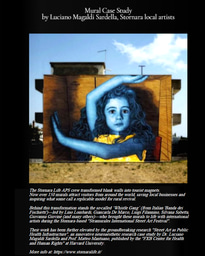
In our recent article for the Health and Human Rights Journal (François‑Xavier Bagnoud Center for Health and Human Rights, Harvard University; Drexel University Dornsife School of Public Health), Matteo Mantuano and I advance the argument that democratically constituted muralism may be understood as a form of public health infrastructure in its own right.
Drawing on the paradigmatic case of the Stramurales International Street Art Festival in Stornara, Puglia, we examine how participatory mural practices disrupt the entrenched dynamics of rural decline. Voluntary wall offerings, communal theme selection, and inclusive governance mechanisms collectively restore collective agency, invigorate cultural rights, and contribute to community mental health. These processes align closely with what the World Health Organization defines as community empowerment.
The study is anchored in the normative framework of international human rights law—specifically Article 12 (the right to health) and Article 15 (the right to participate in cultural life) of the International Covenant on Economic, Social and Cultural Rights. We argue that community‑driven cultural initiatives, when democratically governed, instantiate these rights in practice. Empirical evidence—from increased tourism revenues to testimonies of renewed civic pride—demonstrates that such interventions yield tangible psychosocial dividends.
Importantly, the murals themselves operate as visual health activism, interrogating structural violence, migration policy, and the social determinants of health. In contexts where conventional development strategies have faltered, modest fiscal investment in participatory cultural production should be recognised as a legitimate and effective allocation of public health resources.
Keywords: Street Art; Public Health; Community Empowerment; Human Rights; Cultural Rights; Mental Health.
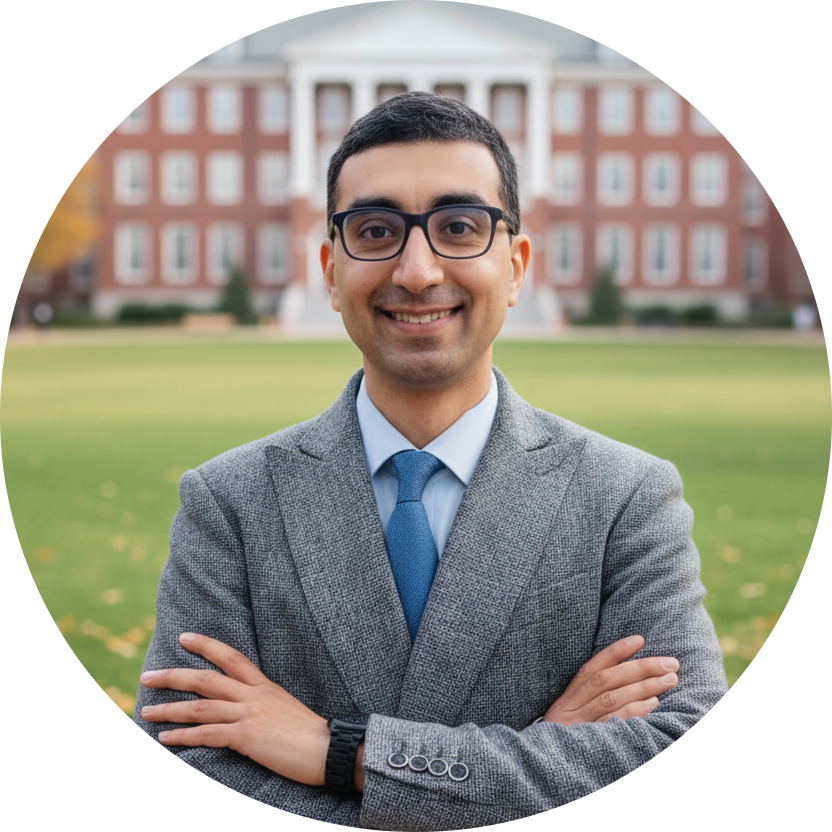
- Pluriennal high-tech practictioner at Google Ireland (Dublin), Apple EU Headquarters (Cork), and Amazon Slovakia (Bratislava).
- Alumnus of Aspire Institute, Harvard Business School.
- Current Member of Harvard Aerospace and Defense Alumni Organization (HADAO).
- Former Member of the White House Historical Association (WHHA).
- Former Member of Yale Club of New Haven (YCNH).
- International Journalist with numerous pieces/interviews featured on London Daily News, New York Post, Los Angeles Journal, The Hill, The Washington Post Opinion, Fox News USA, The Associated Press, The Daily Mirror UK, Metro UK, BBC News World Services, AS USA, Yahoo, AOL, MSN, The Scottish Daily Express, The Daily Record Scotland's Champion, L' Essentiel Luxembourg, 20Minuten.ch, NYC Up Magazine, Yale Daily News, The Stanford Daily, The Psychologist, Popular Archeology, Hollywood Beats Magazine, Opera Gazet, Corriere della Sera, Blog L' Espresso-Repubblica "Fino a Prova Contraria", Blog Nicola Porro, Agenda Digitale.
- Contributing Academic Author to the "Stanford Social Innovation Review" at Stanford University.
- Contributing Academic Author to the Faculty of Law B., University of Oxford.
- Contributing Academic Book Critic to the LSE Review of Books with Executive Education Certificate in Communication from the London School of Economics (LSE) and Political Science.
- Alumnus of the Aspire Institute, Harvard Business School.
- Pro PhD and MBA at the European Open University, Germany.
- Open Researcher and Contributor ID (ORCID):
0009-0003-9392-9213
- Web of Science ResearcherID:
OYE-6074-2025
- Google Scholar:
https://scholar.google.com/citations?user=XALdgW8AAAAJ&hl=it
- Zenodo Author Page Profile:
https://zenodo.org/search?q=metadata.creators.person_or_org.name%3A%22Magaldi%20Sardella%2C%20Luciano%22&l=list&p=1&s=10&sort=bestmatch
- Academia.edu Profile: https://cambridge.academia.edu/LucianoMagaldiSardellaPhD
- ResearchGate Profile:
https://www.researchgate.net/profile/Luciano-Magaldi-Sardella