From a Classroom Idea to an Optimized MEMS Design for Glaucoma Monitoring

How can we improve glaucoma management? In our latest work, we transition from sporadic clinical visits to continuous monitoring. We introduce a MEMS pressure sensor featuring “engineered asymmetry” in serpentine springs to achieve high sensitivity in a miniaturized, eye-integrated footprint.
From a Classroom Idea to an Optimized MEMS Design for Glaucoma Monitoring
Like

Share this post

Choose a social network to share with, or copy the URL to share elsewhere

This is a representation of how your post may appear on social media. The actual post will vary between social networks

Explore the Research

Springer Berlin Heidelberg
Springer Berlin Heidelberg Springer Berlin Heidelberg

Design and numerical analysis of a MEMS capacitive pressure sensor with engineered serpentine springs for intraocular pressure monitoring - Microsystem Technologies

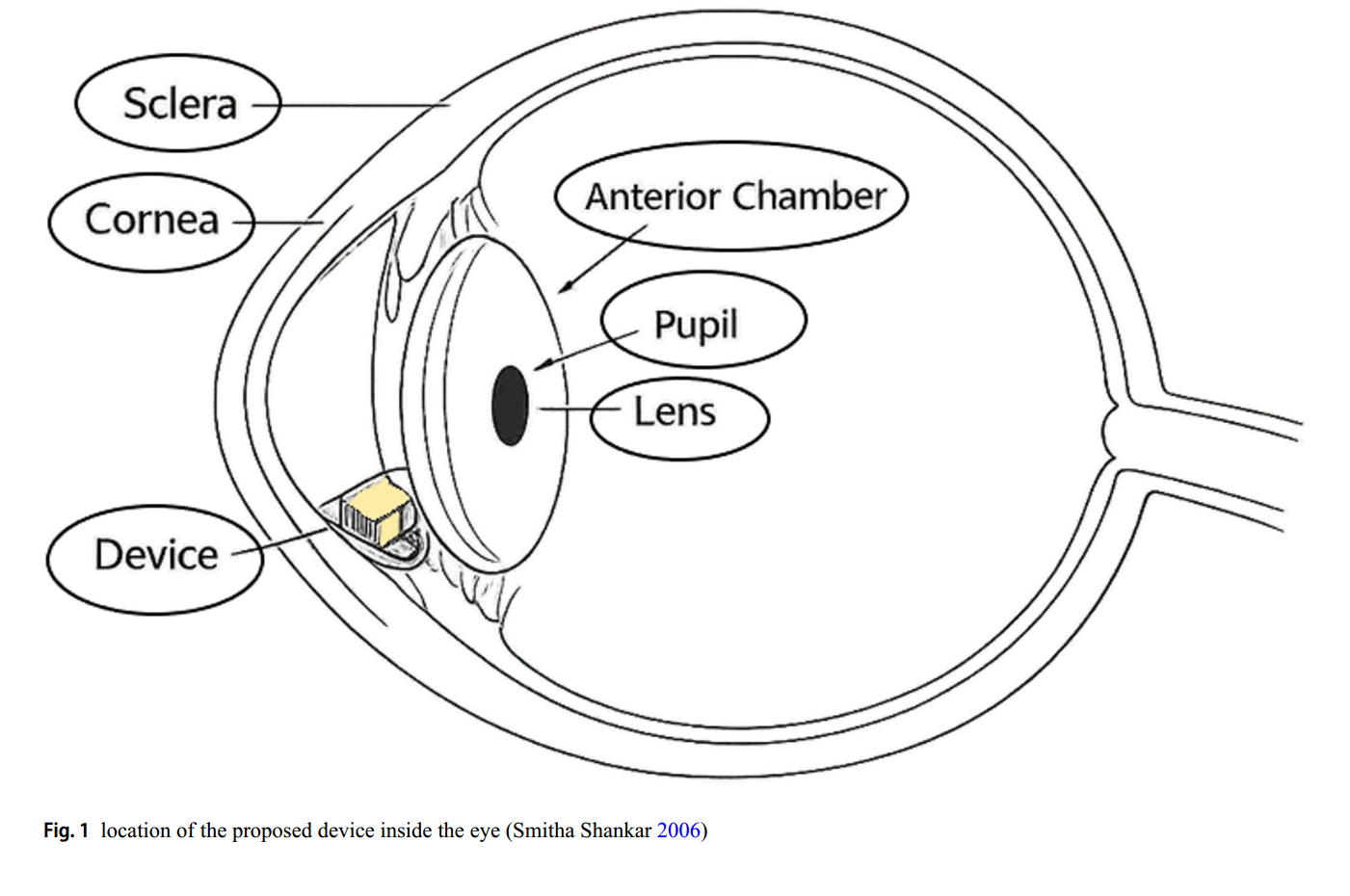
This paper presents the design and numerical investigation of a capacitive MEMS pressure sensor specifically engineered for intraocular pressure (IOP) monitoring over the physiological range of 0–8 kPa (0–60 mmHg). In ophthalmic applications, strict size constraints are imposed to avoid visual field obstruction when the sensor is integrated onto ocular lenses or implantable platforms. However, reducing the sensor footprint particularly limiting the diaphragm radius to 100 $$\:\:{\upmu\:}\text{m}$$ inherently degrades pressure sensitivity and poses a major design challenge. The key novelty of this work lies in an application-driven structural design approach, in which an asymmetric arm serpentine suspension is engineered to overcome the inherent sensitivity loss associated with aggressive miniaturization required for intraocular pressure monitoring. A tunable geometric asymmetry parameter, defined as γ = L₁/L₂, is introduced to tailor the effective stiffness of the suspension and optimize electromechanical performance. Parametric studies on diaphragm thickness, electrode gap, and spring arm asymmetry are conducted to guide the final design. The optimized configuration features a 4 $$\:{\upmu\:}\text{m}$$ thick circular diaphragm suspended above a fixed bottom electrode with a 3 $$\:{\upmu\:}\text{m}$$ initial gap and a 0.1 $$\:{\upmu\:}\text{m}$$ silicon nitride dielectric layer to ensure electrical insulation and prevent pull-in instability. Finite element simulations show that the corresponding mechanical and capacitive sensitivities are 2.596 × 10⁻⁴ $$\:{\upmu\:}\text{m}$$ /Pa and 2.66 × 10⁻⁵ pF/Pa, respectively. Compared to a conventional symmetric configuration, the optimized asymmetric design (γ = 10) achieves a 1.21× improvement in mechanical sensitivity, a 1.72× enhancement in capacitive sensitivity, an approximately 82% reduction in geometric nonlinearity, and a 2.12× increase in the figure of merit. The proposed design is fully compatible with standard MEMS fabrication processes, making it a promising candidate for compact and reliable IOP monitoring applications.

We are excited to share our latest research, “Design and Numerical Analysis of a MEMS Capacitive Pressure Sensor with Engineered Serpentine Springs for Intraocular Pressure Monitoring,” just published in Microsystem Technologies.

This project began in a biosensor class, but the motivation behind it was deeply personal. Witnessing the struggles of family and friends in managing glaucoma—a leading cause of irreversible blindness—highlighted a critical gap in current care. Intraocular pressure (IOP) is a vital metric for these patients, yet it is often measured only through sporadic “snapshot” visits to the doctor. Because IOP fluctuates significantly throughout the day and night, we believe the future of patient care lies in reliable, high-resolution, continuous monitoring.

It is important to emphasize that this work focuses on the computational design and comprehensive numerical analysis of a MEMS capacitive pressure sensor. The core engineering challenge was the trade-off between miniaturization and sensitivity. To overcome this, we moved beyond conventional symmetric designs and introduced a new geometric parameter, γ(gamma), to engineer the asymmetry of the serpentine spring suspensions. Through this systematic numerical optimization, we found that tuning γ acts as a precise design knob to balance structural stability and sensitivity.

Our results indicate that this asymmetric design achieves a superior Figure of Merit (FOM), effectively demonstrating that we can significantly boost performance—both mechanically and capacitively—for low-pressure biomedical applications.

The journey from a classroom concept to a rigorous numerical study has been incredibly rewarding. While this paper presents a computational framework and design optimization, we believe this “engineered asymmetry” offers a compelling and robust path forward for future researchers looking to develop high-precision, compact biomedical pressure sensors. Beyond pressure sensing, we believe this design methodology—leveraging the geometric asymmetry of serpentine structures—can be extended to optimize the performance of various other MEMS devices, offering a versatile design strategy for the broader micro-system community.

Please sign in or register for FREE

If you are a registered user on Research Communities by Springer Nature, please sign in

Follow the Topic

Microsystems and MEMS
Technology and Engineering > Biological and Physical Engineering > Microsystems and MEMS
Glaucoma
Life Sciences > Health Sciences > Clinical Medicine > Diseases > Eye Diseases > Ocular Hypertension > Glaucoma
Sensors and Biosensors
Physical Sciences > Materials Science > Materials for Devices > Sensors and Biosensors

Related Collections

With Collections, you can get published faster and increase your visibility.

Micro/Nanoelectronics Devices, Circuits & Systems (MNDCS-2026)

The special issue will cover original research and review articles related to design, fabrication, modeling, characterization, and applications of microsystem technologies, including but not limited to:

  • Micro- and nano-electromechanical systems (MEMS/NEMS)
  • Microsensors and microactuators
  • Microelectronic and nanoelectronic devices for microsystems
  • Microfabrication and nanofabrication techniques
  • Novel materials for microsystem applications
  • Device physics and compact modeling of microsystems
  • Multiphysics simulation and optimization of microsystems
  • System-level integration and packaging of microsystems
  • Reliability, testing, and performance evaluation
  • Microsystems for biomedical and healthcare applications
  • Energy harvesting and power management in microsystems
  • RF, microwave, and communication microsystems
  • Lab-on-chip and microfluidic systems
  • AI- and data-driven design approaches for microsystems
  • Emerging applications of microsystem technologies

Publishing Model: Hybrid

Deadline: Ongoing