From a Real Road Project to a Scientific Case Study: Behind the Wipfing Bypass Stormwater Protection System
Published in Earth & Environment and Civil Engineering



From a Real Road Project to a Scientific Case Study: Behind the Wipfing Bypass Stormwater Protection System
Strapline
How does a real-world road drainage facility become a scientific case study? This is the story behind the planning, hydraulic design, implementation and field observation of the stormwater protection system constructed for the Wipfing Bypass in Upper Austria.
From an engineering challenge to a research paper
The paper “Planning and hydraulic design of a stormwater protection system with retention and infiltration basin: a case study of the Wipfing Bypass road, Austria”, published in Innovative Infrastructure Solutions, did not originate from a laboratory experiment or a purely theoretical research question. It grew out of a real infrastructure project: the Wipfing Bypass in Upper Austria.

Road runoff presents a particular engineering challenge. Stormwater from paved traffic surfaces must be managed safely from a hydraulic perspective, while transported solids need to be considered and impacts on the natural water cycle should be limited.
For the Wipfing Bypass, a combined system was implemented that integrates gross-solids retention, temporary storage, controlled discharge and infiltration. The hydraulic design was based on regional design rainfall data from the Austrian Hydrographical Service and carried out in accordance with ÖNORM B 2506 and DWA-A 138.
For me, however, the calculations were not the only point of interest. One aspect that was particularly important in this work was bridging the gap between engineering practice and scientific documentation.
Following the project from its hydrological and hydraulic basis through construction and observations during actual rainfall events provided the foundation for turning an engineering project into a scientific case study.
When calculations become built infrastructure
Hydraulic calculations produce numbers. In practice, those numbers have to become basins, pipelines, throttle structures, storage volumes and infiltration areas.
The hydraulic analysis resulted in a maximum retention volume of approximately 318 m³ for the five-year design event (HQ5). The discharge through the DN 100 throttle outlet was calculated at 14.6 l/s, while the drainage times were 31.5 hours for HQ1 and 43.2 hours for HQ5.
But these values tell only part of the story.
Following construction, the facility could also be observed during actual rainfall events. These observations allowed the intended hydraulic sequence to be followed qualitatively in the field—from stormwater entering the system, through temporary storage and sediment retention, to controlled transfer and subsequent infiltration.
This connection between hydraulic calculation, physical implementation and field observation became one of the central ideas behind the publication.
At the same time, it was important to define the limits of the available evidence. The observations provide qualitative confirmation of the intended hydraulic behaviour, but they do not replace long-term instrumented monitoring or continuous quantitative water-quality measurements.
A case study should not claim more than the available evidence supports. Instead, it should clearly show what was calculated, what could be observed and where further research is needed.
Beyond the main paper: Appendix A
A particularly important part of the publication is the Supplementary Information, especially Appendix A.
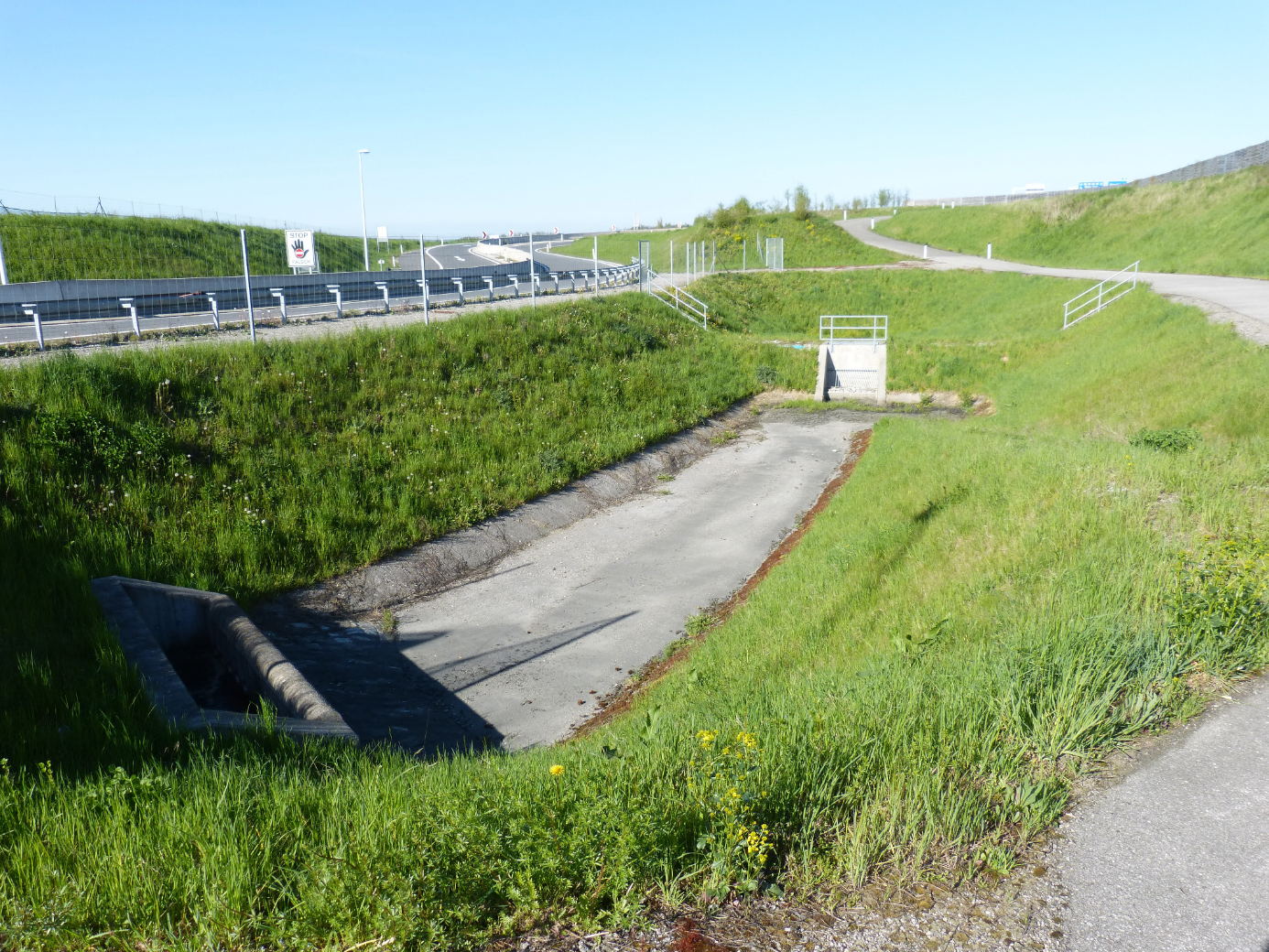
A journal article necessarily condenses a complex engineering project. Appendix A allows interested readers to go further. It contains 15 supplementary figures documenting the constructed facility under dry-weather and actual rainfall conditions, including the gross-solids trap, inlet structures, active stormwater inflow, baffle wall and monk control structure, retention system, hydraulic transition and infiltration basin.
These images show something that hydraulic numbers alone cannot convey: how the design was translated into a real infrastructure facility and how the system behaves under operating conditions.

Appendix A also provides detailed hydraulic design and reservoir-routing tables. For HQ5, the supplementary calculations document a maximum stored volume of approximately 318.4 m³, a maximum water depth of 1.10 m, a peak infiltration rate of 3.8 l/s, and a calculated total drainage time of 43.2 hours.
Appendix A therefore forms a technical and visual bridge between the scientific paper and the engineering project behind it. I particularly encourage readers interested in the practical hydraulic implementation to explore the Supplementary Information alongside the main article.
What can be transferred from this project?
Every infrastructure project is site-specific. Rainfall conditions, geology, available space, drainage requirements and regulatory frameworks vary.
What can be transferred, however, is the engineering methodology.
The case study demonstrates how hydrological assessment, hydraulic design, retention, controlled discharge, infiltration, structural implementation and field observation can be integrated into a complete engineering process.

Future research could extend this work through long-term monitoring, quantitative water-quality assessment, and investigations of sediment accumulation and long-term clogging.
For me, one broader lesson from this project is that relevant research questions do not arise exclusively in laboratories. They can begin with a road project, a drainage challenge and a set of hydraulic calculations—and with the question of whether the intended behaviour can actually be observed once the system has been constructed.
The Wipfing Bypass stormwater facility began as a specific engineering task. Through scientific documentation of its planning, hydraulic design, construction and field observations, it became a case study whose findings may also be useful beyond this individual project.
This connection between engineering practice and scientific documentation is what I wanted to establish through this work—and, in doing so, contribute practical knowledge towards more sustainable and climate-resilient road infrastructure.
Read the published article
Planning and hydraulic design of a stormwater protection system with retention and infiltration basin: a case study of the Wipfing Bypass road, Austria
Innovative Infrastructure Solutions, Springer Nature (2026), 11:544
Official publication on SpringerLink:
SpringerLink – Published Article
Free full-text access via Springer Nature SharedIt:
Springer Nature SharedIt – Free Full-Text Access
DOI: 10.1007/s41062-026-02958-7
For further engineering details, I strongly recommend consulting Supplementary Information – Appendix A, which provides photographic documentation of the constructed facility and detailed hydraulic design and reservoir-routing tables.
AI use declaration:
AI-assisted language editing and editorial structuring were used in the preparation of this blog post. The author reviewed and approved the final content and is responsible for its accuracy.

Follow the Topic
-
Innovative Infrastructure Solutions
This is a peer-reviewed international journal. It aims to present innovative studies serving the general disciplines of geotechnical engineering and sustainable civil infrastructures, in addition to non-geotechnical fields.