Why Is a Residue Conserved? Separating Structural Rigidity from Functional Motion
Published in Ecology & Evolution, Protocols & Methods, and Genetics & Genomics




The question we kept running into
Evolutionary conservation is one of the most powerful signals in genetics. If a position in a protein has stayed unchanged across hundreds of millions of years of divergence, something is protecting it. Nearly every variant effect predictor in clinical use leans on this idea.
But conservation is a single number describing at least two very different situations:
A residue can be conserved because it holds the protein together: a buried hydrophobic anchor in the core, where substitution destabilizes the fold and the protein never folds correctly in the first place.
Or a residue can be conserved because the protein needs it to move. A hinge that lets a domain swing. A catalytic glycine that provides backbone flexibility at an active site. An allosteric switch that transmits a signal across the molecule.
These two situations produce the same conservation score. They are completely different biophysically, and they fail in completely different ways. Mutate a core anchor and the protein unfolds. Mutate a hinge and the fold survives intact while the motion stops.
Proteins are dynamic molecular machines, not static sculptures. Yet the standard interpretation pipeline treats conservation as a single, undifferentiated signal. We wanted to see what happens if you pull the two apart.
What we did
We combined atomistic molecular dynamics with evolutionary conservation and coupling analysis across 151 protein structures, totaling more than 30,000 residues. The dataset had two halves: 93 cross-species alpha-helical proteins, and a targeted cohort of 58 medium-length human proteins (400–600 amino acids). Structures and trajectories drew on the ATLAS molecular dynamics database, with conservation and coupling computed through EVcouplings.
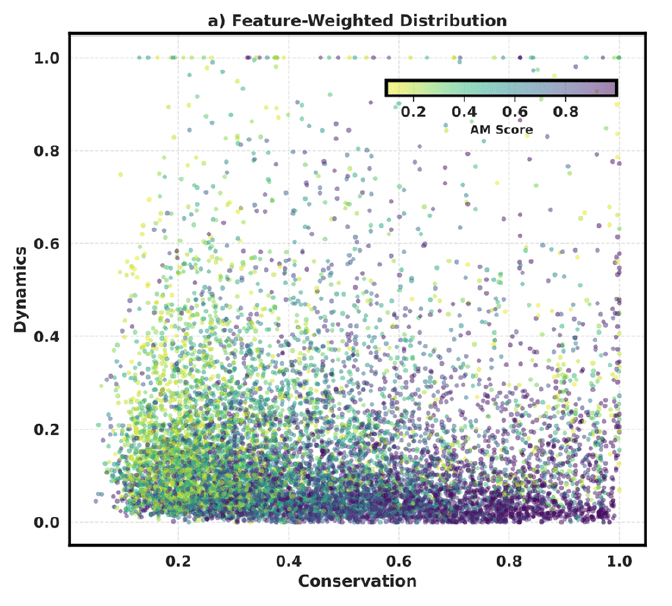
For each residue we asked two independent questions: how conserved is this position across homologs, and how much does it actually move during simulation?
Crossing those axes produces four metrics:
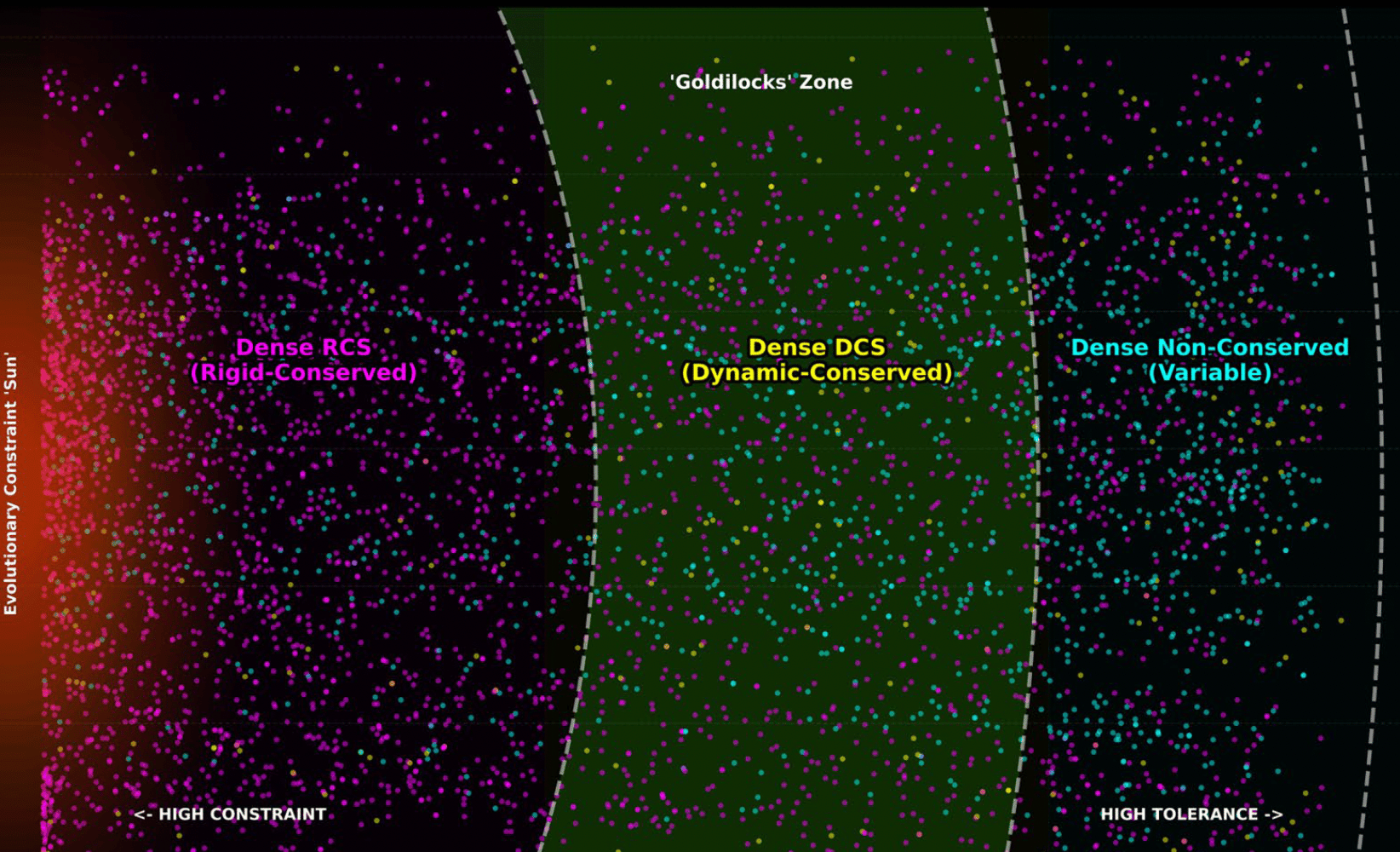
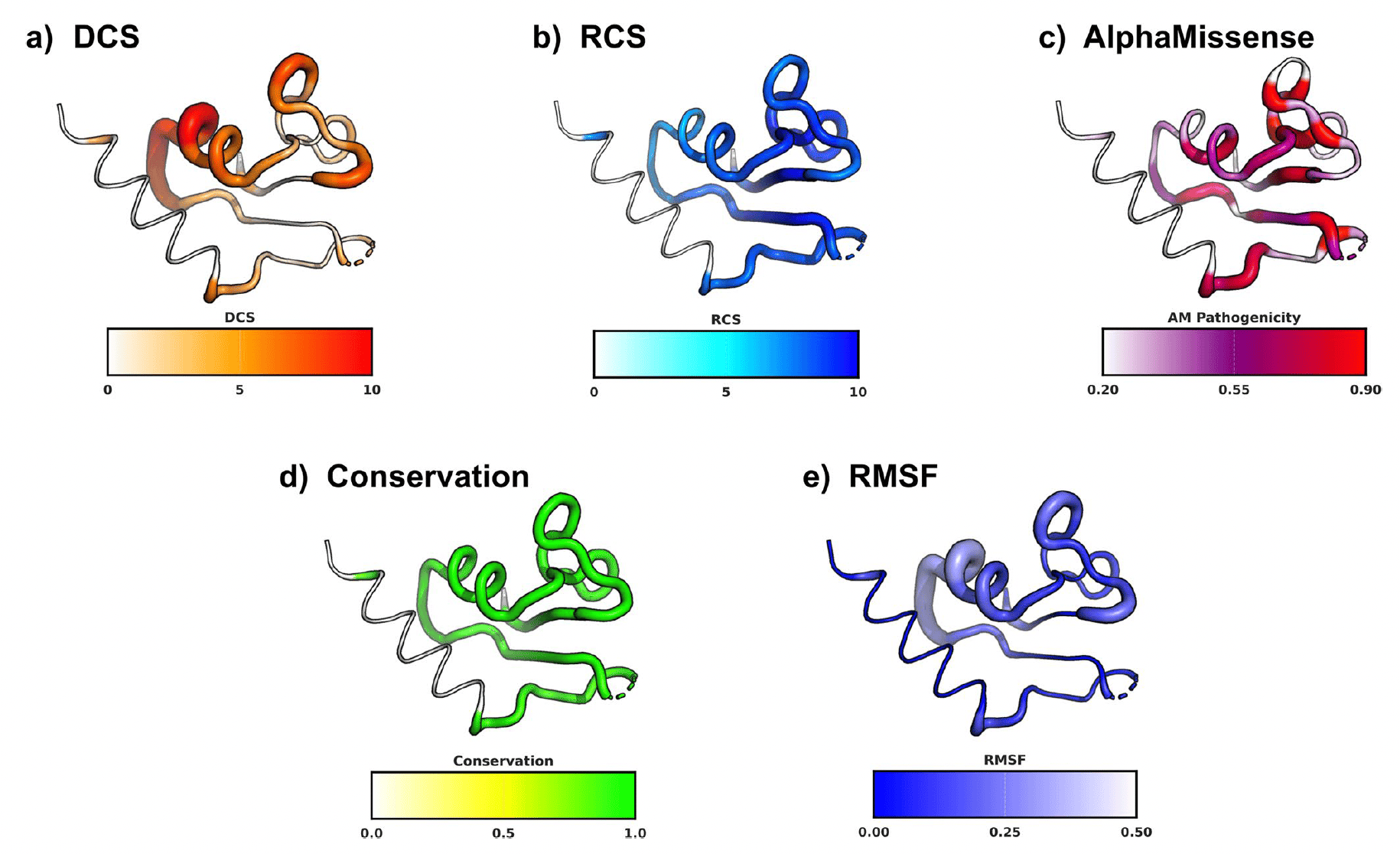
Rigid Conserved Score (RCS): conserved and structurally locked. These are the stability bottlenecks: buried, hydrophobic, intolerant of substitution because mutation triggers unfolding.
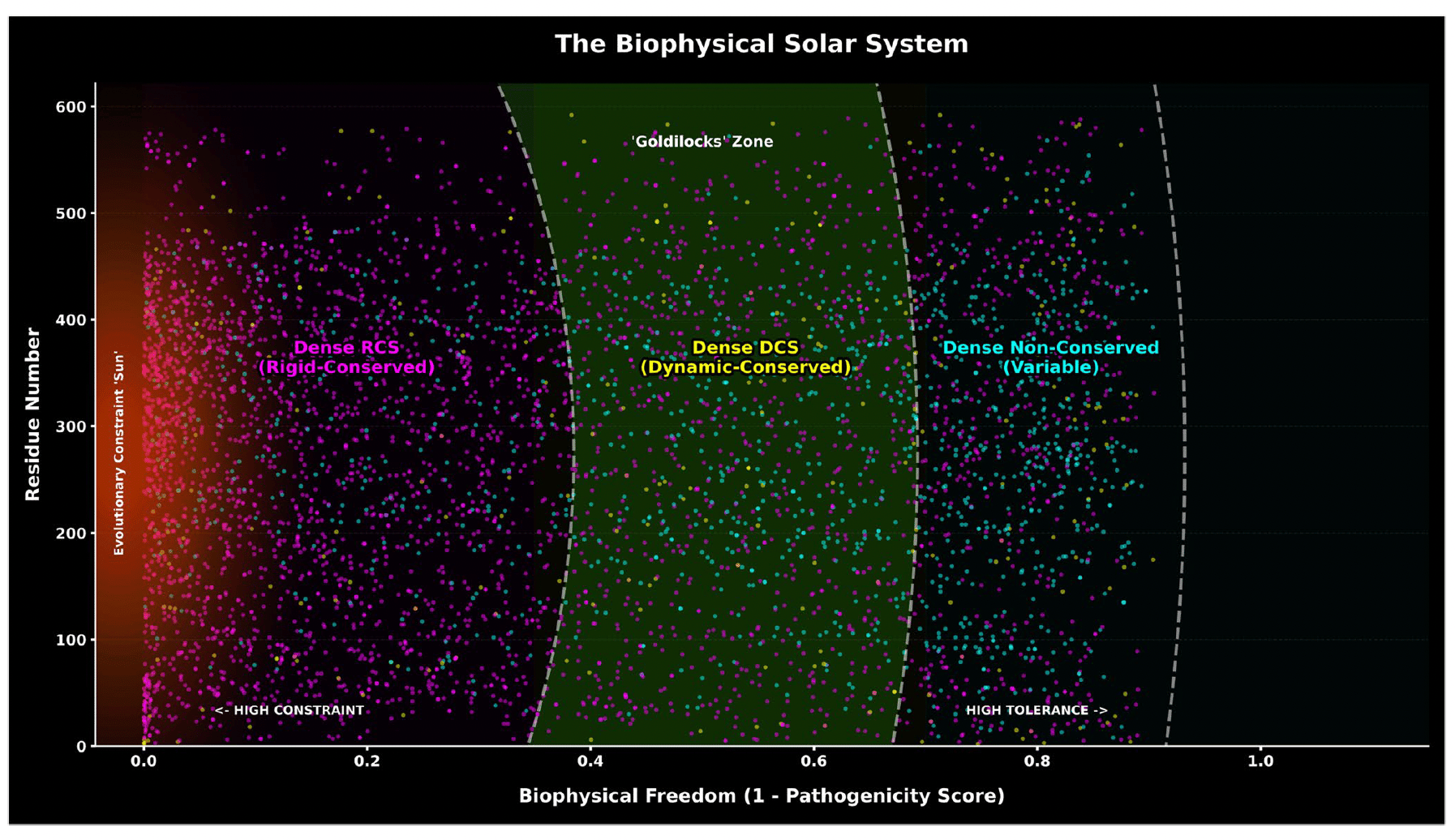
Dynamic Conserved Score (DCS): conserved and structurally mobile. A rarer population, enriched in flexible hinge residues such as glycine and proline, clustering around active, allosteric, and binding sites.
RCopS and DCopS: the corresponding coupling-based scores, which incorporate evolutionary coupling rather than conservation alone.
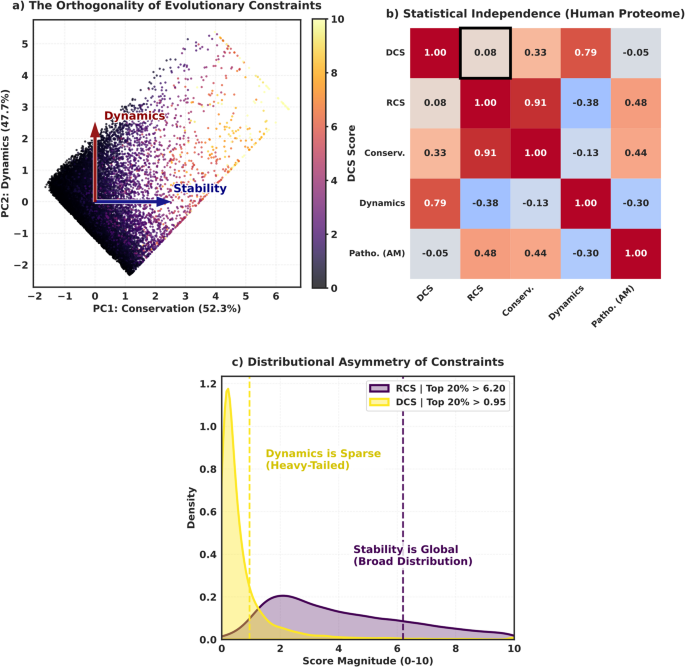
The first thing to check was whether RCS and DCS were simply measuring the same thing from different angles. They are not. Across the dataset they capture statistically independent information channels, successfully disentangling the conserved dynamics of a protein from its rigid scaffold.
The clinical signal
Statistical independence is interesting. Clinical relevance is what makes it useful.
We mapped 737 human variants from ClinVar onto these scores. What emerged was a bifurcation in how pathogenicity operates.
RCS behaves as expected. It acts as a filter for lethal structural failure, isolating hydrophobic core residues whose mutation triggers unfolding. These are the classic cases, and existing predictors generally catch them.
DCS captures something else. Dynamic-conserved sites show intermediate pathogenicity, not catastrophic destabilization, but a distinct failure mode where the protein still folds and still looks structurally sound while its functional motion is compromised. (Biophysical Goldilocks Zone)
To quantify this we defined a DCS Discovery Zone: variants with DCS > 0.95, AlphaMissense < 0.6, and a ClinVar classification of Pathogenic or Likely Pathogenic. In other words, variants that are clinically established as harmful but that a leading static predictor scored as probably benign.
The clearest example is NARS1 p.Thr17Met. Classical predictors score it low. ClinVar classifies it as pathogenic. Our dual-score system flags it correctly. A comparable case appears in PGK1.
These are not variants that break the fold. They break the motion. And that failure mode is invisible to a model reasoning about a single static structure.
What ADEPT is and how to use it
We wanted the method usable by anyone, not only groups with the infrastructure to run their own MD pipelines and custom analysis scripts.
ADEPT (the Automated Dynamics-aware Evolutionary Profiling Tool) is an open-access web server available at https://www.karagolresearch.com/adept.
How it works:
- Input: standard CSV files containing per-residue RMSF values and evolutionary conservation or coupling data.
- Output: the full suite of dynamics-aware scores (DCS, RCS, DCopS, and RCopS) computed automatically.
- Visualization: the server integrates the 3Dmol.js library, so scores can be mapped directly onto the three-dimensional structure.
- Privacy: the application is architected as a secure client-side tool. Processing happens in your browser. Your data does not leave your machine.
That last point was deliberate. For anyone working with unpublished structures or patient-derived variant data, a tool that requires uploading to a server is often a non-starter. We took the same client-side approach in our earlier Evolutionary Statistics Toolkit and it has worked well.
The complete list of analyzed proteins, along with the Python and R scripts used for data preparation and statistical analysis, is available at https://github.com/karagol-taner/Dynamics-aware-Evolutionary-Profiling.
What this is, and what it is not
We want to be precise about scope.
Dynamics-aware evolutionary profiling is not a replacement for global pathogenicity predictors. AlphaMissense, CADD, and similar tools do something ADEPT does not attempt: proteome-scale prediction across all variant classes, without requiring a molecular dynamics trajectory as input.
What DCS provides is a targeted filter for a rare population of functional dynamic sites that static models are structurally blind to. The natural use case is downstream refinement: taking variants that primary predictors have scored as uncertain or that conflict with clinical evidence, and asking whether the position is a dynamic-conserved site where a motion-disrupting mechanism might apply.
Used that way, the approaches are complementary rather than competing.
Beyond variant interpretation
Two implications reach past clinical genetics.
Allosteric drug design. If dynamic-conserved residues concentrate at allosteric regulatory sites, they define a tunable target class distinct from the usual focus on the static folded state. Sites that must move to function are, in principle, sites where motion can be modulated.
De novo protein design. Our results suggest that successful design may need to optimize a multi-objective function: ensuring the protein folds, while separately tuning DCS to engineer specific permissible motions. Designing for stability alone risks producing proteins that are rigid where they should be flexible.
Where this came from
Five years ago we were medical students in Istanbul, teaching ourselves to use the newly released open-access tools for protein structure during the COVID lockdown. The field had suddenly become accessible to anyone with an internet connection and enough stubbornness. Everything we have built since rests on tools other scientists gave away for free. Releasing ADEPT as an open, client-side, no-cost web server is a deliberate attempt to return that.
What comes next
Longer timescales. Our simulations capture local side-chain fluctuations and fold stability well, but large-scale conformational transitions occur on microsecond timescales beyond what we sampled. Extending there would likely sharpen the DCS signal at genuinely allosteric sites.
Broader validation. We would like to see ADEPT stress-tested on systems we did not anticipate: allosteric enzymes, intrinsically disordered regions, membrane proteins under lipid constraint. If it breaks somewhere, we want to know where.
Integration. The most useful outcome would be for dynamics-aware scores to sit alongside static predictors inside existing interpretation pipelines, rather than as a separate step researchers have to remember to take.
Paper: Karagöl, T., Karagöl, A. Dynamics-aware evolutionary profiling uncouples structural rigidity from functional motion to enable enhanced variant interpretation. Funct Integr Genomics 26, 228 (2026). https://doi.org/10.1007/s10142-026-02013-9
ADEPT web server: https://www.karagolresearch.com/adept
Code and data: https://github.com/karagol-taner/Dynamics-aware-Evolutionary-Profiling
Taner Karagöl and Alper Karagöl
Follow the Topic
-
Functional & Integrative Genomics
This journal focuses on publishing high-impact original research and comprehensive reviews in all aspects of genomics and its biotechnological applications.

Related Collections
With Collections, you can get published faster and increase your visibility.
Integrative Multi-omics and Spatial Genomics for Human Disease
Recent advances in integrative genomics and multi-omics technologies are transforming the investigation of human diseases by enabling systems-level characterization of molecular and cellular heterogeneity. Emerging approaches such as single-cell sequencing, spatial transcriptomics, epigenomics, proteomics, metabolomics, and integrative computational analysis are providing unprecedented insight into disease mechanisms, cellular interactions, and therapeutic responses across cancer, metabolic disorders, neurological diseases, and immune-related conditions. This Collection aims to provide a multidisciplinary platform for cutting-edge research and authoritative reviews focusing on the integration of multi-omics and spatial genomics approaches in human disease. Particular emphasis will be placed on studies combining experimental and computational strategies to uncover regulatory networks, cellular dynamics, biomarkers, and translational mechanisms. The Collection also welcomes studies utilizing artificial intelligence, machine learning, and systems biology frameworks to enhance multi-dimensional data interpretation and biological discovery.
Topics of interest include, but are not limited to, single-cell and spatial omics technologies, integrative genomics, tumor microenvironment and immunometabolism, non-coding RNA biology, CRISPR-based functional genomics, AI-driven bioinformatics, disease heterogeneity, and precision medicine applications. Both original research articles and high-quality integrative reviews are encouraged.
Publishing Model: Hybrid
Deadline: Jan 31, 2027