From "Dirty-to-Green" to "Fossil-Fuel-to-All": Rethinking Worker Mobility in the Energy Transition
Published in Sustainability



Header Photo from magnific.com
This paper began with a straightforward but difficult question: as the world moves away from fossil fuels, what happens to the people who work in them?
The scale of the issue is significant. Under the International Energy Agency's Net Zero Emissions by 2050 scenario, approximately 13 million fossil-fuel-related jobs are at risk by 2030. Policy discussions frequently invoke the principle of a "just transition," yet this principle only carries weight if it is backed by concrete and realistic employment pathways. Such pathways must extend beyond coal miners to cover the full range of workers whose livelihoods currently depend on oil, gas, or coal.
The blind spot in the existing literature
A clear pattern emerged as we reviewed the research on this topic. Most existing studies follow a "dirty-to-green" framework, examining whether a fossil fuel worker, typically a coal miner, can move into a solar or wind energy job. This body of work is valuable, but it leaves two important gaps unaddressed.
The first concerns the limitations of green jobs as a destination. Green jobs tend to be geographically concentrated, often at a distance from existing coal, oil, and gas regions, which would require workers to relocate. These jobs also demand specific technical skills that do not always overlap with a fossil fuel background. In addition, many workers reasonably prefer to remain within an industrial sector and community they already know rather than move into an unfamiliar one. Taken together, geographic dislocation, skill mismatch, and worker preference substantially narrow the practical scope of the dirty-to-green approach.
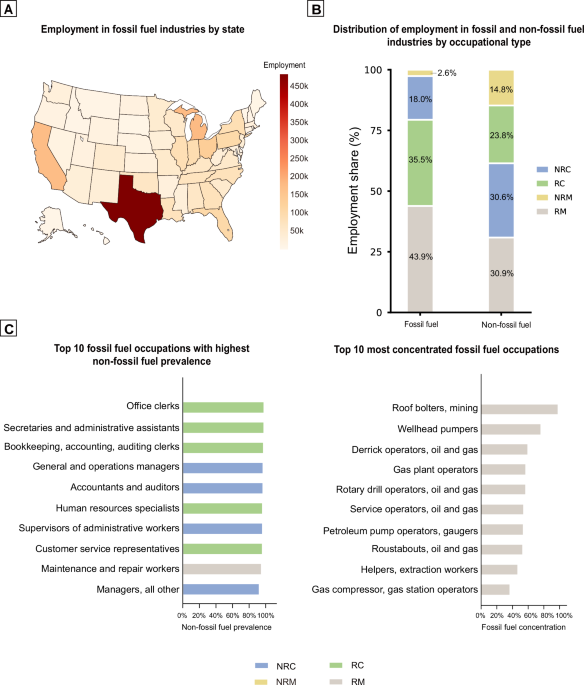
The second gap concerns who is studied. The near-exclusive focus on routine manual occupations such as coal miners overlooks a large portion of the workforce. The fossil fuel industry also employs petroleum engineers, geologists, project managers, office clerks, and safety inspectors, whose specialized expertise does not map neatly onto renewable energy roles either. When we examined the occupational structure of the industry directly, we found that routine manual workers account for less than half of the workforce at risk. The remaining share, consisting of technical, administrative, and professional occupations, had largely been absent from the existing literature.
Our approach: a "fossil-fuel-to-all" framework
This gap motivated us to reframe the question. Rather than asking whether a given worker can move into a green job, we asked what the full range of feasible destinations across the entire economy looks like, given that worker's actual skill profile.
To answer this, we combined several U.S. labor datasets that are rarely used together: detailed occupation and skill data, longitudinal worker transition records, and job-to-job mobility flows between industries. We measured the skill overlap between every fossil fuel occupation and every other occupation in the economy. Importantly, the threshold for what qualifies as a feasible transition was not chosen arbitrarily. Instead, it was derived from observed worker behavior, by tracking actual occupational switches in the survey data, both with and without a documented reskilling episode.
Fossil fuel occupations show high transferability across the wider economy
The results were more encouraging than we had anticipated. 77.4% of fossil fuel occupations already exhibit high-skill transferability to jobs outside the sector, and an additional 11.3% could reach that same level of transferability after a period of reskilling. Because our analysis spans the entire economy rather than green jobs alone, the most viable destination sectors include accommodation and food services, administrative and waste management services, and professional and scientific services. These industries exist in nearly every region, which directly addresses the geographic barrier that limits dirty-to-green approaches.
At the same time, we did not want to overstate the case. Many of these transitions involve a wage reduction, and we quantified how reskilling affects this risk: the probability of a pay cut falls from 67% to 65%, while the upper bound of potential wage gains roughly doubles. A meaningful account of a just transition should acknowledge these trade-offs alongside the opportunities.
The central message of this paper is that the fossil fuel workforce is considerably more diverse, and has considerably more room to move, than the coal-miner-to-solar-technician framing suggests. The transition will remain difficult, and it will impose real costs on many workers. Yet the range of viable pathways is wider than previous research has recognized.
Follow the Topic
-
Communications Sustainability
An open-access journal publishing high-quality, editorially selected and peer-reviewed advances in all sustainability-related areas of science, including the natural and social sciences as well as engineering.

What are SDG Topics?
An introduction to Sustainable Development Goals (SDGs) Topics and their role in highlighting sustainable development research.
Continue reading announcementRelated Collections
With Collections, you can get published faster and increase your visibility.
Carbon Dioxide Removal
Publishing Model: Hybrid
Deadline: Jan 16, 2027
Critical materials supply chain sustainability
Publishing Model: Open Access
Deadline: Oct 26, 2026