From farm to fork via the analytical road: the case of Passiflora waste on the integration of chemistry, circular economy and a sustainable future
Published in Chemistry

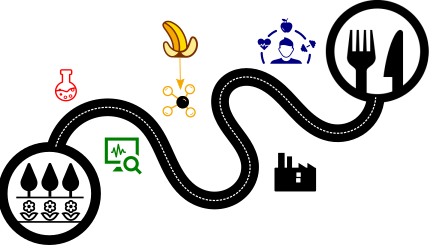



According to The United Nations Food and Agriculture Organization (FAO), one third of the food produced worldwide is lost or discarded per year [1] and, in a world with more than 800 million people going hungry, it is increasingly necessary to rethink the way we produce and deal with food. Especially in an integrated (or globalized) system, with agriculture production in massive scales, local problems related to crops and food systems have increased significantly and impacted not only local ecosystems, but also globally. The recent fires in the Amazon and Pantanal biomes in Brazil, often related to the expansion of low-efficiency crops and meat production – that are shipped all over the world –, are examples of how there is a world-wide responsibility over local issues, which may also have global impacts and accelerate the climate crisis.
New movements towards a more sustainable relationship of mankind with food have been created recently, such as Field & Food Tech Hub-UFSCar launched in November 2019 and, this year the EU’s “From Farm to Fork” strategy, focusing on the prevention of food waste and greener food production, logistics and consumption, as one of the main actions of the European New Green Deal. In this way, new opportunities arise for agriculture-based countries through sustainable agriculture and food production, on which regional solutions can be promoted to create new markets and help boosting weaker economies towards economical emancipation, as long as it ensures a fair distribution of wealth and land.

From Farm to Fork through analytical chemistry
The article “Development and application of green and sustainable analytical methods for flavonoid extraction from Passiflora waste” comes from a place of study and several lessons learned from the Brazilian agro-industrial scenario, as well as it shows the integration of the local problems related to food waste with green and sustainable chemistry and circular economy [2]. This work aimed at developing, applying and comparing three different methodologies to evaluate the best conditions of flavonoids extraction from the processing residue of Passion fruit, one of the most important fruits in the Brazilian agriculture. Flavonoids are naturally occurring compounds that are often related to defense mechanisms in plants, possessing several bioactivities (e.g. fungicide, bactericide and pesticidal activity in general) and antioxidant properties. They are considered a valuable chemical product that, isolated or incorporated in crude extracts, could return to the food supply chain as a nutritional enhancement or conservative food ingredient.
The extraction of flavonoids isoorientin, orientin and isovitexin, from the peels of the Passiflora edulis Sims f. flavicarpa Deg (yellow or sour passion fruit), was evaluated with homogenizer-assisted (HAE), ultrasound-assisted (UAE) and microwave-assisted (MAE) solid-liquid extraction techniques in ethanolic solutions, with the aid of a full factorial design to reach optimal parameters concerning sample mass, energy and solvent efficiencies. Therefore, it was possible analyze efficiency and sustainability aspects and compare the three extraction techniques, being a more simple and holistic approach to lab scale extraction methodologies when compared to other green metrics available in the literature [3].
According to the results, we have observed that the sustainable factors could assist to distinguish efficiency in terms of mass yield and energy and solvent consumption, helping us to better understand true sustainability for each technique and to make a fairer comparison between green technologies. As extraction results, the procedure based on HAE presented best conditions for the extraction of selected flavonoids (1.07, 0.90 and 0.33 mg g-1 of isoorientin, orientin and isovitexin, respectively) and it was considered the best method according to the green and sustainable factors. In this case, we concluded that two extraction techniques (MAE and UAE) that are usually listed as green and/or sustainable methods, had lower energy and solvent efficiencies than HAE, which is usually neglected as a sustainable technology.
References
[1] European Commission. “Preparatory Study on Food Waste Across EU-27”. Report, 2012. https://doi.org/10.2779/85947
[2] KÜMMERER, K.; CLARK, J. H.; ZUIN, V. G. "Rethinking chemistry for a circular economy". Science (80)., 367 (6476), p. 369–370, 24 jan. 2020. https://doi.org/10.1126/science.aba4979
[3] GAŁUSZKA, A.; MIGASZEWSKI, Z. M.; KONIECZKA, P.; NAMIEŚNIK, J. "Analytical Eco-Scale for assessing the greenness of analytical procedures". TrAC Trends Anal. Chem., 37, p. 61–72, jul. 2012. https://doi.org/10.1016/j.trac.2012.03.013
Follow the Topic
-
BMC Chemistry
Formerly known as Chemistry Central Journal, this is an open access, peer reviewed journal publishing research in all areas of pure and applied chemistry.

Related Collections
With Collections, you can get published faster and increase your visibility.
Advancing energy conversion and wastewater treatment with porous/2D materials
The emergence of porous and two-dimensional (2D) materials have opened new avenues for addressing pressing environmental and energy challenges. Their unique structures, characterized by high surface area, tunable porosity, and exceptional electronic characteristics, make them ideal candidates for applications in energy conversion and wastewater treatment. These materials can facilitate critical processes such as electrocatalysis, photocatalysis, and adsorption, leading to significant improvements in the efficiency of energy systems and the purification of water resources.
Recent breakthroughs in sustainable nanomaterial development for these applications underscore the significance of research in this field. Innovations in porous and 2D materials have demonstrated their potential in CO2 reduction and hydrogen production, contributing to the global transition towards cleaner energy solutions. Likewise, their ability to act as adsorbents, catalysts, and customizable filters enables them to clean and filter water affected by a wide array of contaminants. As these materials evolve, they offer increasingly energy efficient and cost-effective solutions to address the dual challenges of energy sustainability and environmental remediation, ultimately leading to a more sustainable future.
Continued exploration of porous and 2D materials holds promise for transformative advancements in both energy and water sectors. Future research may unlock new methodologies for the design and synthesis of these materials, paving the way for enhanced performance in energy conversion processes and more effective treatment of wastewater. As interdisciplinary collaboration intensifies, we may witness the emergence of novel applications that integrate energy and water management, fostering a circular economy and promoting sustainable practices.
- Synthesis and characterization of porous/2D materials
- Implementation of porous/2D materials in electrocatalytic and photocatalytic applications
- Water purification techniques using porous nanomaterials
- CO2 reduction and hydrogen production strategies
- Improvements in sensing technologies
- Hybrid and heterostructured porous/2D materials for energy and environmental applications
- Interface engineering and membrane-based separation using porous/2D materials
- Electrochemical sensing and multifunctional surface phenomena in porous nanomaterials
This Collection supports and amplifies research related to SDG 6: Clean Water and Sanitation and SDG 7: Affordable and Clean Energy.
All manuscripts submitted to this journal, including those submitted to collections and special issues, are assessed in line with our editorial policies and the journal’s peer review process. Reviewers and editors are required to declare competing interests and can be excluded from the peer review process if a competing interest exists.
Publishing Model: Open Access
Deadline: Jan 14, 2027
Ionic transport in solid state chemistry
Ionic transport in solid state chemistry plays a crucial role in understanding the behavior of ionic solids, which are essential for a wide range of applications, including energy storage, catalysis, and electrochemistry. This Collection seeks to explore the mechanisms of ionic transport, including diffusion processes, ionic conduction, and the role of defects in solid electrolytes. By investigating the fundamental principles governing ionic transport, researchers can gain insights into the design and optimization of materials that exhibit desirable ionic conductivity.
The significance of this research is underscored by the rapid advancements in energy storage technologies, particularly lithium-ion batteries, which rely on efficient ionic transport for optimal performance. Recent breakthroughs in ionic liquids and solid electrolytes have opened new avenues for enhancing energy density and stability in battery systems. Additionally, understanding ion transport mechanisms has implications beyond energy storage, influencing fields such as sensors, fuel cells, and electronic devices. Continued research in this domain is vital for addressing the challenges of energy conversion and storage.
As research in ionic transport progresses, we can anticipate the development of novel materials with tailored ionic conductivities, potentially leading to next-generation energy storage solutions. Innovations in ionic conductors may pave the way for more efficient batteries, supercapacitors, and fuel cells, significantly impacting the transition to sustainable energy systems. Furthermore, integrating insights from computational modeling and experimental techniques may facilitate the discovery of new ionic materials with unprecedented properties.
- Mechanisms of ionic transport in solid-state materials
- Ionic conductors for energy storage applications
- Ionic liquids and their applications in chemistry and energy
- Ion transport in functional materials and solid electrolytes
- Applications in energy storage and conversion (e.g., lithium-ion batteries)
This Collection supports and amplifies research related to SDG 7: Affordable and Clean Energy.
All manuscripts submitted to this journal, including those submitted to collections and special issues, are assessed in line with our editorial policies and the journal’s peer review process. Reviewers and editors are required to declare competing interests and can be excluded from the peer review process if a competing interest exists.
Publishing Model: Open Access
Deadline: Jan 20, 2027