From Infection Control to Decision Control: The Next Revolution in Public Health
Published in Social Sciences, Bioengineering & Biotechnology, and Biomedical Research
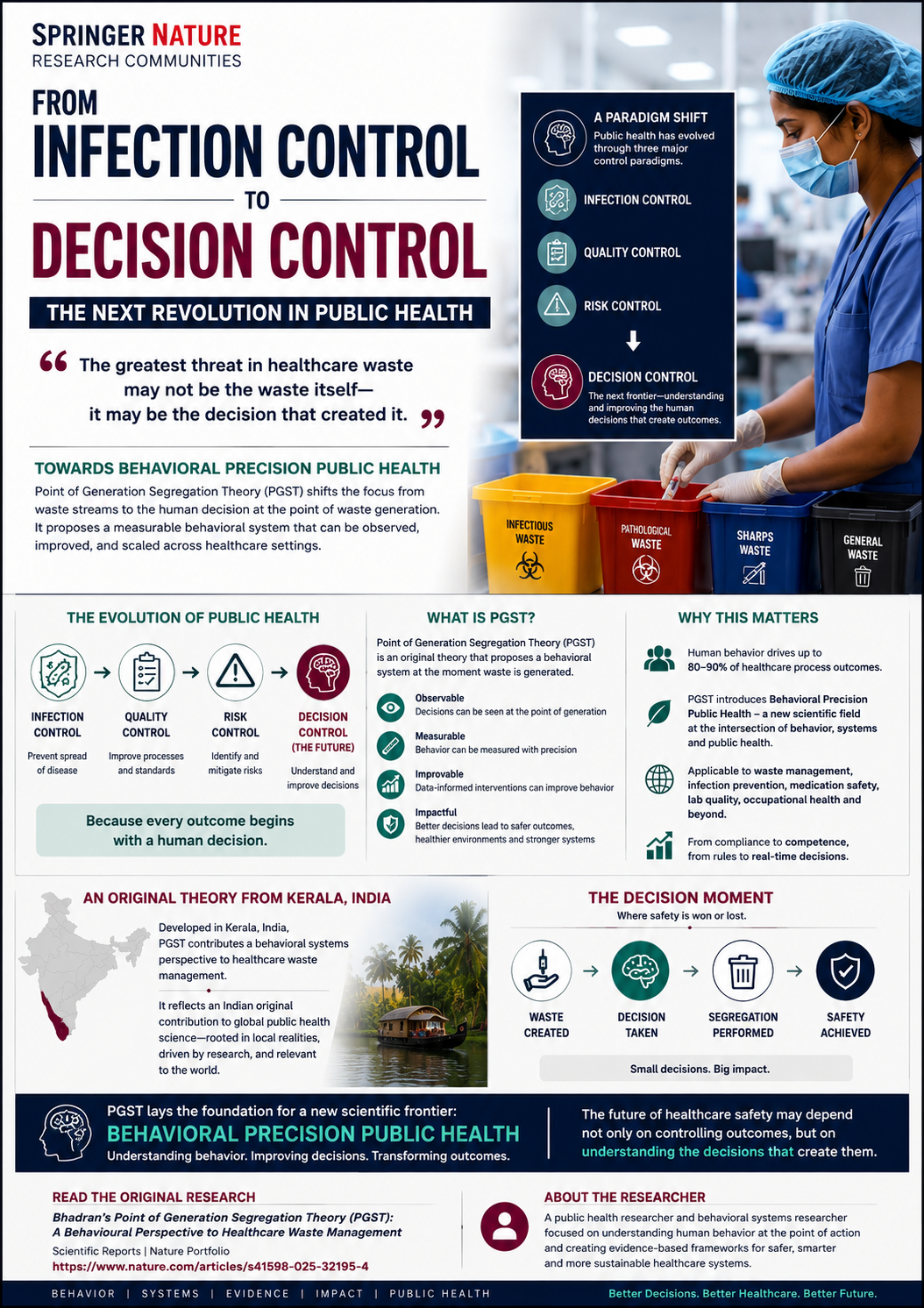 Public health has evolved through a series of transformative paradigms. Infection control helped reduce the spread of communicable diseases. Quality control introduced systematic approaches to improving healthcare delivery. Risk management enabled organizations to identify, assess, and mitigate threats to patient safety.
Each of these advances addressed a visible outcome of healthcare processes. Yet an important question remains: what happens before the outcome?
Before an infection occurs, before a quality lapse is recorded, and before a risk event is documented, a decision is made. In healthcare settings, thousands of decisions are taken every day by professionals operating under complex conditions. These decisions shape safety, efficiency, and ultimately health outcomes.
Historically, healthcare waste management has been viewed primarily as an environmental and operational challenge. Most interventions have focused on infrastructure, disposal technologies, regulatory compliance, and waste categorization. While these approaches remain important, they often overlook the critical moment at which waste is generated and classified.
The recently published "Bhadran's Point of Generation Segregation Theory (PGST)" proposes a different perspective. Instead of focusing solely on waste streams and disposal pathways, the theory directs attention to the behavioral decision occurring at the point of waste generation. In this view, segregation is not merely a technical process but a behavioral event that can be observed, measured, and improved.
What makes this perspective particularly interesting is its potential relevance beyond healthcare waste management. If decision-making at the point of generation influences waste segregation outcomes, similar principles may apply to infection prevention, medication safety, laboratory quality, occupational health, and other domains where human behavior plays a central role.
This raises the possibility of a broader framework that could be described as Behavioral Precision Public Health—an approach that seeks to understand public health challenges through measurable behavioral actions occurring at critical points within systems.
An important aspect of this development is its origin. PGST emerged from research conducted in Kerala, India, contributing an original theoretical perspective from the Global South to an area often dominated by operational and policy-based frameworks. The work reflects a growing recognition that meaningful scientific innovation can arise from local observations while addressing globally relevant challenges.
The theory also highlights the value of systems thinking in public health research. Rather than viewing errors as isolated events, it encourages researchers to examine the behavioral mechanisms embedded within larger organizational systems. This shift aligns with contemporary efforts to integrate behavioral science, implementation science, and systems research into public health practice.
Whether PGST ultimately becomes a widely adopted framework remains a question for future empirical investigation and validation across diverse settings. However, its central proposition is compelling: improving public health may require not only controlling outcomes but also understanding the decisions that create them.
The transition from infection control to decision control is not intended to replace existing public health approaches. Instead, it invites researchers to explore a complementary dimension of healthcare systems—human decision-making itself.
As public health continues to evolve, the next major breakthrough may not come from managing waste, preventing infections, or reducing risk alone. It may come from understanding the behavioral decisions that precede them all.
To explore the complete theory and its implications for healthcare waste management, readers are encouraged to visit the original article published in Scientific Reports and join the ongoing discussion on the future of behavior-centred public health research.

Renjith Seela Bhadran, developer of Bhadran’s Point of Generation Segregation Theory (PGST), is an Indian academic and public health researcher whose work integrates behavioral science with public health to address systemic challenges in healthcare waste management. He is an Assistant Professor in the Department of Public Health at Amrita School of Medicine, Amrita Vishwa Vidyapeetham, Kochi, India, where he primarily teaches Social and Behavioral Science to healthcare students.
Bhadran holds a Master of Science in Public Health (MSc PH) from the University of Bedfordshire and an MBA from the University of Nottingham, United Kingdom. His academic work reflects a multidisciplinary perspective that combines public health systems analysis, behavioral science, and environmental sustainability. His research initially focused on onsite biomedical waste segregation challenges in healthcare facilities and later expanded to investigate the cognitive and behavioral determinants influencing segregation practices at the point of generation.
During his doctoral research (PhD) at Amrita School of Medicine, Bhadran developed the Point-of-Generation Segregation Theory (PGST), a behavioral–systems framework that conceptualizes biomedical waste segregation as a precision-dependent behavioral process occurring at the moment of waste generation. The theory introduces analytical constructs such as the Precision Behavior Score (PBS) and Moment-Based Precision Behavioral Fidelity (MBPBF) to evaluate segregation accuracy at the point of disposal, along with behavioral drift analysis to monitor system performance and support improvement over time.
PGST also proposes the Global Segregation Safety Scale (GSSS), a structured benchmarking framework designed to classify institutional segregation performance and support international comparisons in biomedical waste management practices. By reframing waste segregation as a behavioral decision-making process rather than solely an operational activity, the framework provides a new interdisciplinary perspective linking healthcare worker behavior, environmental sustainability, and public health safety.
Bhadran’s research sits at the intersection of behavioral systems research, public health impact assessment, health education, and environmental health management. His work is increasingly gaining international academic attention for its potential to strengthen training systems, institutional audits, and evidence-based policy development in biomedical waste management.
Follow the Topic
Introducing: Social Science Matters
Social Science Matters is a campaign from the team at Palgrave Macmillan that aims to increase the visibility and impact of the social sciences
Continue reading announcement
Please sign in or register for FREE
If you are a registered user on Research Communities by Springer Nature, please sign in