From the Global Village to Spaceship Earth
Published in Earth & Environment

by
Subrato Banerjee
Department of Economics, Indian Institute of Technology Bombay
Benno Torgler
School of Economics and Finance & ARC Training Centre for Behavioural Insights for Technology Adoption (BITA), Queensland University of Technology
On Valentine’s Day 1990, Voyager 1 turned its camera homeward from about six billion kilometres away. Earth occupied roughly one pixel, suspended in scattered sunlight (Sagan, 1994). It was not the first “selfie”, but it may be humanity’s most consequential group portrait. Every border, battlefield, forest, parliament and childhood was compressed into the same tiny speck of light.
The image is powerful partly because it reveals and conceals at the same time. It reveals our physical unity: one inhabited world inside a vast darkness. Yet it conceals the social divisions, unequal risks and historical responsibilities that structure life on that world. A mature cosmic perspective must hold both truths together.
A global perspective remains indispensable. It helps us see trade, migration, conflict, disease and climate as processes that cross borders. Yet global thinking often retains the nation-state as its basic unit: a world composed of countries observing, comparing and negotiating with one another. A cosmic perspective changes the foreground. It begins with Earth as a finite system within which states, economies and cultures operate. It does not replace the global; it places the global inside the planetary.
Historian Dipesh Chakrabarty offers a useful distinction here. “The globe” is largely a human construction, mapped by commerce, empire, technology and politics. “The planet” confronts us with Earth-system processes and timescales that were not organised for human purposes. To think planetarily is therefore to recognise that human history unfolds within a biophysical history much older, larger and less negotiable than our institutions.
This idea has a rich intellectual lineage. In Spaceship Earth, Barbara Ward presented technological interdependence, international inequality and survival as problems aboard a shared Spaceship Earth vessel which we as the crew need to handle. In the same year, economist Kenneth Boulding contrasted the expansive “cowboy economy” with a “spaceman economy” that has no limitless reservoirs for extraction or pollution and must conserve stocks while reducing wasteful throughput. Buckminster Fuller’s Operating Manual for Spaceship Earth then transformed the metaphor into a design problem: humanity had inherited an extraordinarily complex craft without an instruction manual. He stressed that “we have not been seeing our Spaceship Earth as an integrally-designed machine which to be persistently successful must be comprehended and serviced in total” (p. 60).
The spaceship metaphor is illuminating, but incomplete. Earth is not a machine assembled for us, with replaceable parts and passengers standing outside its operation. James Lovelock and Lynn Margulis’s Gaia hypothesis helped establish a systems view in which organisms and the physical environment interact through feedback. We are not simply passengers on Earth. We are participants in its living processes, capable of altering the conditions on which our own flourishing depends.
Frank White later named the cognitive and perception shift reported by astronauts who saw Earth from space the “overview effect”. He also refers to the universal insight, which is the recognition that the Earth is not only a whole system but also that we are part of the universe and have an important part to play in it. Psychologist David Yaden and colleagues interpreted many astronaut accounts through awe and self-transcendence: an encounter with vastness can temporarily diminish the individual self and enlarge identification with humanity and the planet as a whole. Carl Sagan’s work suggests that no rocket ticket is required. Discussing Kepler’s imagined journey to the Moon, Sagan observed that “by changing our perspective we can figure out how worlds work” (p. 65). Scientific knowledge and disciplined imagination can therefore produce a terrestrial analogue of the decentring associated with viewing Earth from space. Scientific knowledge, imagery and disciplined imagination can produce a terrestrial version of the same decentring. Still, inspiration should not be mistaken for evidence of lasting change. Femke van Horen and colleagues found that a short virtual-reality overview experience did not alter measured pro-environmental behaviour. A longer, more immersive version produced suggestive but statistically non-significant increases in connection with nature and environmental donations, with no detectable change in meat or dairy consumption. Awe may open attention; it does not automatically reorganise habits, incentives or institutions.
Social psychology points to another promise or danger. A common identity can recategorise former outsiders as members of a larger “we”. Yet John Dovidio, Samuel Gaertner and Tamar Saguy show that an undifferentiated common identity can also make existing inequalities less visible. The stronger model is a dual or nested identity: people can remain members of nations, cultures and communities while also recognising a superordinate human identity. Planetary solidarity should enlarge belonging, not erase difference.
This matters because the phrase “we are all in the same boat” is only partly true. We inhabit the same Earth, but not equally protected cabins. Populations differ in their contribution to ecological harm, their exposure to danger, their political power and their capacity to adapt. The view from space removes borders from sight; it does not remove responsibility from history. Without justice, the cosmic perspective risks becoming a beautiful way of looking past inequality.
Elinor Ostrom’s work offers a practical bridge from vision to action. Planetary problems do not require a choice between local initiatives and global agreements. They require polycentric governance: households, communities, cities, firms, states and international institutions experimenting, learning, monitoring and coordinating across several levels. The useful maxim is therefore not merely “think globally, act locally”, but “think planetarily, govern polycentrically”.
The cosmic perspective is neither a luxury purchased with a seat on a spacecraft nor a sentimental escape from politics. It can be cultivated through astronomy, Earth observation, education, art, simulation and public institutions that make interdependence visible. Its achievement is not that the world suddenly appears simple. It is that the world appears whole without its differences becoming disposable.
Voyager’s photograph is a mirror held at an almost unimaginable distance. It cannot formulate climate policy, settle a conflict or determine how responsibilities should be distributed. What it can do is alter the scale at which such questions are understood. It reminds us that planetary belonging need not replace national, cultural or local identities; it can contain them within a larger and more consequential sense of “we.” As Sagan wrote, “The Cosmos may be densely populated with intelligent beings. But the Darwinian lesson is clear: There will be no humans elsewhere. Only here. Only on this small planet. We are a rare as well as an endangered species. Every one of us is, in the cosmic perspective, precious. If a human disagrees with you, let him live. In a hundred billion galaxies, you will not find another” (p. 339). The task before us is to turn that recognition from a moment of wonder into an enduring principle of collective life.
References
1. Chakrabarty, D. The planet: An emergent humanist category. Critical Inquiry 46, 1–31 (2019).
2. Ward, B. Spaceship Earth (Columbia University Press, 1966).
3. Boulding, K. E. The economics of the coming Spaceship Earth. In Environmental Quality in a Growing Economy (ed. Jarrett, H.) 3–14 (Resources for the Future/Johns Hopkins University Press, 1966).
4. Fuller, R. B. Operating Manual for Spaceship Earth (Southern Illinois University Press, 1969).
5. Lovelock, J. E. & Margulis, L. Atmospheric homeostasis by and for the biosphere: The Gaia hypothesis. Tellus 26, 2–10 (1974).
6. White, F. The Overview Effect: Space Exploration and Human Evolution (Houghton Mifflin, 1987).
7. Yaden, D. B. et al. The overview effect: Awe and self-transcendent experience in space flight. Psychology of Consciousness: Theory, Research, and Practice 3, 1–11 (2016).
8. Sagan, C. Cosmos, 339 (Random House, 1980).
9. Sagan, C. Pale Blue Dot (Random House, 1994).
10. van Horen, F., Meijers, M. H. C., Zhang, Y., Delaney, M., Nezami, A. & Van Lange, P. A. M. Observing the earth from space: Does a virtual reality overview effect experience increase pro-environmental behaviour? PLOS ONE 19, e0299883 (2024).
11. Dovidio, J. F., Gaertner, S. L. & Saguy, T. Another view of “we”: Majority and minority group perspectives on a common ingroup identity. European Review of Social Psychology 18, 296–330 (2007).
12. Ostrom, E. Polycentric systems for coping with collective action and global environmental change. Global Environmental Change 20, 550–557 (2010).
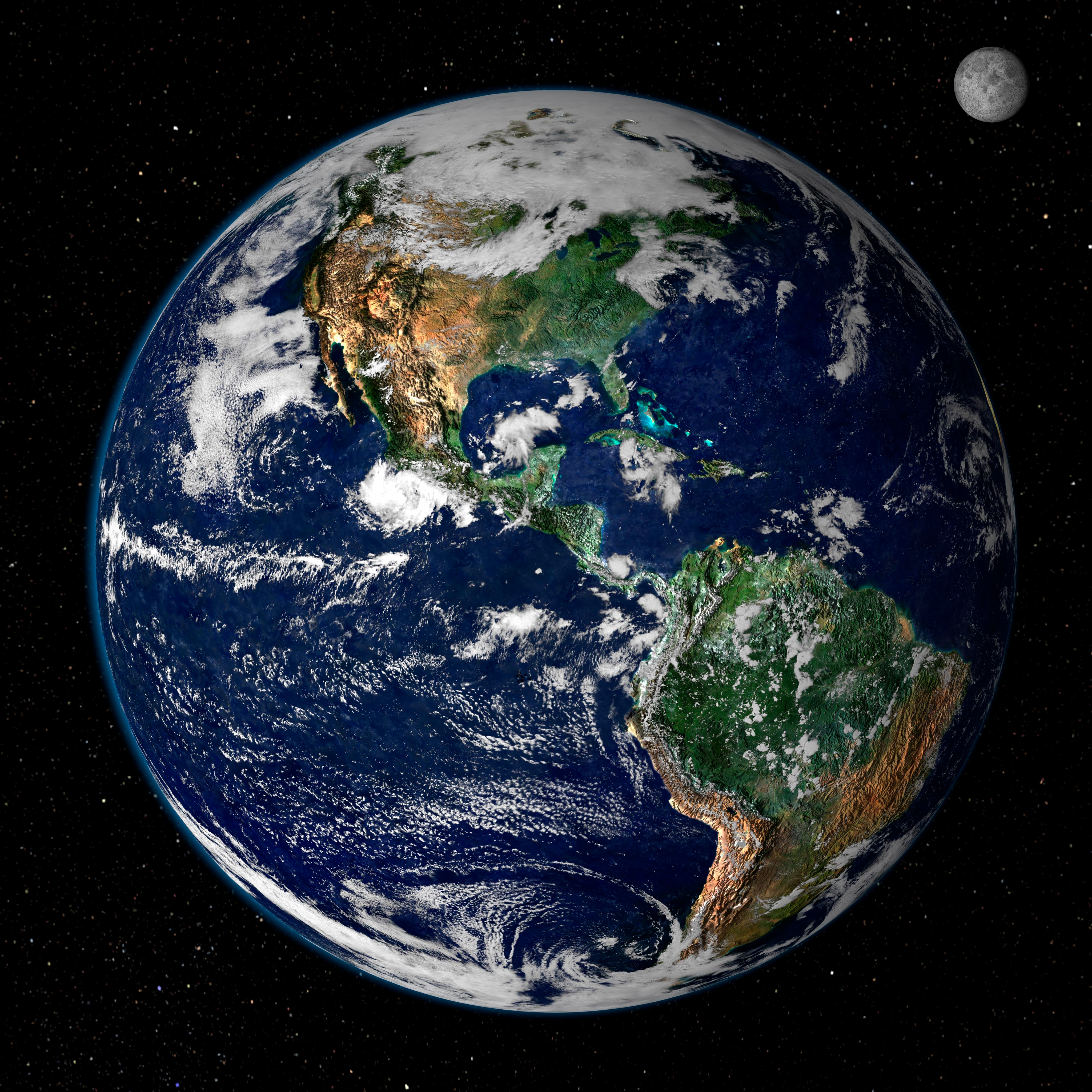
The image used was created by Reto Stöckli, Nazmi El Saleous, and Marit Jentoft-Nilsen, NASA GSFC. It shows North and South America as they would appear from space 35,000 km (22,000 miles) above the Earth. The image is a combination of data from two satellites. The Moderate Resolution Imaging Spectroradiometer (MODIS) instrument aboard NASA’s Terra satellite collected the land surface data over 16 days, while NOAA’s Geostationary Operational Environmental Satellite (GOES) produced a snapshot of the Earth’s clouds.