From thyroid disorders to watching metabolism through a nanopore
Published in Chemistry



Our study began with a simple question: why are thyroid disorders often accompanied by changes in mood and behaviour?
The relationship is undoubtedly complex, but one biochemical connection caught our attention. Tyrosine is not only involved in thyroid hormone biosynthesis; it is also a precursor for catecholamines, including dopamine, noradrenaline and adrenaline—molecules that play important roles in mood, cognition and stress responses.
This connection made us wonder: could changes associated with thyroid dysfunction also perturb catecholamine metabolism? And, more fundamentally, could we actually watch such a metabolic pathway unfold over time?
From detecting molecules to watching a pathway
This second question brought us back to nanopores.
Our laboratory has long been interested in using nanopores to identify individual molecules from their characteristic ionic-current signatures. But metabolism presents a very different challenge. A metabolic pathway is not a single molecule—it is a dynamic network in which substrates disappear, intermediates emerge and products accumulate continuously.
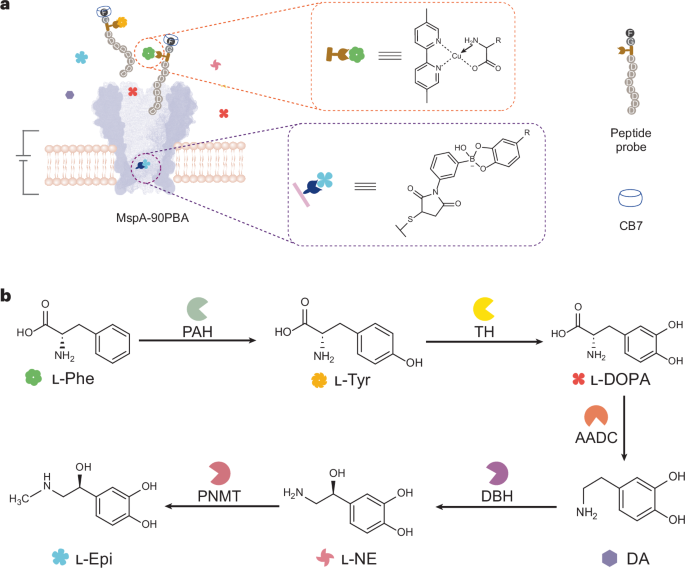
The catecholamine-related phenylalanine pathway offered an ideal test case. It begins with phenylalanine and proceeds through tyrosine and L-DOPA to dopamine, noradrenaline and adrenaline. These six metabolites differ substantially in chemical structure, making it extremely difficult to recognize all of them using a single nanopore recognition mechanism.
Our solution was to combine two orthogonal recognition strategies in one nanopore platform. A phenylboronic-acid-modified MspA nanopore recognizes L-DOPA and the catecholamines, while a designed peptide probe enables phenylalanine and tyrosine to be distinguished. Together, the two recognition modes allowed all six metabolites to be identified within the same sensing system.
For us, this was the key step: the nanopore was no longer simply detecting a molecule. It could begin to report the state of an entire metabolic pathway.
Watching metabolism unfold
We then reconstructed the complete pathway in vitro using five enzymes and the required cofactors.
When the reaction was started, we could follow phenylalanine disappearing, tyrosine rapidly accumulating and then declining, and dopamine, noradrenaline and adrenaline gradually appearing. Tyrosine peaked at around 12 minutes, and the system approached a steady state after about 50 minutes. Interestingly, L-DOPA remained at a very low level throughout the reaction, suggesting efficient substrate channelling between tyrosine hydroxylase and aromatic L-amino acid decarboxylase.
Seeing these trajectories emerge from nanopore signals was one of the most rewarding moments of the project. Instead of reconstructing metabolism from an endpoint measurement, we could watch the pathway evolve in time.
Returning to the question that started the project
Finally, we returned to thyroid biology.
During thyroid hormone synthesis, monoiodotyrosine (MIT) is normally recycled by iodotyrosine dehalogenase 1 (DEHAL1). In DEHAL1 deficiency, this recycling is impaired and MIT can accumulate and enter the circulation.
We therefore introduced MIT into our reconstructed metabolic system. The result was striking. Phenylalanine was still converted to tyrosine, but the downstream pathway was strongly suppressed. Our measurements showed that MIT inhibited tyrosine hydroxylase, leaving phenylalanine and tyrosine to account for about 95% of the detected metabolites while catecholamine production was greatly reduced.
This experiment does not mean that altered catecholamine metabolism alone explains the neurological or emotional manifestations of thyroid disorders. Human physiology is far more complicated. But it provides a possible biochemical connection and, more importantly, demonstrates how a metabolic perturbation can be followed dynamically rather than inferred only from its endpoint.
Beyond this pathway
Looking back, the project changed the way we think about nanopore sensing.
Nanopores have traditionally been powerful tools for asking “What molecule is this?” Our work suggests that they can also begin to address a different question:
“What is happening in this biochemical system over time?”
We hope that combining multiple molecular recognition mechanisms will eventually allow nanopores to follow increasingly complex metabolic and signalling networks.
For us, a question about thyroid disease ultimately became a journey from detecting individual molecules to watching biology unfold—one molecular event at a time.

Follow the Topic
-
Nature Nanotechnology
An interdisciplinary journal that publishes papers of the highest quality and significance in all areas of nanoscience and nanotechnology.