When a metabolite becomes more than a metabolite
Published in Microbiology, Immunology, and Anatomy & Physiology

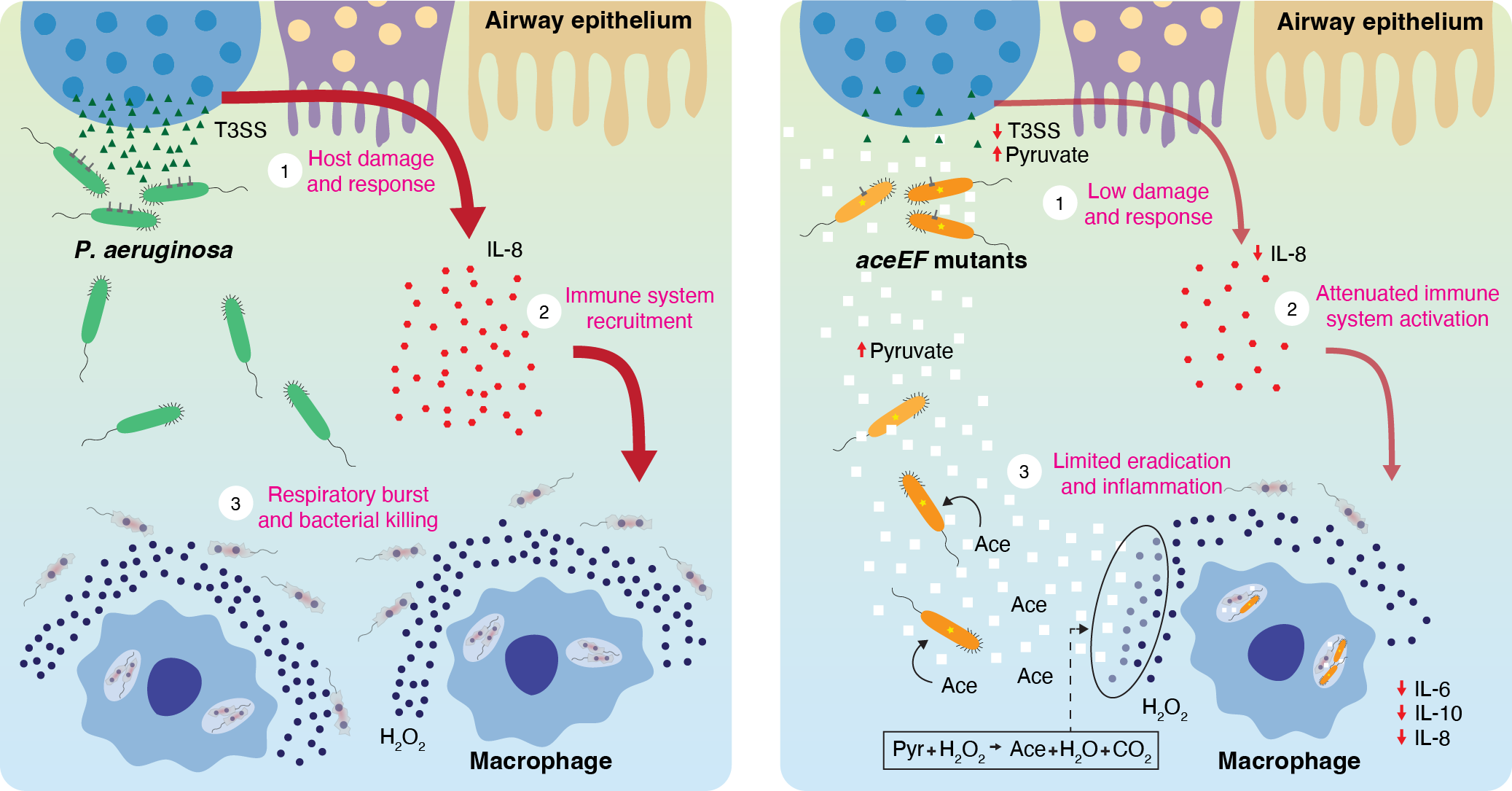




In bacteria, mutations that compromise central metabolism are generally expected to be costly, because they slow growth and reduce fitness. That is why, when we began to see mutations in the pyruvate dehydrogenase complex (PDHc) appear again and again in clinical isolates of Pseudomonas aeruginosa from people with cystic fibrosis, we were puzzled.
At first glance, it made little sense. PDHc sits at the crossroads between glycolysis and the TCA cycle, controlling one of the most important metabolic decisions a cell can make. Disrupting it should not be advantageous. These mutations impaired PDHc activity, causing bacteria to accumulate and secrete pyruvate. Yet they were not rare accidents. They appeared independently in different patients and bacterial lineages, and they persisted over years of chronic infection.
Why would evolution repeatedly select mutations in one of the most fundamental enzymes of cellular metabolism?
The first clue came from oxidative stress. Chronic lung infections in cystic fibrosis are characterized by an intense inflammatory environment, where immune cells continuously produce reactive oxygen species to eliminate bacteria. Pyruvate is known in biochemistry as an efficient scavenger of hydrogen peroxide, but we wondered whether bacterial pyruvate could actually perform this function during infection.
Much of this experimental exploration was driven early on by two master’s students in the lab, who helped turn what initially felt like a speculative idea into a set of concrete, testable questions. When we tested this hypothesis, the answer was clear: extracellular pyruvate protected bacteria from oxidative killing.
This observation immediately raised another question. If pyruvate accumulates outside bacterial cells, then it is no longer simply part of bacterial metabolism. It becomes part of the host–pathogen interface.
As we explored further, the story became increasingly compelling. Pyruvate reduced inflammatory signalling by airway epithelial cells, dampened macrophage activation, and increased bacterial survival after phagocytosis. Rather than acting through a single mechanism, it appeared to reshape the infection environment in several complementary ways. A metabolite that we had initially considered merely a consequence of metabolic dysfunction turned out to influence the host response itself.
One aspect that we find particularly intriguing is that pyruvate is one of the most universal metabolites in biology. Unlike many classical virulence factors, it is not specific to P. aeruginosa. Every living cell depends on pyruvate. This raises the possibility that metabolites, especially central metabolites, may have underappreciated signalling roles during infection that extend far beyond their functions in metabolism.
Supporting this idea, we also identified analogous PDHc mutations in clinical isolates of several other important bacterial pathogens. Whether these mutations produce the same phenotype remains to be demonstrated experimentally, but they hint that similar evolutionary solutions may arise independently in different species facing comparable host environments.
For us, one of the most rewarding aspects of this work was the conceptual shift it required. We started by studying mutations in metabolism, and we ended up thinking about metabolism as a language through which bacteria communicate with, and manipulate, the host. Equally rewarding was seeing how much of this story was shaped by early-career researchers: the curiosity and hard work of the students involved played a key role in transforming an initially puzzling observation into a coherent narrative.
Pyruvate has been at the centre of biochemistry for over a century, yet in the context of chronic infection it becomes much more than a metabolic intermediate. It acts as an immunometabolite that reshapes the host environment and, in doing so, helps resolve the paradox that first drew us in: why evolution repeatedly favours mutations in one of the most essential enzymes of cellular metabolism.
Follow the Topic
-
Nature Communications
An open access, multidisciplinary journal dedicated to publishing high-quality research in all areas of the biological, health, physical, chemical and Earth sciences.

Related Collections
With Collections, you can get published faster and increase your visibility.
Women's Health
Publishing Model: Hybrid
Deadline: Ongoing
Tumor Microenvironment Crosstalk and Therapeutic Implications
Publishing Model: Hybrid
Deadline: Nov 02, 2026