From Water and Anaemia to Reproductive Timing: How the Research Question Emerged
Published in Sustainability, General & Internal Medicine, and Public Health


In Aparajita's own words:
This has been a long research journey, evolving gradually from personal experience to field-based observations and, eventually, to the use of large-scale secondary data. I come from eastern India, where I grew up and spent my early adulthood, and have spent nearly three decades in western India pursuing my professional work. Over the years, I began noticing a curious contrast in my own life. Whenever I travelled back home to the east, I would often experience stomach disturbances, while anaemia remained a persistent concern despite what I considered a reasonably healthy diet. Menstruation had also been heavy for much of my reproductive life, although there was no clear diagnosis or explanation for it until I began to recognise its significance myself in my mid-thirties. These experiences were never, by themselves, evidence of an environmental cause. But they stayed with me and gradually shaped a set of questions that became increasingly difficult to ignore: Why was anaemia so persistent? Why was menstruation so heavy? Could the environment in which we live, particularly the quality of water and air, have some role in shaping women's health?
My scientific interest in these questions therefore did not begin with menarche or menopause. It evolved through a much longer engagement with population health, environmental conditions and spatial diversity. The initial questions were relatively simple: why are certain health problems more concentrated in some places than others, and what characteristics of those places might explain the pattern? Over time, these questions led me from observations of anaemia to groundwater, from groundwater to spatial clustering, from spatial clustering to direct investigation of water quality, and eventually to the broader question of whether environmental exposures might influence important reproductive events across the life course.
An early study to understand the response to iron supplementation to selected villages in West Bengal indicated that oral iron supplementation improved haemoglobin, particularly among severely anaemic women, although the response varied considerably, indicating that iron deficiency was an important but not the only determinant of anaemia (Unisa et al., 2011). One of the early turning points was our work comparing DHS data of West Bengal and Bangladesh, two geographically contiguous and historically connected populations with many cultural and environmental similarities. In our study of more than 21,000 women, we found that groundwater use was associated with higher odds of anaemia in both West Bengal and Bangladesh (Jana et al., 2022). This workraised an important question: could the environmental context of water, rather than water simply as a household source, be part of the explanation?
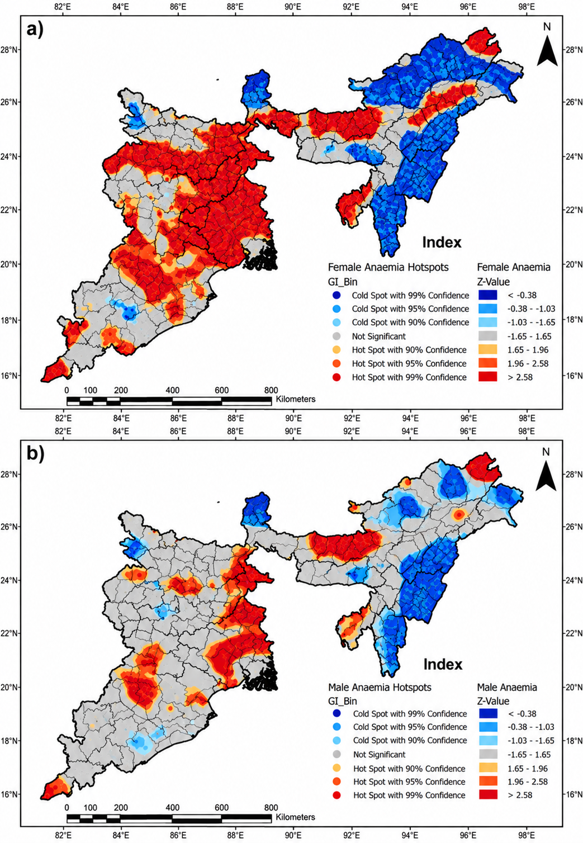
That question led to the next stage of our work. One of my PhD scholars, Lobsang Tshering Bhutia, mapped the spatial distribution of anaemia among women and men across eastern and north-eastern India. What was particularly striking was that the spatial concentration of anaemia was remarkably similar among females and males (Bhutia & Chattopadhyay, 2025). This suggested that the explanation might lie partly beyond sex-specific behavioural or reproductive factors and instead in shared environmental conditions to which entire populations are exposed. The study showed that anaemia clusters were concentrated in the riverine and humid regions of the Ganga, Brahmaputra and Mahanadi belts. An Analytical Hierarchy Process (AHP) model further showed spatial association between anaemia clusters and vulnerability to mosquito-borne diseases in riverine areas.
Fig 1: Prevalence of anaemia among (a) females, and (b) males in eastern India (NFHS-5) 2019-21 (Bhutia & Chattopadhyay, 2025).
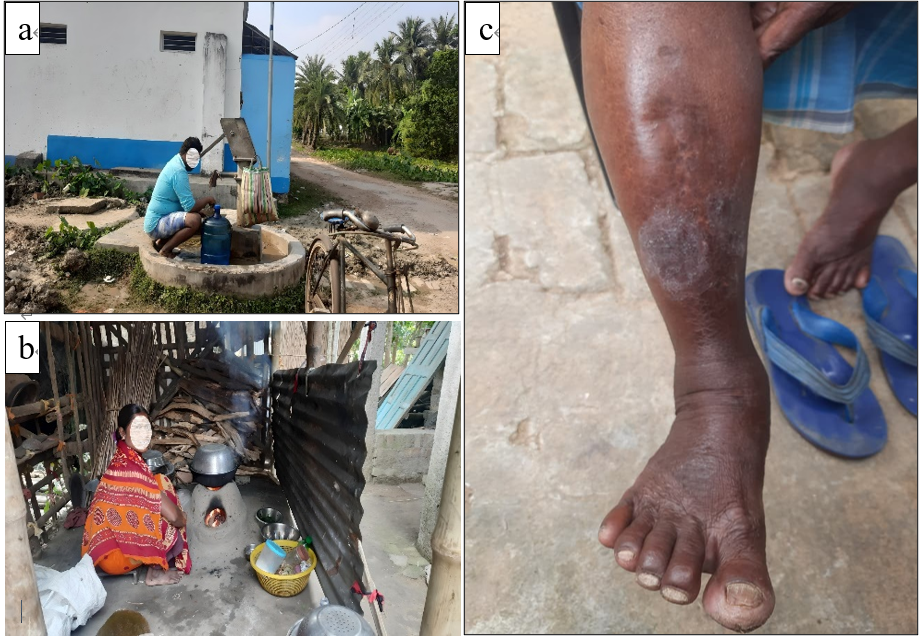
The next logical step was to examine water quality more directly. Sourav Biswas, another PhD scholar, began working with publicly available government groundwater-quality data. He mapped the spatial distribution of groundwater characteristics across India and subsequently undertook an intensive field investigation in the Ganga delta region, examining perceived and measured drinking-water quality and selected health outcomes. The field photographs and observations made the environmental exposure much more tangible: what had initially appeared as a set of secondary variables on a map was, in reality, part of people's everyday living environment. His subsequent study demonstrated substantial differences between perceived and measured drinking-water quality and highlighted the importance of examining water quality as a multidimensional environmental-health issue rather than simply as access to a water source (Biswas et al., 2024, 2025, 2026).
Parallelly another question emerged almost unexpectedly: could environmental quality also be related to the timing of major reproductive events, particularly menarche and menopause? Studies are rare in India. The timing of menarche and menopause and the menstrual flow and anaemia are not merely demographic or public health information. These are interconnected and represent important biological transitions and have implications for subsequent reproductive and non-communicable disease risks and perhaps on mental well being. Yet evidence from India on environmental influences on these transitions was remarkably sparse. The question became particularly compelling because India is experiencing persistent environmental challenges: substantial population exposure to elevated PM₂.₅ and groundwater-quality concerns involving contaminants such as arsenic and fluoride.
Fig 2: Field photographs: (a) drinking water collection; (b) a woman boiling water; and (c) observed skin disease.
My interest in menarche had also been strengthened by a parallel line of work on menstrual health management (MHM) with Shireen Jejeebhoy in Mumbai. Our MHM project among girls and young women living in Mumbai slums made visible how little attention is often paid to the experience of entering menstruation and to the social, informational, infrastructural and health-related challenges surrounding it. The findings were striking. Only about one-quarter of girls and young women in the study experienced what could be classified as good menstrual health management, despite relatively widespread use of menstrual products; and nearly one in five adolescent girls and young women reported having anaemia. (Chattopadhyay et al., 2024; Majumdar, Jejeebhoy, & Chattopadhyay, 2026; Majumdar, Jejeebhoy, Chattopadhyay, et al., 2026).
The idea for the present study on timing of menarche and menopause emerged a week before the International Union for the Scientific Study of Population’s (IUSSP) population conference paper submission deadline. The opportunity was particularly timely because NFHS-5 provided nationally representative information on reproductive timing, while environmental datasets provided increasingly fine-scale information on PM₂.₅, groundwater chemistry and land cover that Sourav had already mapped geospatially in his doctoral work. I invited Kathrin Schilling to join the study because of her expertise in environmental exposure science, particularly the measurement and health implications of metals and trace elements in South Asian settings. Our collaboration allowed us to bring together three complementary perspectives: population and reproductive health, geo-spatial and environmental epidemiology, and environmental exposure science. Sourav played a particularly important methodological role.
What we found
The resulting study, published in Communications Medicine, linked NFHS-5 data from 2019–2021 with satellite-derived PM₂.₅ estimates, Central Ground Water Board monitoring data and remotely sensed land-cover information. Late menarche was examined among women aged 15–24, while early menopause was examined among women aged 30–49, with adjustment for demographic, socioeconomic and geographic characteristics.
The findings suggested a consistent environmental pattern, after controlling most of the relevant socio-economic, demographic and nutritional factors : PM₂.₅ above the Indian annual standard of 40 μg/m³ was associated with later menarche (AOR 1.24) and earlier menopause (HR 1.23), with stronger patterns reported in northern India. Groundwater arsenic concentrations above 0.01 mg/L were associated with delayed menarche (AOR 1.06) and earlier menopause (HR 1.14). Higher groundwater fluoride was associated with earlier menopause (HR 1.12). Combined exposure to elevated PM₂.₅ and poorer groundwater quality was associated with greater likelihood of deviations from typical reproductive timing. Conversely, greater surrounding green cover was associated with lower likelihood of late menarche and early menopause. These associations should, of course, be interpreted as population-level associations rather than proof of causality, particularly because the study is cross-sectional and environmental exposures were assigned using area-level data. Nevertheless, the consistency across different environmental dimensions provides a strong basis for further investigation.
Why I consider this study important
What makes this study distinctive is not simply that it examines menarche and menopause. Its contribution lies in bringing reproductive demography into conversation with environmental health and spatial epidemiology. First, it moves beyond the conventional determinants of reproductive timing- education, wealth, nutrition, family characteristics to consider the environmental context in which women live. Second, it examines two reproductive transitions at opposite ends of the reproductive life course. Menarche represents the initiation of reproductive maturity, while menopause represents its cessation. Observing associations at both points raises the possibility that environmental conditions may have broader implications for reproductive ageing. Third, the study brings together nationally representative population data, satellite-based environmental exposure estimates, government groundwater monitoring data and remote-sensing information on land cover. This kind of data integration is particularly valuable in a setting such as India, where individual-level biomonitoring data are still limited but extensive population and environmental datasets exist. Fourth, the study demonstrates the potential of spatially linking population health with publicly available environmental information. The same approach can potentially be extended to other reproductive, maternal, ageing and chronic-health outcomes. Most importantly, the study emerged from a cumulative research trajectory rather than from a single hypothesis generated in isolation. The progression—from anaemia, to groundwater, to spatial environmental vulnerability, to direct investigation of water quality, to menstrual health, and finally to menarche and menopause—reflects a broader question that has increasingly shaped my work: How does the environment in which people live become part of their health across the life course?
For me, this is perhaps the most interesting aspect of the study. Population science traditionally asks who experiences a particular health outcome, where, and with what social and demographic characteristics. Environmental epidemiology asks what people are exposed to and why. Bringing the two together allows us to ask a larger question: whether the places in which people grow, menstruate, reproduce and age leave a measurable imprint on their health trajectories.
Policy relevance
The findings suggest that women's reproductive health cannot be separated completely from environmental health. Improving air quality, strengthening groundwater surveillance and remediation, protecting safe drinking-water sources, and maintaining green environments may have implications beyond infectious disease and conventional environmental-health outcomes. At the same time, the study points to the need for better environmental monitoring linked to health surveillance. The larger message is therefore not simply that pollution may affect menarche or menopause. It is that reproductive timing may be another sensitive indicator through which the cumulative quality of the environment becomes visible in population health. There remain numerous unanswered questions at the intersection of anaemia, menstruation, environmental exposures, and women’s reproductive health. Large-scale surveys provide valuable population-level evidence and allow the identification of broad patterns and associations, and data triangulation with environmental exposure may help exploring nuanced pathways underlying these complex issues.
A note of gratitude: I remain deeply grateful to my doctoral students, who, through their efforts to triangulate evidence from different sources, opened my eyes to the possibilities of environmental demography and health. I am particularly indebted to Sourav Biswas and Kathrin Schilling for trusting in me, believing in the idea, and lending their expertise, time and support to this work. I am equally thankful to my friend in Kolkata, Suchandra Chatterjee, a professor in Chemistry for her support. And, beyond all limits, I remain grateful to Dr Shireen J. Jejeebhoy, whose intellectual companionship and encouragement have continually fuelled my thinking.
References:
Bhutia, L. T., & Chattopadhyay, A. (2025). Environmental determinants of anaemia and its spatial association with Mosquito-Borne disease vulnerability: a case of Eastern and North-Eastern India. Discover Public Health, 22(1), 364.
Biswas, S., Chattopadhyay, A., & Chatterjee, S. (2026). Perceived versus measured drinking water quality in rural West Bengal, India: a comparative cross-sectional mixed-method case study. Scientific Reports.
Biswas, S., Chattopadhyay, A., Schilling, K., & Das, A. (2025). Investigating the association between groundwater contaminants and hypertension risk in India: a machine learning-based analysis. Journal of Exposure Science & Environmental Epidemiology, 1–18.
Biswas, S., Chattopadhyay, A., Shaw, S., & Hoffmann, R. (2024). Assessing groundwater quality and its association with child undernutrition in India. Science of the Total Environment, 943, 173732.
Chattopadhyay, A., Jejeebhoy, S., Ray, S., Rana, G. S., & Sinha, D. (2024). Menstrual Health Management (MHM) of Adolescents in Mumbai Slums: Identifying Gender Norms and Gaps. International Institute for Population Sciences. https://iipsindia.ac.in/sites/default/files/MHM_Fact_sheet.pdf
Jana, A., Chattopadhyay, A., & Saha, U. R. (2022). Identifying risk factors in explaining women’s anaemia in limited resource areas: evidence from West Bengal of India and Bangladesh. BMC Public Health, 22(1), 1433.
Majumdar, P., Jejeebhoy, S. J., & Chattopadhyay, A. (2026). Challenges in menstrual health service delivery to girls and young women in Mumbai slums: provider perspectives. Culture, Health & Sexuality, 1–13.
Majumdar, P., Jejeebhoy, S. J., Chattopadhyay, A., & Sinha, D. (2026). Male engagement in menstrual care: evidence from boys and young men in urban slums in Mumbai. Culture, Health & Sexuality, 1–13.
Unisa, S., Chattopadhyay, A., Ganguly, S., & Roy, T. K. (2011). Causes of anaemia among reproductive age women: an intervention study in the Eastern region of India. Population Review, 50(2).
Follow the Topic
-
Communications Medicine
A selective open access journal from Nature Portfolio publishing high-quality research, reviews and commentary across all clinical, translational, and public health research fields.

📢 Introducing: # Mental Health
Mental Health is a Topic created to increase visibility and impact of research in this area and facilitate exchange amongst researchers.
Continue reading announcementRelated Collections
With Collections, you can get published faster and increase your visibility.
Diagnosis and Care of Sepsis
Publishing Model: Open Access
Deadline: Jan 27, 2027
Exercise and Physical Activity in Health and Disease
Publishing Model: Open Access
Deadline: Dec 03, 2026