Funding Doesn't Kill Startups. Legitimacy Does.
Published in Business & Management


Introduction
The startup world is obsessed with funding. Pitch competitions celebrate investment announcements. Accelerators train founders to perfect their decks. Media headlines often equate fundraising with success. For many entrepreneurs, securing capital feels like crossing the finish line.
Yet a strange paradox persists. Some startups raise millions and disappear. Others struggle to secure funding yet survive, grow, and eventually dominate their markets. If funding is the ultimate determinant of success, why do so many well-funded ventures fail?
The conventional explanation points to poor execution, weak leadership, or market conditions. While these factors matter, they often obscure a deeper reality. Startups do not operate in a vacuum. They operate within systems of trust, norms, expectations, regulations, and stakeholder relationships.
In other words, they operate within institutions.
The missing variable in most startup conversations is legitimacy—the acceptance and trust granted by customers, regulators, employees, partners, investors, and society. Legitimacy determines whether a venture is viewed as credible, trustworthy, and worthy of support.
This distinction matters because funding and legitimacy solve different problems. Funding provides resources. Legitimacy provides permission. One helps a startup launch. The other helps it survive.
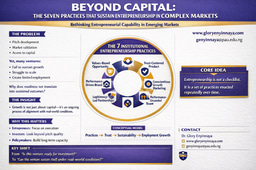
This article introduces what I call the Legitimacy Ladder, a simple framework for understanding why startups succeed or fail beyond fundraising. The framework suggests that entrepreneurial survival depends on four progressively deeper forms of legitimacy:
Trust. Acceptance. Authorization. Reputation.
Founders who understand these dimensions build ventures that endure. Those who ignore them often discover that capital can accelerate growth—but it cannot compensate for a lack of legitimacy.
As the African proverb reminds us, a tree does not become strong because it grows quickly; it becomes strong because its roots grow deep.
The same is true of startups.
Insight 1: Stop Mistaking Capital for Trust
The first mistake many founders make is assuming that investment automatically creates credibility.
It doesn't.
Investors can provide funding, introductions, and visibility. What they cannot provide is trust.
Trust is earned through consistent behavior and demonstrated value.
Customers rarely ask how much money a startup has raised before deciding whether to buy. Employees do not stay because a company completed a funding round. Partners do not commit because an investor signed a term sheet.
They commit because they believe. They believe the company will deliver. They believe the founders are competent. They believe promises will be kept.
Consider the countless startups that raised significant venture capital only to struggle with customer retention. Despite impressive valuations, many failed because customers did not trust their products, pricing models, or long-term intentions.
Trust cannot be outsourced.
Nor can it be purchased.
You cannot prototype trust.
Why does this matter?
Because trust is often the first form of legitimacy entrepreneurs must earn. Without it, every subsequent growth initiative becomes more difficult. Marketing becomes expensive. Customer acquisition slows. Partnerships become harder to secure.
Trust is the foundation upon which all other forms of legitimacy rest.
Action Item
Identify the three stakeholder groups whose trust matters most to your venture. Rate your current trust level with each group on a scale of 1–10. Then identify one action that could increase each score by one point within the next 30 days.
Insight 2: Earn Market Acceptance Before Pursuing Scale
Many founders assume that if customers need a solution, they will automatically embrace it.
Reality is more complicated. Markets do not merely evaluate products. They evaluate the organizations behind those products.
A venture can solve a genuine problem and still face resistance.
Why?
Because adoption is not only about utility. It is also about perceived alignment.
Customers ask questions such as: Do these people understand us? Do they share our values? Can we trust them with our money, data, or future?
This challenge is particularly evident across emerging markets, where local realities often differ significantly from assumptions imported from Silicon Valley.
Many ventures enter markets with technically sound solutions yet struggle because they fail to understand cultural expectations, stakeholder concerns, or local institutional dynamics.
The issue is not product quality. The issue is acceptance. This is where many scaling strategies fail. Entrepreneurs become preoccupied with TAM—Total Addressable Market—while ignoring what truly determines survival.
TAM chases size. TAV earns survival.
TAV—Total-Addressable Void—asks a different question:
How large is the void our customers face, and are we the right people to fill it?
The answer depends not only on functionality but also on legitimacy. Markets reward value. Institutions reward legitimacy. Sustainable ventures need both.
Action Item
Conduct five customer interviews this week. Ask one simple question: "What would make you trust a company like ours more?"
The answers may reveal barriers that product improvements alone cannot solve.
Insight 3: Treat Regulators as Strategic Stakeholders
Founders often describe regulation as an obstacle.
Institutional entrepreneurs see something different. They see stakeholders. This distinction changes everything.
Traditional entrepreneurs focus on market demand. Institutional entrepreneurs focus on stakeholder alignment. They recognize that regulators are not merely rule enforcers. They are gatekeepers of legitimacy.
Across Africa's fintech ecosystem, some of the most successful companies achieved growth not by avoiding regulators but by engaging them proactively.
Rather than asking, "How do we work around regulation?" they asked, "How do we build trust with regulators?" This mindset produces a fundamentally different growth strategy.
Instead of reacting to compliance challenges, companies anticipate them. Instead of treating regulation as friction, they treat it as relationship-building. This approach becomes increasingly important as industries mature.
In sectors such as fintech, healthtech, education, artificial intelligence, and digital infrastructure, regulatory legitimacy can determine whether a venture scales nationally or remains trapped in perpetual uncertainty.
The entrepreneurs who endure understand a critical truth: Permission often matters more than speed.
MVP proves possibility. MTP earns permission. The Minimum Trustworthy Product is not simply functional. It demonstrates responsibility, reliability, and alignment with stakeholder expectations.
Why does this matter?
Because regulatory support can accelerate growth just as quickly as regulatory resistance can destroy it.
Action Item
List the top three regulatory concerns that could affect your business over the next two years. Develop a proactive engagement strategy for each before they become urgent.
Insight 4: Build Reputation Like an Asset
Funding is spent.
Reputation compounds.
This is perhaps the most overlooked principle in entrepreneurship.
Capital depreciates the moment it is deployed. Reputation, by contrast, becomes more valuable over time.
Every fulfilled promise strengthens it.
Every customer success story reinforces it.
Every ethical decision expands it.
The strongest ventures eventually benefit from a powerful flywheel.
Customers trust them because others trust them.
Partners want to work with them because their reputation reduces uncertainty.
Employees join because the organization signals credibility.
Investors become interested because legitimacy lowers risk.
In effect, reputation becomes a form of strategic capital.
Unlike financial capital, however, reputation cannot be transferred from one bank account to another. It must be accumulated.
This is why some companies continue attracting opportunities long after competitors with larger budgets disappear.
Their legitimacy compounds. Their reputation compounds. Their stakeholder relationships compound.
Over time, these intangible assets become more valuable than the money that initially funded the business. Values outlast valuation. That is not merely a moral statement.
It is a strategic one.
Action Item
Choose one measurable reputation-building initiative for the next 30 days. Publish customer outcomes, improve complaint resolution times, showcase impact metrics, or publicly share lessons learned from failures.
Focus on actions that demonstrate trustworthiness rather than merely claiming it.
Conclusion: The Real Startup Balance Sheet
Entrepreneurs often view growth through a financial lens. Revenue. Funding. Valuation. Runway.
These metrics matter.
But they do not tell the entire story.
Beneath every successful venture sits an invisible balance sheet composed of trust, acceptance, authorization, and reputation. These assets rarely appear in investor presentations, yet they frequently determine whether a startup survives.
This is the central insight of the Legitimacy Ladder. Trust earns credibility. Acceptance earns adoption. Authorization earns permission. Reputation earns endurance.
Together, they create the institutional foundation upon which sustainable ventures are built.
The startup ecosystem frequently asks whether founders are investment-ready.
Perhaps the more important question is whether they are legitimate. Because in the long run, capital does not determine survival. Stakeholder belief does.
Funding may help a startup begin its journey. Legitimacy determines whether that journey continues.
So before asking how much capital your venture needs, consider a different question:
If every investor disappeared tomorrow, would enough stakeholders still believe in your company for it to survive

Dr. Glory Enyinnaya is a researcher, writer, educator and founder exploring one central question: ''How do change agents pursue entrepreneurial opportunities?''
A member of the faculty of Pan-Atlantic University in Nigeria, she created the entrepreneurial change readiness framework, which she introduced in the Harvard Business Review (May 2023), her Palgrave Macmillan book ''Institutional Entrepreneurship in African Fintech'' (June 2026) and expands further in her forthcoming book with Cambridge University Press.
A passionate educator, she teaches strategic thinking, innovation, platform strategy, business startups and ethics at Pan-Atlantic University and Lagos Business School.
Before entering academia, she worked as a change management consultant at Accenture and Ernst & Young and founded Kleos Advisory, a strategy consulting firm focused on entrepreneurial ecosystems.
Want a peek inside Glory's mind? Download a free chapter of her latest book here.