Gravity and human respiration: biophysical limitations in mass transport and exchange in spaceflight environments
Published in Bioengineering & Biotechnology, Electrical & Electronic Engineering, and Physics



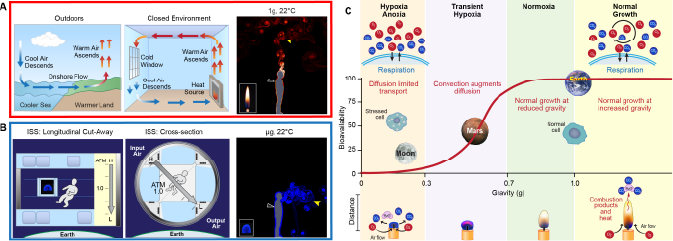
A major requirement for humans is a breathable atmosphere for adequate respiratory CO2/O2 gas exchange. In microgravity, despite environmental life support systems regulating air exchange, astronauts complain about air quality, with elevated CO2-levels resulting in detrimental health and performance effects. Using high-fidelity computational fluid dynamics, we create a model of human respiratory ventilation to show how gravity biophysically shapes and drives respiratory exchange on Earth and in microgravity. On Earth, gravity influences gas exchange through buoyancy and biothermal convection, generating a ‘human thermal body plume’ that drives airflow around the human body, and so facilitates effective gas exchange. We show that the absence of biothermal convection in microgravity reduces this airflow around the human body. This impairs gas exchange by creating an environmental breathing deadspace immediately in front of the face, leading to significant CO2-rebreathing, with direct implications for astronaut health and countermeasures. This model was also used to estimate engineering requirements for directed external airflow equivalent to that generated by the human thermal body plume to alleviate this problem. Our model further shows that in Earth-normal 1 g, increasing ambient air temperature can also reduce efficient respiratory exchange, resulting in breathing conditions equivalent to those in microgravity, with implications for respiratory health on Earth.

Dr. Porterfield is a Professor of Biological Engineering and Space Biophysics at Purdue University, where his primary research focus is understanding the biophysical spaceflight environment at the molecular membrane/organelle stress level, translated through cellular signaling to whole organism responses. This work focuses on enabling the integration of bioregenerative life support systems (BLiSS), with controlled ecological agriculture, and precision medicine using computational systems genomics and differential transcriptomics (Biosystomics) to support deep space, long duration human exploration. This work also includes the development and application of biomimetic/biophysical sensor technology leveraging biosensors, bio-MEMS, bio-nanotechnology, and lab-on-a-chip systems to support novel research to understand how living systems adapt and respond to the biophysical spaceflight environment. He has worked on microgravity-based crop hydroponics and is the inventor of mycoponics for substrate free mycoproduction. Dr. Porterfield served NASA as Division Director (now BPS, NASA HQ, 2012-2016) overseeing the Human Research, Physical Sciences and Space Biology programs, while envisioning and enabling the GeneLab Open Science program, and the original Twins Study. Now back at Purdue he now serves as the Science PI for the Lunar Effects on Agricultural Flora (LEAF) Payload for the Artemis 3 Lunar Mission. His work includes 100s of peer reviewed manuscripts, papers, technical publications, patents, and book chapters; and he was recently recognized for his lifetime publication record (Top 2%) by the Stanford Survey. His leadership also includes service as President of the American Society for Gravitational and Space Biology/Research, and President for the Institute for Biological Engineering. He was elected a Fellow for the American Institute for Medical and Biological Engineering, an honor reserved for the top 2% of medical and biological engineers, cited for his work "bridging the interface between engineering and physiology through outstanding contributions to biosensor technology and fundamental cell biology." In 2025 he was honored as a Fellow of the American Society for Gravitational and Space Biology/Research.
Follow the Topic
-
npj Biological Physics and Mechanics
npj Biological Physics and Mechanics considers research that explores the understanding of physical and mechanical aspects of biological processes across all relevant length scales, from molecular, cellular, and tissue scales, to organs and organisms.

Related Collections
With Collections, you can get published faster and increase your visibility.
Decoding Mechanosensitive Cell Types: From Molecular Transducers to Therapeutic Innovations
Publishing Model: Open Access
Deadline: Nov 06, 2026
Mechanosensitive and Mechanoregulatory Ion Channels
Publishing Model: Open Access
Deadline: Feb 28, 2027