High-Temperature Hydrogen Isotope Separation with Lattice-Driven Gating
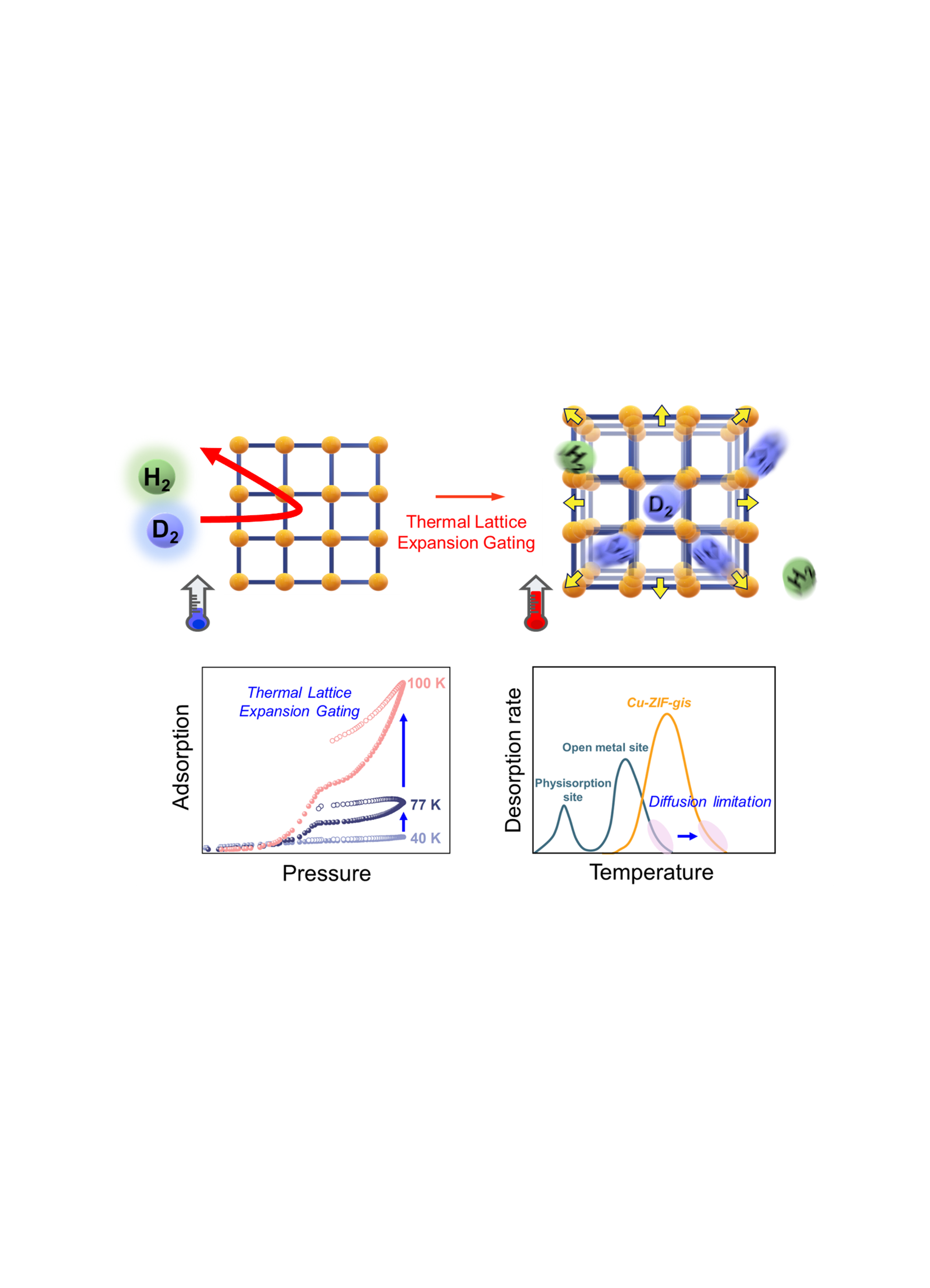




Hydrogen isotopes, deuterium (D2), as a source of nuclear fusion, play a crucial role in various scientific and industrial applications. Especially in the semiconductor industry, deuterium is used instead of hydrogen (H2) to extend the lifespan of semiconductors. However, separating H₂ and D₂ is extremely challenging due to their similar identical physicochemical properties. Conventional separation techniques, such as cryogenic distillation, require cryogenic temperatures (below 20 K), making them energy-intensive and costly. Moreover, the separation factor is low. (1.5 at 24 K).1 To replace conventional separation techniques, confined porous systems have recently emerged as efficient methods for hydrogen isotope separation, utilizing the kinetic quantum sieving (KQS) effect to differentiate isotopes at cryogenic temperatures.2
Why is increasing the operating temperature important for isotope separation?
Most KQS-based porous materials separate isotopes efficiently only below 77 K, and their separation performance decreases exponentially as temperature increases. Increasing the separation operating temperature significantly reduces energy consumption and enables the use of cheaper liquid nitrogen (77 K) or existing LNG (111 K) infrastructure instead of expensive helium. Therefore, higher separation operating temperatures enhance efficiency and economics by utilizing existing infrastructure such as LNG.
The Discovery: A Zeolitic Imidazolate Framework (ZIF) with a Unique Gating Mechanism
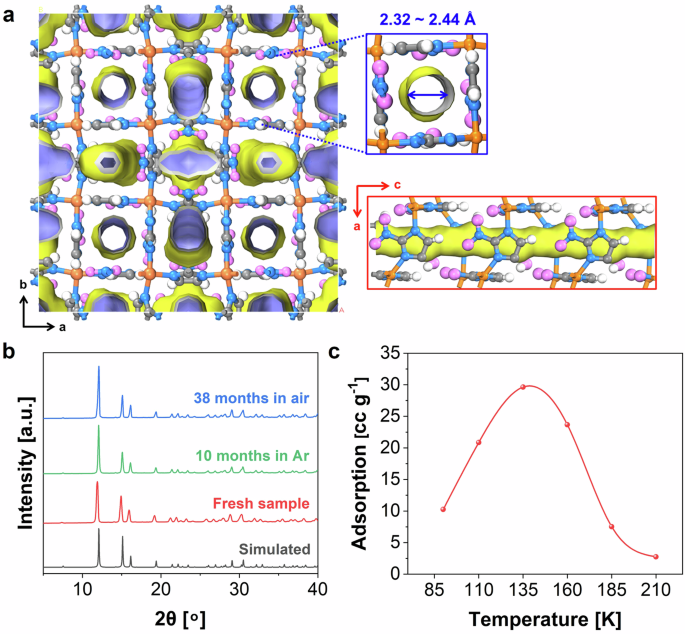
Our research identified Cu-ZIF-gis, a copper-based zeolitic imidazolate framework (ZIF) with ultra-narrow pores (~2.4 Å), smaller than the kinetic diameter of H2 (2.89 Å) (Figure 1).3 Conventional porous materials with the KQS effect typically enable efficient isotope separation only below 77 K, but we observed an unexpected phenomenon: Cu-ZIF-gis exhibited Lattice-Driven Gating (LDG), allowing effective hydrogen isotope separation even above 120 K.
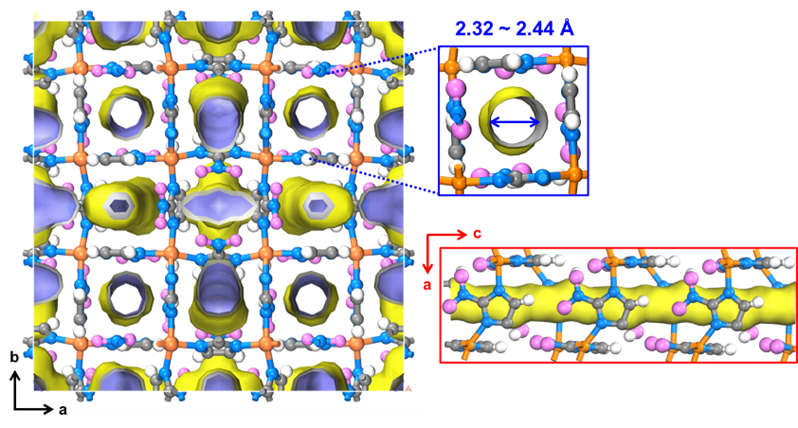
Figure 1 The structure of Cu-ZIF-gis.
The LDG effect is a mechanism by which the lattice expands with increasing temperature, enhancing pore accessibility. This effect was confirmed through various analysis techniques such as cryogenic gas sorption isotherm measurement, cryogenic thermal desorption spectroscopy (TDS), and temperature-varied X-ray diffraction (XRD) measurements. Gas sorption isotherm measurements showed increased uptake and hysteresis behavior from 40 K to 100 K, indicating a gating effect by temperature. This effect was also confirmed in the TDS analysis for pure gas. In the TDS spectrum, D2 was diffusion limitation due to the gating effect, and desorption up to 180 K was observed without strong adsorption sites. (Figure 2) This result indicates a higher desorption temperature than MOF-74,4 which has open metal sites (strong adsorption sites). For temperature-varied XRD Measurements, structural analysis conducted between 20 K and 300 K revealed a gradual unit cell expansion, particularly along the a-axis, leading to a controlled increase in pore size. These results support the presence of LDG effect by temperature.
The hydrogen isotope separation ability of Cu-ZIF-gis even at high temperatures via the LDG effect was verified by TDS and quasi-elastic neutron scattering (QENS) measurements. In the TDS analysis using the H2/D2 mixture, a D2/H2 selectivity of 1.7 was observed even at 120 K. Additionally, QENS studies confirmed that D2 exhibited more confined motion than H2, further enhancing selectivity. These results collectively demonstrate that Cu-ZIF-gis effectively utilizes LDG effect to achieve efficient high-temperature hydrogen isotope separation, overcoming the limitations of conventional KQS materials.
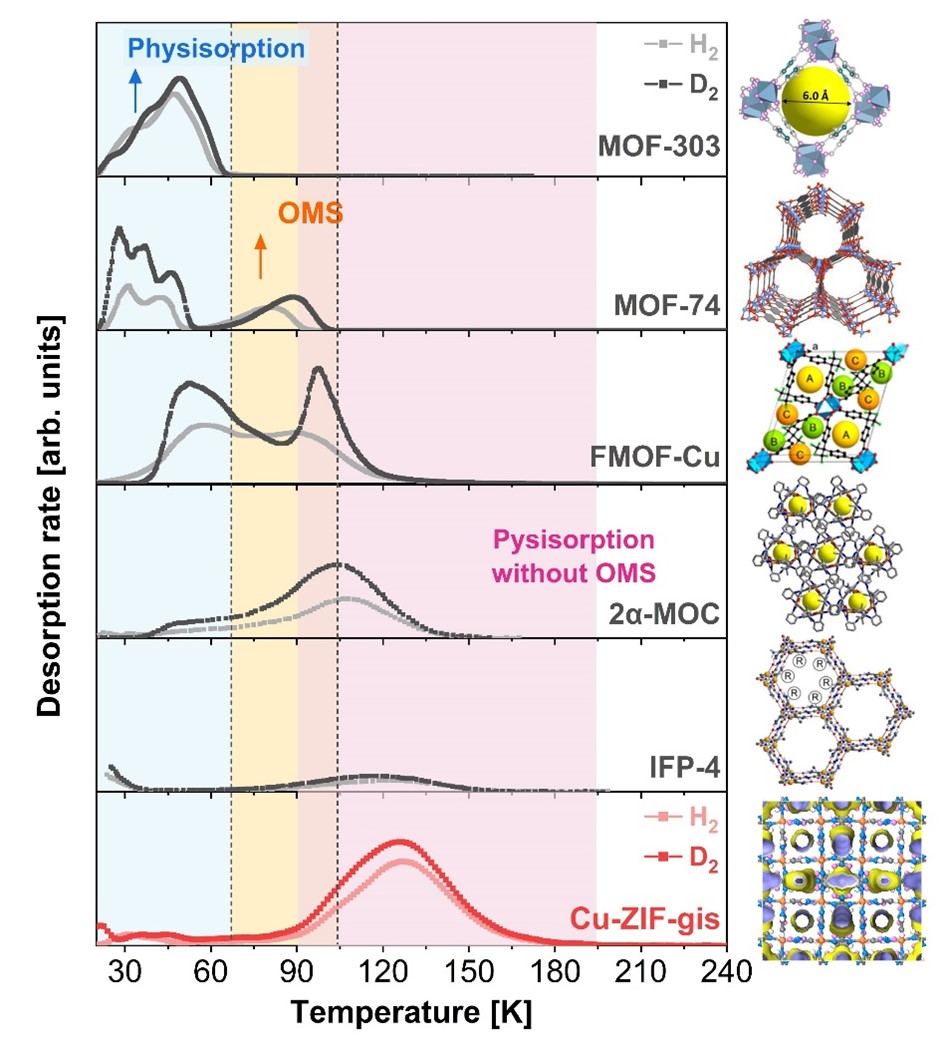
Figure 2 TDS spectra of Cu-ZIF-gis by exposing with ‘Single-component’ H2 and D2 and comparison of its thermal desorption behavior with microporous MOF-3035, MOF-74(Ni)4 with open metal sites, partially fluorinated FMOF-Cu6,7, IFP-4 and metal-organic cage (MOC) 2α8
Challenges and Breakthroughs
Most nanoporous materials with the KQS effect can only achieve hydrogen isotope separation below 77 K. However, Cu-ZIF-gis with LDG effect can separate hydrogen isotopes at 120 K without a strong adsorption site. The LDG effect of Cu-ZIF-gis was demonstrated by conducting various experiments. These results suggest that Cu-ZIF-gis can be integrated with LNG infrastructure (111 K) for industrial applications, thereby enabling more efficient hydrogen isotope separation.
Why This Matters
This study demonstrates a new approach to hydrogen isotope separation by utilizing the lattice-driven gating effect of Cu-ZIF-gis. We overcame the limitations of conventional KQS materials by utilizing the gating effect of Cu-ZIF-gis, pushing the operating temperature above 120 K. This opens new possibilities for developing energy-efficient and economical techniques for hydrogen isotope separation at high temperatures.
Our findings also suggest that lattice-driven gating in porous materials could have broader applications beyond isotope separation, including gas storage, sensing, and catalysis.
Could this approach help advance high-temperature hydrogen isotope separation? We believe so, and we look forward to exploring its full potential!
References
1 Rae, H. Selecting heavy water processes. ACS Publications. (1978).2 Beenakker, J., Borman, V. & Krylov, S. Y. Molecular transport in subnanometer pores: zero-point energy, reduced dimensionality and quantum sieving. Chem. Phys. Lett. 232, 379-382 (1995).
3 Jung, C. et al. Porous zeolitic imidazolate frameworks assembled with highly-flattened tetrahedral copper (ii) centres and 2-nitroimidazolates. ChemComm. 59, 4040-4043 (2023).
4 Kim, J. Y. et al. Exploiting diffusion barrier and chemical affinity of metal-organic frameworks for efficient hydrogen isotope separation. J. Am. Chem. Soc. 139, 15135-15141 (2017).
5 Kim, H. et al. High D2/H2 selectivity performance in MOF-303 under ambient pressure for potential industrial applications. Sep. Purif. Technol. 325, 124660 (2023).
6 Zhang, L. et al. Exploiting dynamic opening of apertures in a partially fluorinated MOF for enhancing H2 desorption temperature and isotope separation. J. Am. Chem. Soc. 141, 19850-19858 (2019).
7 Mondal, S. S. et al. Systematic Experimental Study on Quantum Sieving of Hydrogen Isotopes in Metal‐Amide‐Imidazolate Frameworks with narrow 1‐D Channels. ChemPhysChem 20, 1311-1315 (2019).
8 He, D. et al. Hydrogen isotope separation using a metal–organic cage built from macrocycles. Angew. Chem. Int. Ed. 61, e202202450 (2022).

Follow the Topic
-
Nature Communications
An open access, multidisciplinary journal dedicated to publishing high-quality research in all areas of the biological, health, physical, chemical and Earth sciences.

Related Collections
With Collections, you can get published faster and increase your visibility.
Women's Health
Publishing Model: Hybrid
Deadline: Ongoing
Tumor Microenvironment Crosstalk and Therapeutic Implications
Publishing Model: Hybrid
Deadline: Nov 02, 2026


