How young sandhoppers find their way
Published in Earth & Environment and Zoology & Veterinary Science

A question that emerged by chance
Our study began with a practical problem. Sandhoppers were available for collection on beaches during the summer, but in winter we did not have field-collected animals at hand. To perform some confirmatory experiments on orientation and polarized light, we therefore worked with animals born in the laboratory.
We expected these experiments to extend and confirm what we had already observed in sandhoppers collected in nature. Instead, the laboratory-born animals did not orient as their field-collected counterparts had done.
This unexpected difference prompted a new investigation. Why should animals of the same species respond differently to the same kind of visual information? Was their visual system still developing? Or was something missing from their experience of the world?
A seasonal limitation had opened up a question about the relationship between sensory development and behaviour.
Bringing biology and optics together
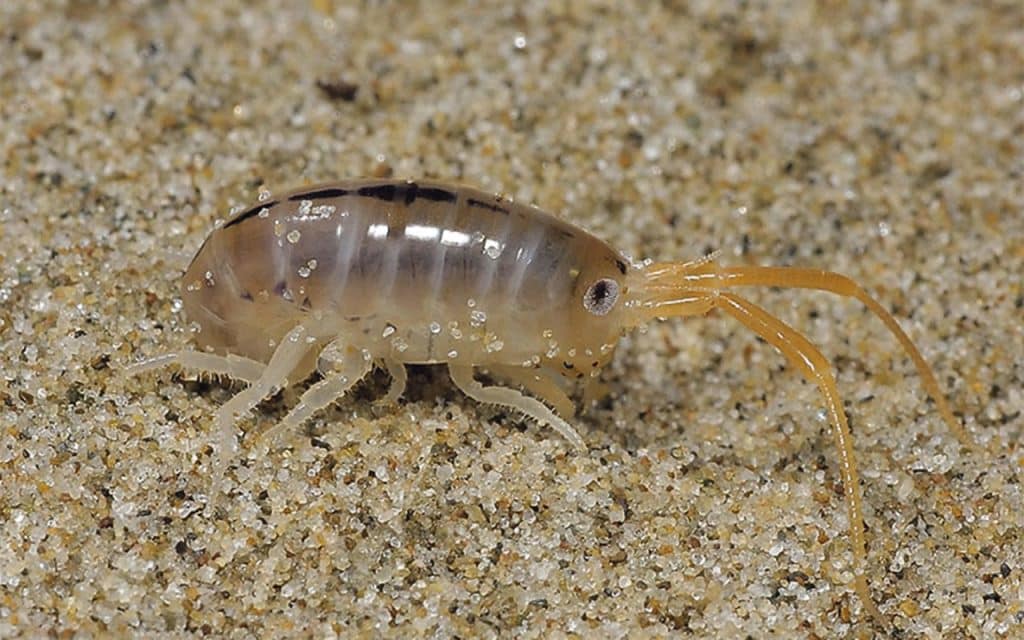
Sandhoppers, Talitrus saltator, are small crustaceans that inhabit sandy beaches. Their ability to return to the damp belt of sand makes them fascinating animals for studying orientation. The sky provides several potential sources of directional information, including the sun and patterns in the light reaching the animal.
Investigating these cues requires careful control over what the animal actually sees. This need brought the University of Florence and the CNR National Institute of Optics together towards the end of the last century. Professor Ugolini was already studying sandhopper orientation and sought the help of optics specialists to develop more rigorously controlled experiments, including a laboratory setup.
For those of us working in optics, the challenge was to translate a biological question into a measurable and reproducible light environment. That meant considering how the source, filters and experimental geometry worked together.
To investigate the developing visual system, we also sought the expertise of Professor Hariyama, whose work includes microscopy and neural recordings from insect eyes. The collaboration allowed us to connect behavioural experiments with observations of the structures involved in detecting light.
Making two halves equally bright
One of the most demanding parts of the experiment was making the amount of light reaching the sandhopper comparable across the two halves of the overhead stimulus.
A polarizing filter changes more than the polarization of light: it also reduces the amount transmitted. Simply placing a polarizer over one half would therefore create a brightness difference between the two sides. This was a serious concern because our earlier work, published in 2009, had already shown that sandhoppers could use a brightness gradient for orientation.
An apparently convincing behavioural response could therefore have been driven by an unintended cue.
We needed to compensate for the polarizer’s attenuation by using neutral-density, or grey, filters on the other half. Finding the most suitable commercially available filter required several evaluations, taking into account the light source and the other filters already present in the setup.
This may sound like a small technical detail, but it was central to the biological question. Before interpreting the animals’ behaviour, we had to establish that the experiment was testing the intended difference in the light environment.
Is a developing eye enough?
Our initial expectation was straightforward: once the visual apparatus had matured sufficiently to detect polarized light, using that information for orientation might be innate.
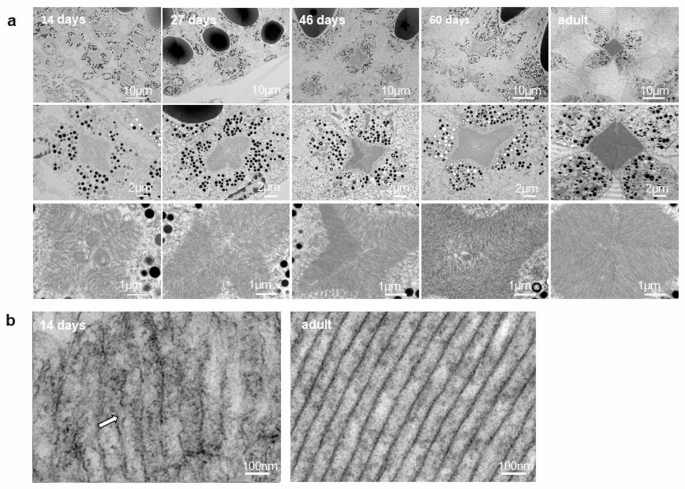
The anatomical observations provided an important part of the picture. In very young sandhoppers, the microvilli—tiny structures within the light-sensitive parts of the eye—were relatively thick and disordered. Their arrangement became more regular with age, suggesting that the capacity to detect polarized light efficiently develops during the first month of life.
But the behavioural results showed that age alone did not explain the response. Adults and field-collected young older than about a month used the polarization gradient for orientation. Laboratory-born young did not show the same directional response, regardless of their age in the groups tested.
The distinction between detecting a visual cue and using it to choose a direction became the central issue. A sufficiently developed sensory apparatus might be necessary, while still leaving a role for experience in learning how to use the information it provides.
From an unexpected observation to the next experiment
Our findings suggest that experience in the natural environment matters when sandhoppers use a polarization gradient for orientation. They do not, by themselves, establish exactly what the animals learn or how that learning takes place.
Testing the learning hypothesis directly is therefore the next step in this research. It means moving beyond the initial comparison between field-collected and laboratory-born animals to investigate how experience changes their subsequent behaviour.
For us, this study also illustrates how research questions can emerge from ordinary experimental circumstances. Working with laboratory-born animals in winter was initially a practical way to continue our experiments. Their unexpected behaviour led us to reconsider an assumption about the connection between sensory maturation and orientation.
Understanding that difference required behavioural biology, microscopy and careful optical measurements. It also required taking an inconvenient result seriously enough to ask a new question.
Follow the Topic
-
Scientific Reports
An open access journal publishing original research from across all areas of the natural sciences, psychology, medicine and engineering.

Related Collections
With Collections, you can get published faster and increase your visibility.
Cancer Prevention and Control
Publishing Model: Hybrid
Deadline: Feb 19, 2027
Healthy Aging
Publishing Model: Open Access
Deadline: Dec 31, 2026