Hunting for worst-case European heatwaves
Published in Earth & Environment and Mathematics
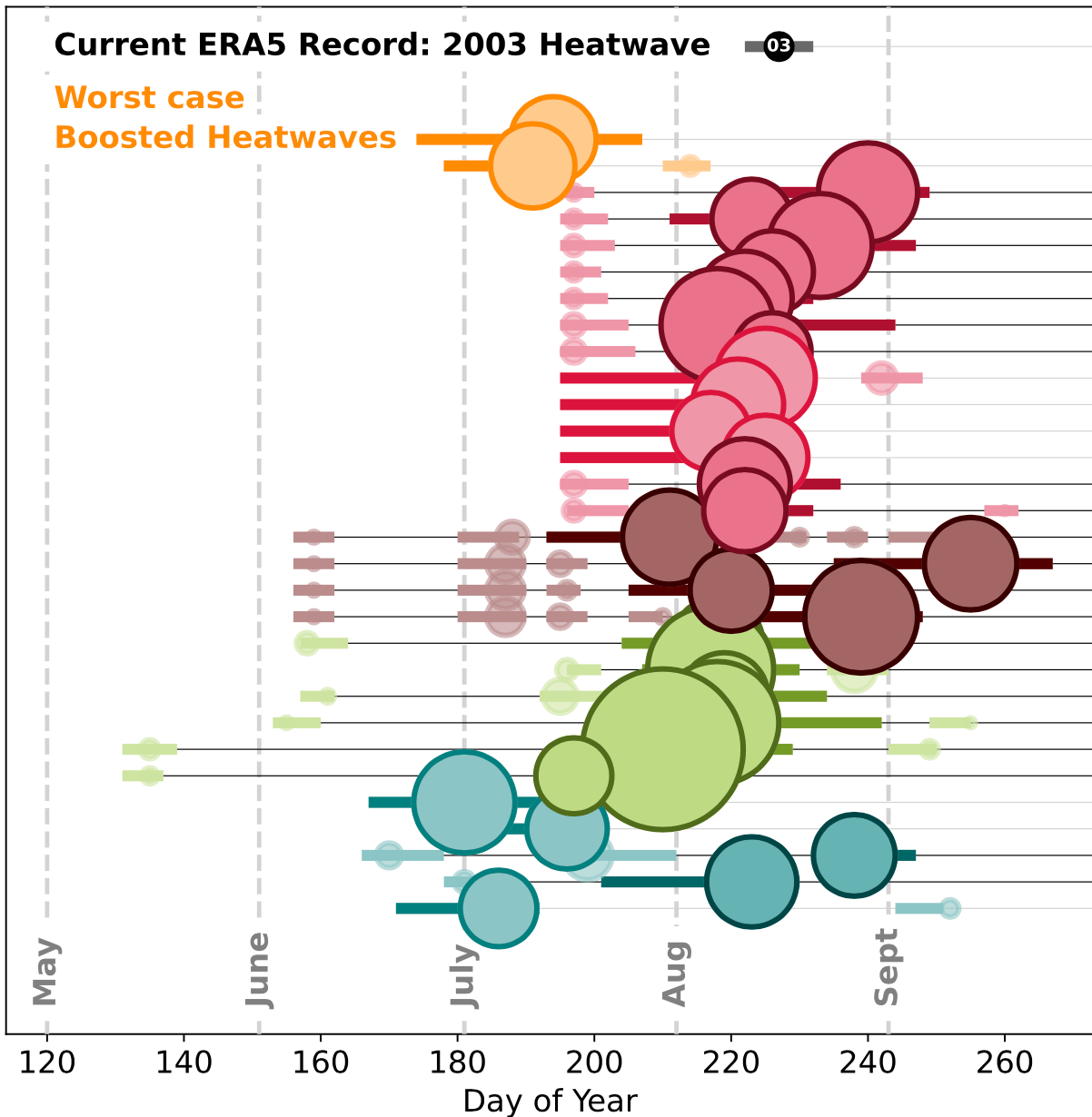



The most extreme heatwaves physically possible already under today's climate could dwarf all events in recent memory. These worst-case heatwaves, emerging from thousands of storyline simulations, are far more intense and persistent than anything Europe has experienced in the historical record. And, strikingly, they show an additional risk: worst-case heatwaves tend to occur successively, after one or more extreme heatwaves earlier in the same summer.
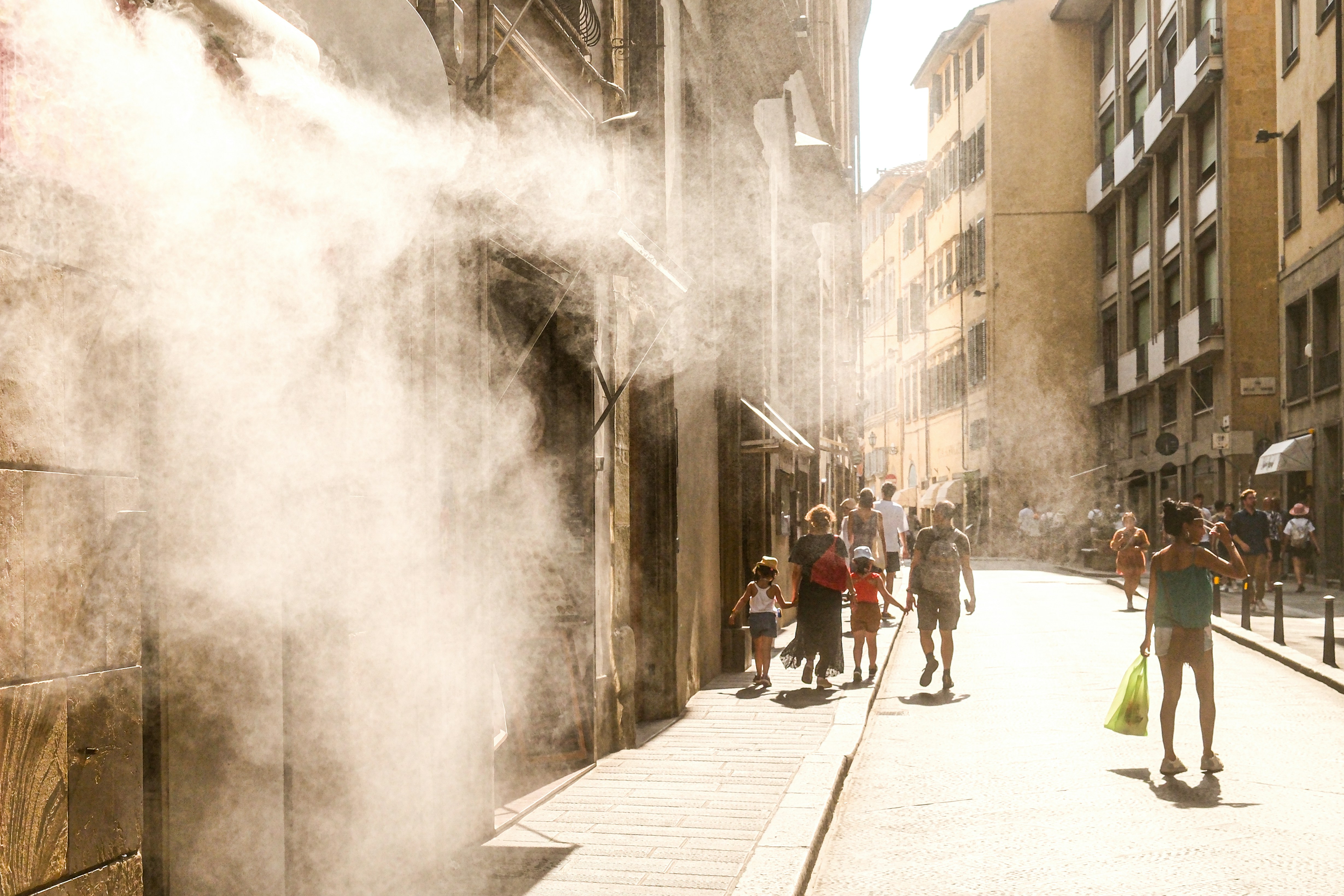
These findings underscore the urgent need for well-informed adaptation strategies that account for these compounding and cascading risks, to sufficiently protect critical infrastructure, ecosystems and vulnerable populations.
Heatwaves that dwarf the worst on the historical record
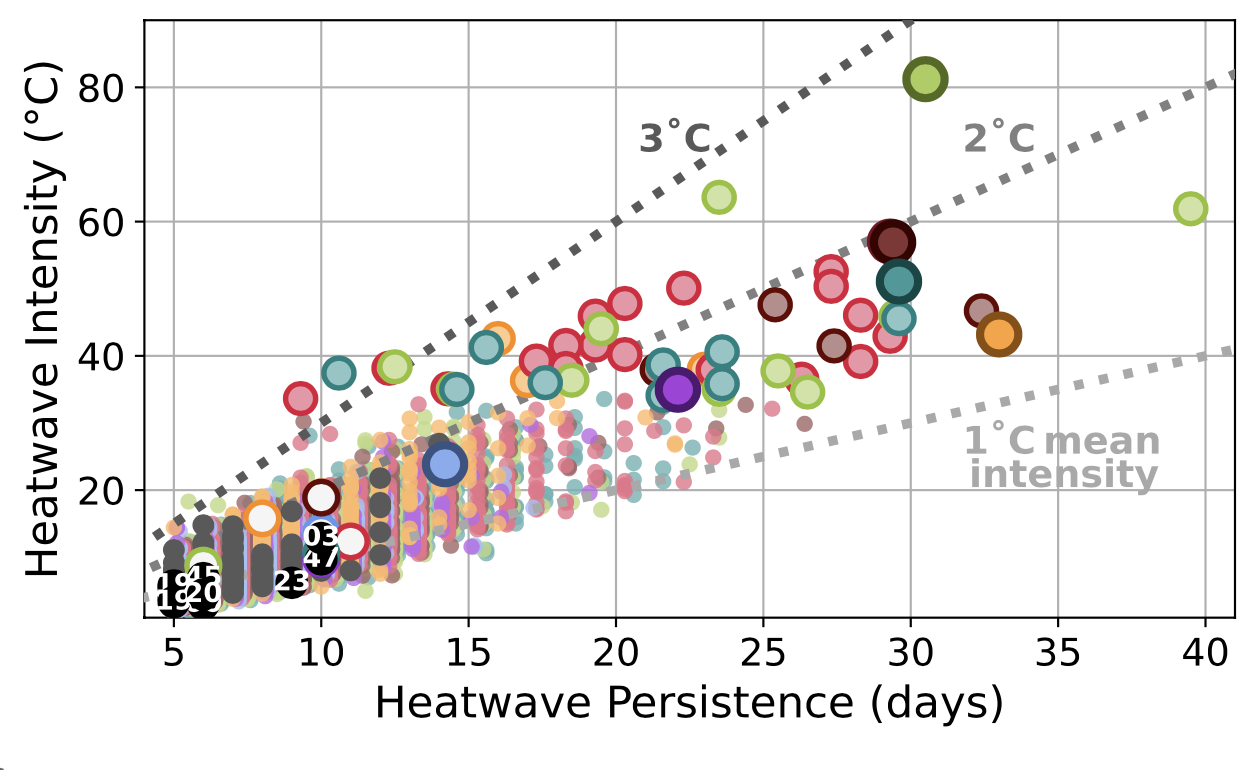
The worst-case simulated heatwaves exceed the 2003 heatwave — which remains the most extreme on record over Central Europe — by more than 50˚C of accumulated excess heatwave intensity, a cumulative measure of how far temperatures exceed extreme thresholds and for how long. Such accumulated intensities are reached by sustaining above-threshold temperatures for weeks at a time, in the most extreme case for almost 40 consecutive days without meaningful respite.
These severe heat conditions do not just exceed the historical record. They also surpass by large margins levels typical of extreme heatwaves in a world 3°C warmer than pre-industrial times, a level of warming that lies decades ahead even under high-emission scenarios. In other words, today's climate is already capable of producing extreme heatwaves not exclusive to a distant much warmer future, and that our societies, ecosystems and infrastructure may not be built to withstand.
Simulating thousands of alternative summer storylines
To explore these worst-case conditions, Suarez-Gutierrez and colleagues at ETH Zürich used a novel modelling technique called ensemble boosting. Starting from a range of simulated summers, or parents, they introduced small butterfly-effect perturbations, producing thousands of alternative summer trajectories, or storylines. The approach generates potentially unprecedented evolutions from the original parent state in a fully-coupled global climate model, meaning the atmosphere, soil and oceans all interact freely as they would in reality. This ensures that the resulting storylines, however extreme, remain physically plausible within a model world under current climate conditions.
The ingredients, and impacts, of worst-case heat
The most severe heatwaves emerge from a complex interplay of factors, yet two stand out as common precursors before worst-case heatwaves start: severe drought, both locally and upstream of the affected region, and exceptionally warm waters in the nearby Atlantic and Mediterranean ocean basins. A preceding heatwave intensifying both conditions adds another layer of concern. By drying out soils and warming nearby oceans, a first heatwave may actively prime the system for even more intense heat to follow. However, the role of it is this active priming effect versus successive heatwaves emerging from exceptional recurring atmospheric conditions through the summer remains an open area of investigation.
Either way, what is clear is that the impacts of successive heatwaves may expand well beyond the sum of their parts. Extreme heat stress striking repeatedly and compounding with other system stressors, such as drought or marine heat stress, can lead to largely amplified societal and environmental impacts. Human and environmental systems are made more vulnerable due to limited recovery windows and prolonged and compound exposure. This can lead to a wide range of impacts and disruptions, from algae blooms and worsened water quality, fish mortality, wildfires and forest dieback, crop yield declines, decreased labour productivity, or heat-related deaths.
Why it matters for preparation and adaptation
Understanding the full range of what is possible, including rare but physically plausible worst-case events, is essential for the stress-testing our systems and infrastructure, and for designing adaptation measures that sufficiently address these complex risks. This study highlights that preparing for extreme heat means preparing for much more than an instance of record-breaking temperatures. Instead, we may need to prepare for unprecedented heat lasting much longer than ever before, or happening repeatedly within one summer, straining emergency response systems and resources. In any case, if adaptation planning stops at preparing for whatever has happened before, we risk being caught unprepared.
Publication:
Suarez-Gutierrez, L., Beyerle, U., Mittermeier, M., Vautard, R. & Fischer, E.M. (2026). Worst-case European heat storylines generated using ensemble boosting. Comms. Earth & Environ. https://doi.org/10.1038/s43247-026-03699-2
More information:
Laura Suarez-Gutierrez, Meteorology and Air Quality group, Wageningen University & Research
laura.suarez@wur.nl