If you are planning to age this might interest you
Published in Physics
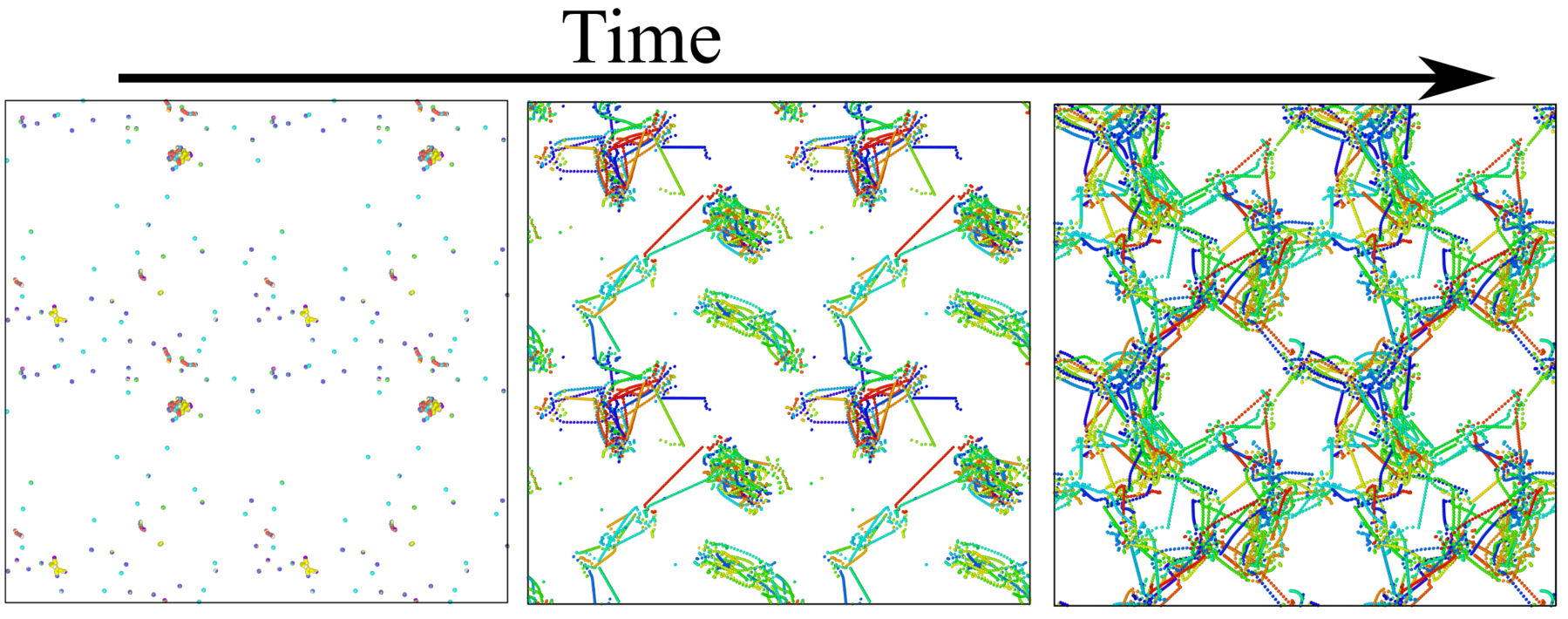

If you can read this, you are ageing, and you will eventually die. Probably you already knew this, but luckily science is working to avoid the side effects of ageing and delay death as late as possible. The problem is that the longer life is the higher the chances of suffering an age-related disease. Particularly, neurodegenerative disorders represent a great challenge in the field. In fact, these pathologies are heavily related to liquid-to-solid transitions of certain biomolecular condensates inside the cell. Hopefully, we have found that RNA may hold the key to inhibit or at least diminish the consequences of these aberrant pathological transitions in protein condensates. But let’s start the story from the beginning.
Most of proteins related to neurodegenerative disorders are well-known for undergoing self-assembly of (at least initially) liquid-like condensates within cells , in the same fashion as oil forms droplets when it’s mixed with water. That’s what I studied in my first internship at the University of Cambridge under the supervision of Dr. J. R. Espinosa.
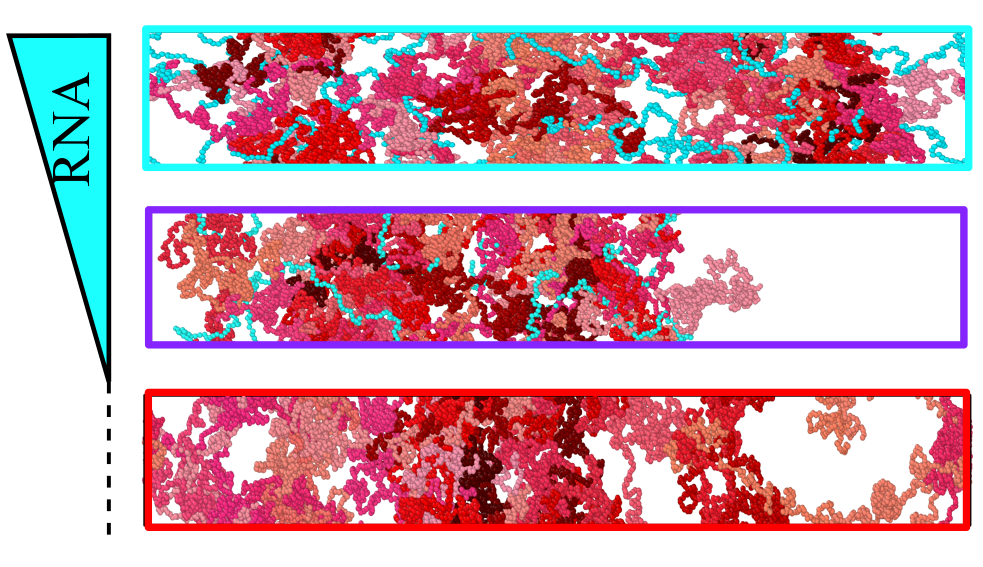
My first project on this topic was carried out in Autumn of 2020 (during the world-wide pandemic), and it consisted in studying the phase behavior of proteins contained in stress granules, the crucible of several neurodegenerative diseases. We employed Molecular Dynamics simulations to explore the phenomenon of how proteins and nucleic acids can phase-separate into liquid-like condensates. Our findings suggested that RNA can enhance phase separation at low concentrations whilst it dissolves protein condensates at high concentrations, so a question was raised straightforwardly: Could we use this mechanism to inhibit condensate ageing?
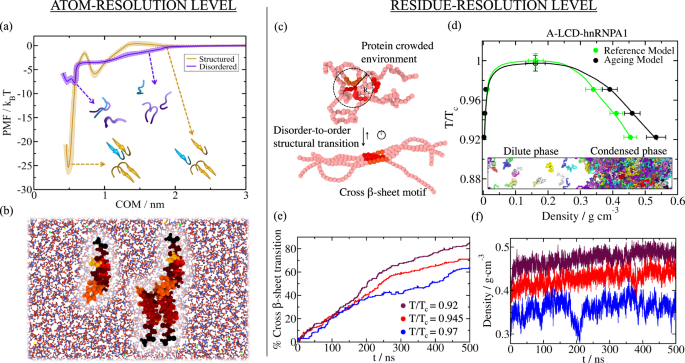
Harmful amyloids triggering condensate dysregulation can be formed when certain domains of naturally occurring phase-separating proteins exhibit a local disorder-to-order transition into structured domains (i.e., kinked β-sheets). Such transitions typically occur when density fluctuations bring together protein regions susceptible of forming kinked β-sheets in close contact, as it occurs in liquid-like protein condensates. Hence, for this reason, RNA self-repulsive interactions may help to control such pathological “gathering”.
We started our project on ageing in April of 2021, in extremely close collaboration with Ignacio Sanchez-Burgos, co-first author of this work, and PhD candidate from the University of Cambridge. By using atomistic simulations in combination with a high-resolution sequence-dependent coarse-grained model, we developed a novel dynamical algorithm that, according to the protein local environment, recapitulates the effect of disorder-to-order structural transitions in full protein sequences by modulating the interaction strength and conformation of the transitioning protein domains.
Importantly, we found that our ageing dynamical algorithm qualitatively reproduced the transformation of protein condensates from displaying liquid-like behavior into pathological gel-like states. The viscoelastic properties of the condensates revealed that gel-like structures are only formed under specific conditions. Nevertheless, it was now our turn to fight back the emergence of such aberrant transitions with RNA. We showed how the number of inter-protein β-sheet transitions critically depends on the concentration of RNA, and that high concentrations of this molecule can prevent ageing of biomolecular condensates.
In that sense, our simulations may provide a possible route map to scientists working on this field to rationalize from a molecular perspective the dysregulation of biomolecular phase-separation driven by local protein structural transitions. Our results may also represent an important breakthrough in understanding the key biological onset of diverse age-related pathologies such as neurodegenerative diseases or even some types of cancer.
Andres R. Tejedor on behalf of the rest of authors.
Follow the Topic
-
Nature Communications
An open access, multidisciplinary journal dedicated to publishing high-quality research in all areas of the biological, health, physical, chemical and Earth sciences.

Related Collections
With Collections, you can get published faster and increase your visibility.
Women's Health
Publishing Model: Hybrid
Deadline: Ongoing
Tumor Microenvironment Crosstalk and Therapeutic Implications
Publishing Model: Hybrid
Deadline: Nov 02, 2026