Integrated effects of dietary supplementation of Spirulina platensis in working dogs: nutritional, biochemical, antioxidant, immunological, gut-related microbial and nutrigenomic insights
Published in Healthcare & Nursing and Genetics & Genomics
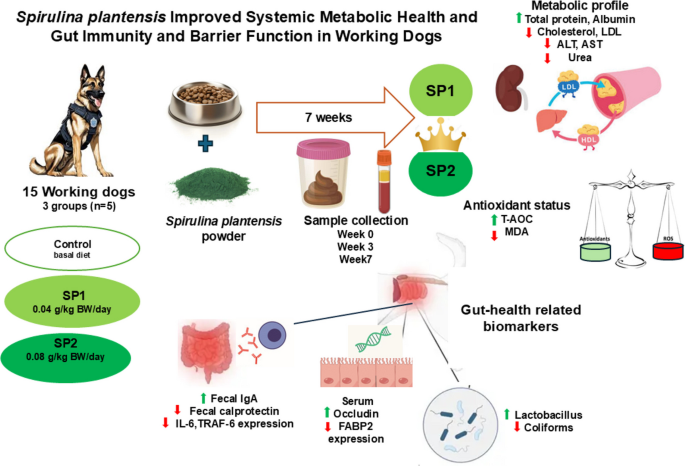

Working dogs, such as those used in search and rescue, law enforcement, military, and competitive sports, face significant physical and mental strain. These animals frequently experience stressful events, environmental stressors (heat, cold, and terrain variability), psychological stress related to task performance and training, and altered feeding and rest patterns, all of which differ substantially from the lifestyle of companion (pet) dogs.
Previous studies have demonstrated that these cumulative stressors are associated with sustained activation of stress-responsive neuroendocrine pathways. Such conditions have been shown to influence the oxidative stress markers, modulation of immune parameters, and alterations in gastrointestinal function and gut microbiota composition. Therefore, working dogs represent a biologically relevant and sensitive model for evaluating the effects of dietary interventions aimed at improving antioxidant defense, immune competence, and gut health, particularly under conditions of elevated physiological stress.
Nutritional approaches that can boost immunological function, increase physiological resilience, enhance performance, and recovery outcomes in these animals are therefore gaining attention. In this context, the use of nutraceuticals has attracted growing interest in canine health management, referring to nutrient-based foods or supplements that exert health-promoting effects beyond their fundamental nutritional roles.
Among these, the blue-green microalga Spirulina (Spirulina plantensis) has emerged as a promising functional ingredient due to its high content of bioactive chemicals. Spirulina platensis is a multicellular, filamentous, and photosynthetic cyanobacterium with a spiral shape. that has been marketed and consumed as a food for humans and animals. Spirulina possesses an exceptional nutritional profile, containing 60–70% high biological value crude protein. It is also rich in vitamins, minerals, essential fatty acids, and antioxidant pigments. These bioactive compounds are linked with broad-spectrum and numerous health benefits, including immunomodulatory, hypolipidemic, antioxidant, anti-inflammatory, hepatoprotective, nephroprotective, anti-viral, and anti-bacterial effects. Owing to these properties, Spirulina has been increasingly incorporated as a nutraceutical feed additive in animal nutrition, with growing interest in its potential to modulate metabolic, immunological, and gut-related molecular pathways under physiologically demanding conditions.
Nutrigenomics is an interdisciplinary field that integrates nutritional science with molecular biology to investigate how specific nutrients modulate gene expression and physiological responses within a given population. Understanding the nutrigenomic effects of nutraceuticals can reveal the mechanisms of their physiological and health-promoting actions, particularly in relation to gut integrity, immune regulation, and inflammatory pathways.
Emerging evidence in canine nutritional physiology indicates that dietary bioactive compounds can influence molecular pathways involved in inflammatory regulation, oxidative balance, and intestinal barrier function, particularly under conditions of increased physiological demand. Working dogs exposed to sustained stress may exhibit alterations in inflammatory signaling mediators and epithelial integrity markers, which are increasingly recognized as nutrigenomically responsive targets.
There are several studies on the incorporation of Spirulina plantensis as a nutraceutical in the diets of both humans and animals for its remarkable effects on general health, immune status, antioxidant activity, lipid profile, and gut immune health. Previous studies have evaluated Spirulina supplementation in dogs across a range of doses (0.04–0.19 g/kg BW/day) and these inclusion levels were reported to be well tolerated and palatable, with no significant adverse effects on gastrointestinal parameters, behavior, or general health status. More recently, Stefanutti et al. showed that Spirulina supplementation in overweight dogs over 12 weeks enhanced antioxidant status and exerted beneficial metabolic effects, including reductions in triglycerides and bilirubin concentrations. Importantly, no negative effects on health or weight management were observed.
Although Spirulina has been widely investigated for its health-promoting effects in various animal species, to date, limited in vivo studies have evaluated the effects of dietary supplementation of Spirulina platensis powder in working dogs. In particular, there is a lack of integrated studies evaluating gut-related nutrigenomic responses, fecal microbiota composition, metabolic as well as inflammatory and immunological biomarkers, and physiological performance. Moreover, dose-dependent responses of Spirulina platensis supplementation in working dogs have not been sufficiently characterized.
Based on this concept, we hypothesized that dietary supplementation of Spirulina platensis would improve the nutritional, biochemical, antioxidant, and immunological parameters in adult working dogs in a dose-dependent manner.
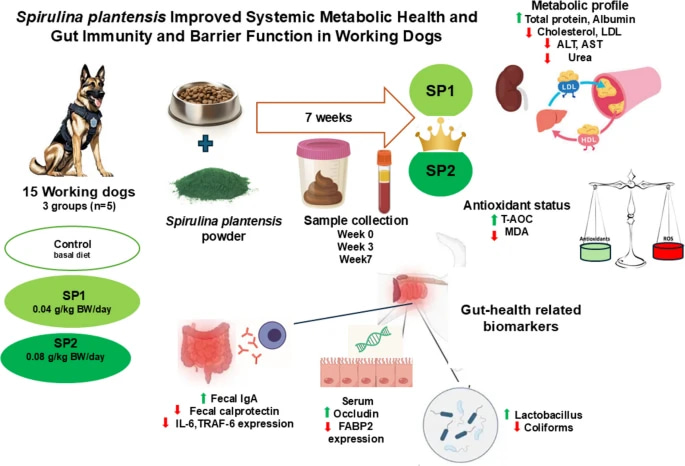
Accordingly, the present study aimed to evaluate and compare the effects of dietary supplementation of Spirulina platensis powder at two inclusion levels for adult working dogs. The objectives of the present study were to assess the potential dose-dependent responses in selected nutritional status parameters and fecal characteristics, protein profile and lipid metabolism, liver and kidney function, antioxidant biomarkers and fecal microbiota composition of adult working dogs. In addition, the study investigated some selected genes related to gut integrity (OCLN, FABP2) and systemic inflammatory and immunological (IL-6, TRAF6) response to determine the potential nutrigenomic impact of Spirulina platensis in dogs.
In the present study, short-term dietary supplementation with Spirulina platensis did not result in statistically significant alterations in nutritional status parameters, including body weight, daily food intake, and BCS or fecal characteristics, including fecal score and fecal moisture. The absence of statistical significance in these parameters should not be interpreted as the absence of a biological effect, particularly given the limited sample size and study duration. Nonetheless, significant modulations were observed in several analyzed biochemical, antioxidant, inflammatory and molecular markers after supplementation with spirulina relative to control groups (all values within the physiological reference ranges). Interestingly, these findings represent functional metabolic and immunological adaptations rather than pathological changes. Dose-dependent trends were particularly evident, where a higher inclusion level typically displayed greater responses in all measured endpoints throughout the 7-week trial.
Serum-based molecular findings, including modulation of OCLN, FABP2, and inflammatory signaling markers, were interpreted as systemic indicators associated with gut integrity and inflammatory balance rather than direct measures of intestinal transcriptional activity. Similarly, observed changes in selected culturable fecal bacterial populations reflect targeted microbial shifts rather than comprehensive microbiota remodeling. Overall, the data suggest that Spirulina platensis supplementation may contribute to systemic metabolic, antioxidant, and immunomodulatory regulation in working dogs. However, given the exploratory nature of the study and the relatively small sample size, these findings should be considered preliminary. Larger, longer-term, and tissue-validated investigations are warranted to confirm these effects and determine their clinical and performance-related relevance.

Follow the Topic
-
BMC Veterinary Research
This journal considers articles on all aspects of veterinary science and medicine, including the epidemiology, diagnosis, prevention and treatment of medical conditions of domestic, companion, farm and wild animals, as well as the biomedical processes that underlie their health.

Related Collections
With Collections, you can get published faster and increase your visibility.
Pollinator health and veterinary medicine
Pollinators, particularly bees, are vital to food production, biodiversity, and ecosystem resilience, yet they are increasingly threatened by a complex interplay of infectious agents, parasites, environmental stressors, and management practices. Diseases such as European foulbrood, Nosema infections, viral syndromes including deformed wing virus, and fungal pathogens, alongside parasitic pressures from Varroa destructor, Tropilaelaps mites, and tracheal mites, represent major challenges to colony health and sustainability. Emerging threats, including invasive species such as the small hive beetle (Aethina tumida) and Vespa velutina, further complicate disease dynamics and apiary management.
Veterinary science plays a central role in the diagnosis, treatment, and prevention of pollinator diseases, integrating parasitology, pathology, epidemiology, and antimicrobial stewardship. Developments in molecular diagnostics, pathogen surveillance, and disease modeling have improved the detection of subclinical infections, antimicrobial resistance, and multifactorial drivers of colony collapse. At the same time, growing attention to pollinator nutrition, queen and brood health, pesticide exposure, and welfare has expanded the scope of honeybee medicine and veterinary involvement in beekeeping practices.
This Collection emphasizes a One Health perspective, recognizing the links between pollinator health, environmental health, and agricultural systems, including shared pathogen pathways, forage landscapes, and chemical exposures affecting livestock, wildlife, and humans. We invite original research articles, reviews, and case-based studies that advance veterinary understanding and management of pollinator health, including, but not limited to, the following topics:
- Veterinary diagnosis and management of pollinator diseases, including bacterial, viral, fungal, and parasitic infections
- Surveillance and epidemiology of pollinator disease outbreaks at apiary, regional, and national scales
- Parasitology of pollinators, including Varroa, Tropilaelaps, acarine mites, and trypanosomatids (Crithidia spp.)
- Honeybee medicine and veterinary practice, including drug efficacy, regulatory considerations, and clinical case reports
- Antimicrobial use, resistance, and alternative control strategies in apiculture
- Effects of pesticide exposure and environmental contaminants on colony, queen, and brood health
- Pollinator nutrition, welfare, and management practices influencing disease susceptibility and resilience
- Comparative pathology and health assessments across managed bees, wild pollinators, and other insects
- Role of pollinator health within One Health frameworks, including links to livestock systems, shared environments, and biosecurity
- Genetic insights into bee breeding and disease diagnostics
All manuscripts submitted to this journal, including those submitted to collections and special issues, are assessed in line with our editorial policies and the journal’s peer-review process. Reviewers and editors are required to declare competing interests and can be excluded from the peer review process if a competing interest exists.
Publishing Model: Open Access
Deadline: Nov 03, 2026
DISCONTOOLS & STAR-IDAZ research gaps for infectious disease control in animals
This collection of narrative reviews discusses key research gaps in the control of infectious diseases in animals, informed by two international initiatives: DISCONTOOLS and the STAR-IDAZ International Research Consortium on Animal Health (IRC).
DISCONTOOLS (DISease CONtrol TOOLS) is the open-access database that identifies gaps in knowledge needing to be addressed to accelerate the development of new diagnostics, vaccines, and pharmaceuticals for over 50 infectious animal diseases. The resource supports evidence-based priority setting by providing structured, expert-reviewed disease information. By guiding investment in research and innovation, DISCONTOOLS delivers wide-ranging benefits - including improved animal health and welfare, enhanced public health, and a safer, more secure food supply. It is widely used by public and private research funders and serves as a key resource for STAR-IDAZ IRC.
The STAR-IDAZ International Research Consortium (IRC) on Animal Health brings together research funders and programme owners on animal health providing a level of coordination to global animal health research activities. Working with expert panels, research roadmaps are developed targeting the most pressing needs in livestock disease prevention and control. The consortium plays an important role in aligning resources and strategies to enhance the efficiency and impact of international animal health research.
This article collection draws on both initiatives to highlight critical gaps, provide scientific rationale through expert working groups, and support the development of innovative infectious disease control tools and strategies.
All manuscripts submitted to this journal, including those submitted to collections and special issues, are assessed in line with our editorial policies and the journal’s peer review process. Reviewers and editors are required to declare competing interests and can be excluded from the peer review process if a competing interest exists.
Publishing Model: Open Access
Deadline: Jun 25, 2027