Inverse Calculation of Cryogenic Convective Heat Transfer Coefficient with Numerical Methods
Published in Mathematics and Mechanical Engineering
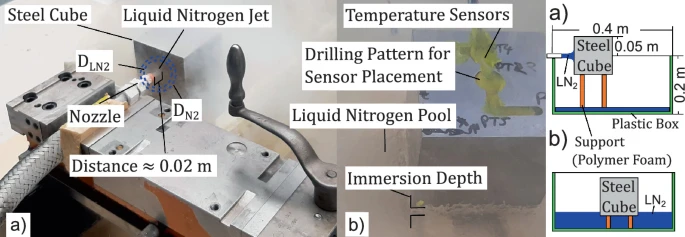


Cryogenic cooling has the potential of a high cooling capacity but is subject to critical variables such as phase changes with high differences in heat transfer coefficients. At normal ambient conditions, liquid nitrogen evaporates so that the convective heat transfer coefficient can vary considerably over a wide range. This is extremely important regarding cryogenic cooling in machining, where the cryogenic coolant is used to reduce the temperature field of the tool to extend the tool’s life and reduce process costs. In the gaseous phase nitrogen has a massively reduced cooling capacity due to many powers of ten reduced heat transfer coefficient compared to the liquid state. Therefore two different cooling processes are experimentally conducted and analysed- jet and immerse cooling. Based on the experimental temperature data a finite difference model was created to fit the experimental and numerical temperature curve to identify the process-specific convective heat transfer coefficient. In this context, the identification and realisation of thermal boundary conditions was particularly challenging because of asymmetric thermal boundary conditions at the experimental tests. Subsequently, the simulation was compared with empirical correlations for verification of the presented method.
DOI:
https://doi.org/10.1007/978-3-031-86893-1_6