JMCR: Clinical Reasoning From Case Reports
Published in Neuroscience and Biomedical Research

Explore the Research
Effects of hypothalamic phospholipid treatment in three patients with neurological disorders: a case series
Introduction
Neurologists frequently encounter patients whose greatest burden stems not from overt motor deficits or seizures but from less easily measured impairments involving cognition, mood, motivation, and overall quality of life. Such symptoms are common across a broad spectrum of neurological diseases and often persist despite otherwise successful management of the primary disorder. The search for adjunctive therapies that might enhance cognitive and affective function therefore remains an area of considerable interest.
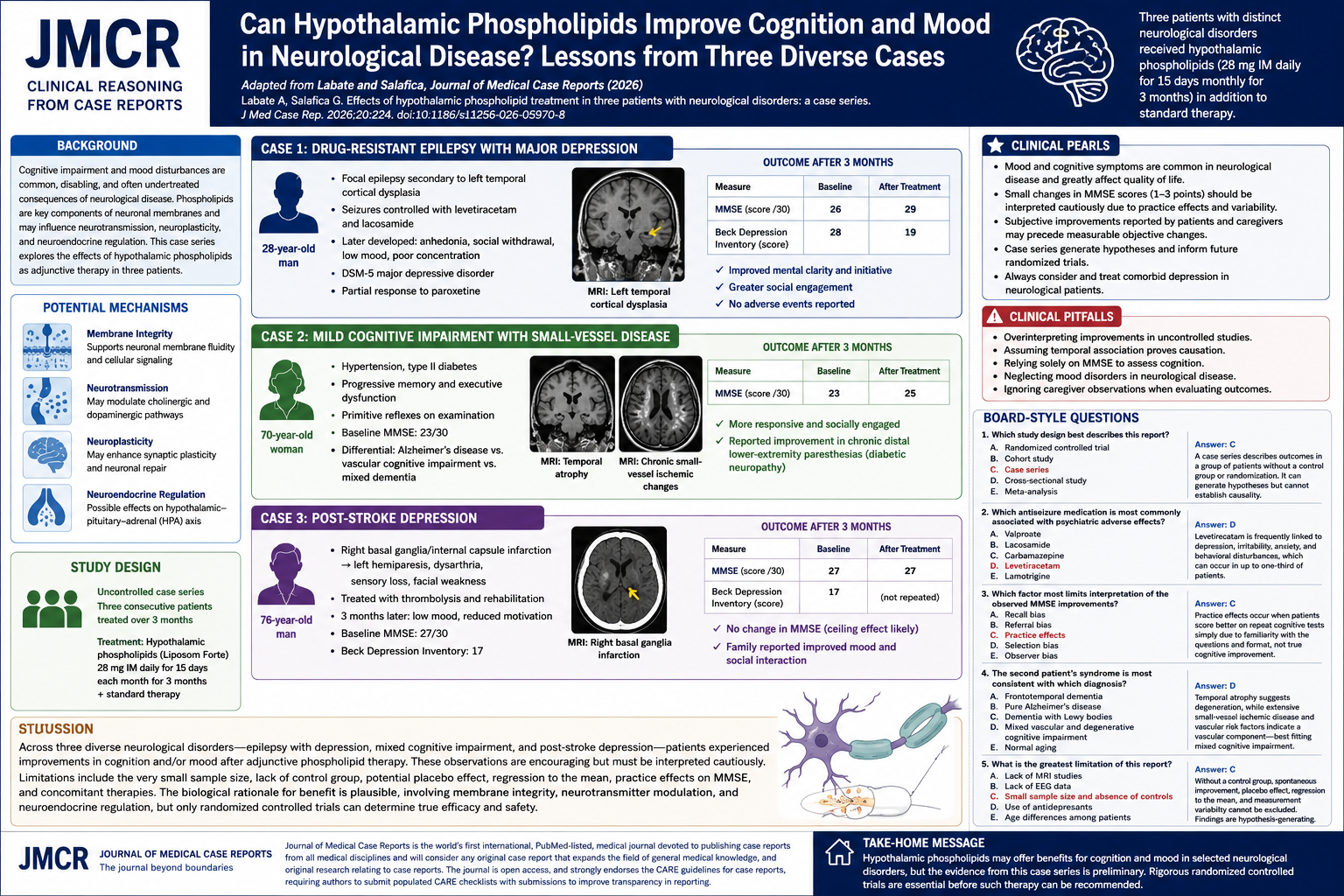
Labate and Salafica described three patients with very different neurological disorders who received intramuscular hypothalamic phospholipids (Liposom Forte) as add-on therapy. The treatment consisted of 28 mg daily for 15 consecutive days each month for three months. Although the cases involved different diseases, all three patients shared symptoms involving cognition, mood, or both. The observations provide an opportunity to explore not only the possible role of phospholipids in neurological disease but also the principles of diagnostic reasoning and the limitations inherent to uncontrolled clinical observations.
Patient 1: Temporal Lobe Epilepsy and Major Depression
The first patient was a 28-year-old man who had developed focal epilepsy at age 20. Brain MRI demonstrated focal cortical dysplasia involving the left temporal lobe. Initially treated with levetiracetam, he subsequently required lacosamide because of continued seizures, after which satisfactory seizure control was achieved. Despite good seizure control, several years later he began experiencing progressive anhedonia, social withdrawal, low mood, reduced initiative, and cognitive complaints characterized by impaired concentration and mental fatigue.
The clinician faced an important diagnostic question. Were these symptoms manifestations of primary depression, consequences of epilepsy itself, or adverse effects of antiseizure medications? Levetiracetam is well known to produce psychiatric side effects, including depression, anxiety, irritability, and behavioral changes. Therefore, medication toxicity represented a reasonable consideration. However, a structured psychiatric evaluation confirmed major depressive disorder according to DSM-5 criteria, and the patient's Beck Depression Inventory score was 28, indicating moderate-to-severe depression.
Paroxetine was initiated and produced only partial improvement. Because cognitive complaints persisted, hypothalamic phospholipids were added while all other medications were maintained. Following treatment, the MMSE improved from 26 to 29, and the Beck Depression Inventory score fell from 28 to 19. The patient reported greater mental clarity, reduced fatigue, improved initiative, and increased social engagement. Family members independently noted a marked improvement in his affect and participation in daily life.
From a clinical reasoning standpoint, the improvement occurring without discontinuation of levetiracetam argues against medication toxicity as the principal cause of his symptoms. Nevertheless, one cannot conclude that phospholipids alone produced the benefit. The observed changes may have reflected synergistic effects with antidepressant therapy, spontaneous improvement, placebo responses, or genuine biological effects on neuronal function.
Patient 2: Mild Cognitive Impairment and Chronic Small-Vessel Disease
The second patient was a 70-year-old woman with hypertension and type II diabetes mellitus who presented with progressive cognitive decline. Neurological examination revealed primitive reflexes suggestive of frontal-subcortical dysfunction. MRI demonstrated mild bilateral temporal atrophy together with diffuse chronic small-vessel ischemic changes involving the periventricular white matter. Baseline MMSE was 23/30.
The differential diagnosis included Alzheimer's disease, vascular cognitive impairment, and mixed dementia. Temporal lobe atrophy supported the possibility of a degenerative process, whereas extensive white matter disease and vascular risk factors strongly suggested vascular cognitive impairment. Because both degenerative and vascular features were present, mixed cognitive impairment represented the most plausible explanation.
After three months of phospholipid therapy, the MMSE improved from 23 to 25. Family members reported greater responsiveness and more active participation in conversations. Interestingly, the patient also described improvement in long-standing distal lower-extremity paresthesias attributed to diabetic neuropathy.
Although intriguing, this unexpected sensory improvement should be interpreted with caution. Single observations are incapable of establishing causation, and spontaneous fluctuations or nonspecific placebo effects remain entirely possible. Nevertheless, such findings may generate hypotheses worthy of future investigation.
Patient 3: Post-Stroke Depression
The third patient was a 76-year-old man who suffered a right basal ganglia and internal capsule infarction resulting in left hemiparesis, dysarthria, sensory loss, and facial weakness. Following thrombolysis and rehabilitation, substantial neurological recovery occurred. Three months later, however, he exhibited reduced motivation and low mood. His MMSE remained normal at 27/30, whereas his Beck Depression Inventory score was 17.
Post-stroke depression represented the most likely diagnosis. Depression is among the most common neuropsychiatric complications following stroke and significantly affects rehabilitation outcomes and quality of life. Progressive dementia was considered less likely because cognitive screening remained within normal limits and the neurological deficits had stabilized.
Following phospholipid therapy, no objective change in MMSE occurred. However, family members reported improved mood and enhanced social interaction. The lack of measurable cognitive improvement may simply reflect a ceiling effect, since baseline MMSE scores were already within the normal range, limiting the ability of the instrument to detect subtle changes.
Discussion
These three cases highlight an important lesson in clinical reasoning: improvement after an intervention does not necessarily prove that the intervention caused the improvement. Human disease is dynamic, and symptoms frequently fluctuate over time. Placebo responses, regression toward the mean, and measurement variability all contribute to apparent clinical changes.
Moreover, repeated administration of cognitive screening instruments such as the MMSE may produce practice effects, whereby patients perform better simply because they have become familiar with the questions. Therefore, small changes in MMSE scores should always be interpreted cautiously.
The biological rationale for phospholipid therapy is plausible. Phospholipids participate in neuronal membrane integrity, neurotransmitter function, synaptic plasticity, and neuroendocrine regulation. Experimental studies have suggested effects on cholinergic and dopaminergic pathways and modulation of the hypothalamic-pituitary-adrenal axis. Nevertheless, plausible mechanisms do not constitute proof of efficacy. Only randomized controlled trials can establish whether the observed benefits represent true therapeutic effects.
Board-Style Questions
Question 1
Which study design best describes the report by Labate and Salafica?
A. Randomized controlled trial
B. Cohort study
C. Case series
D. Cross-sectional study
E. Meta-analysis
Correct answer: C. Case series
Explanation
A case series describes observations in a group of patients without randomization or a control group. The investigators reported outcomes in three patients who received phospholipid therapy but did not compare them with untreated patients or placebo controls. Consequently, causality cannot be established. Although case series occupy a relatively low level within the hierarchy of evidence, they often provide the first clues that stimulate future investigations and randomized trials. Randomized controlled trials, by contrast, are specifically designed to determine whether an intervention truly causes a clinical effect.
Question 2
Which antiseizure medication is most commonly associated with psychiatric adverse effects?
A. Valproate
B. Lacosamide
C. Carbamazepine
D. Levetiracetam
E. Lamotrigine
Correct answer: D. Levetiracetam
Explanation
Levetiracetam is particularly notable for its association with depression, irritability, aggression, anxiety, and behavioral disturbances. These adverse effects may occur in up to one-third of patients. In the first case, clinicians appropriately considered levetiracetam-induced depression in the differential diagnosis. However, because psychiatric symptoms improved while levetiracetam therapy remained unchanged, medication toxicity became less likely. This illustrates the importance of continually reassessing diagnostic hypotheses in light of new clinical information.
Question 3
Which factor most limits interpretation of the observed MMSE improvements?
A. Recall bias
B. Referral bias
C. Practice effects
D. Selection bias
E. Observer bias
Correct answer: C. Practice effects
Explanation
Repeated administration of cognitive screening tests may itself produce improved scores because patients become familiar with the questions and testing format. This phenomenon, known as a practice effect, can create the illusion of cognitive improvement even when no genuine biological change has occurred. Because the MMSE is relatively insensitive to subtle executive dysfunction and because score changes of two or three points may occur because of learning effects or day-to-day variability, small improvements should be interpreted cautiously.
Question 4
The second patient's syndrome is most consistent with which diagnosis?
A. Frontotemporal dementia
B. Pure Alzheimer's disease
C. Dementia with Lewy bodies
D. Mixed vascular and degenerative cognitive impairment
E. Normal aging
Correct answer: D. Mixed vascular and degenerative cognitive impairment
Explanation
The patient's vascular risk factors, MRI evidence of diffuse small-vessel disease, and frontal release signs strongly supported vascular cognitive impairment. However, bilateral temporal lobe atrophy suggested concomitant degenerative pathology. Pure Alzheimer's disease would not fully explain the subcortical findings, while frontotemporal dementia and Lewy body disease lacked characteristic clinical features. Mixed dementia is common in older adults and frequently represents the convergence of neurodegenerative and cerebrovascular mechanisms.
Question 5
What is the greatest limitation of this report?
A. Lack of MRI studies
B. Lack of EEG data
C. Small sample size and absence of controls
D. Use of antidepressants
E. Age differences among patients
Correct answer: C. Small sample size and absence of controls
Explanation
The principal weakness of the study lies in its observational nature. Only three patients were studied, and no placebo or control group was included. Consequently, numerous alternative explanations remain possible, including spontaneous recovery, placebo responses, regression toward the mean, practice effects, and interactions with existing therapies. Although the findings are interesting and biologically plausible, they should be viewed as hypothesis-generating rather than definitive evidence. Randomized controlled trials are necessary before any conclusions regarding efficacy can be drawn.
Clinical Pearls
Mood and cognitive symptoms often represent the greatest source of disability in neurological disease and deserve the same attention as motor or seizure manifestations. Small improvements on cognitive screening tests should always be interpreted in the context of measurement variability and practice effects. Subjective improvements reported by patients and caregivers may provide valuable information but do not establish treatment efficacy. Finally, carefully described case reports and case series frequently serve as the foundation upon which future randomized clinical trials are built.
Take-Home Message
These three cases suggest that hypothalamic phospholipids may exert beneficial effects on cognition, mood, and quality of life in selected neurological disorders. However, because the observations derive from an uncontrolled case series, the findings should be considered exploratory and hypothesis-generating. The report serves as a reminder that temporal association does not prove causation and that biologically plausible therapies must ultimately be tested in rigorous randomized controlled trials before being incorporated into routine neurological practice.
Journal of Medical Case Reports is the world’s first international, PubMed-listed, medical journal devoted to publishing case reports from all medical disciplines and will consider any original case report that expands the field of general medical knowledge, and original research relating to case reports. The journal is open access, and strongly endorses the CARE guidelines for case reports, requiring authors to submit populated CARE checklists with submissions to improve transparency in reporting.

Richard Alan Rison is the interim Editor-in-Chief of Journal of Medical Case reports. He is also an associate neurology editor (editorial board) for BMC Neurology, and the former lead editor for case reports of BMC Research Notes (currently on the editorial board). His scholarly work focuses on medical case reporting, reporting standards, and editorial methodology. Dr. Rison participated in the development and dissemination of the CARE guidelines for clinical case reporting and has authored numerous publications addressing both neurological disorders and the role of case reports in advancing medical knowledge. Dr. Rison practices general neurology and served as the founding medical director of the PIH Health Hospital-Whittier Stroke Program and the PIH Health Hospital-Whittier Non-Invasive Vascular Laboratory, is a clinical assistant professor of neurology at the University of Southern California Keck School of Medicine and Los Angeles County Medical Center, and is a Fellow of the American Academy of Neurology, the American Neurological Association, and the American Association of Neuromuscular and Electrodiagnostic Medicine. Dr Rison is board-certified by the American Board of Psychiatry and Neurology in neurology and vascular neurology, and neurocritical care and neuroimaging by the United Council of Neurologic Subspecialties. He is also board-certified by the American Board of Electrodiagnostic Medicine in electrodiagnostic medicine. Dr. Rison is a former president of the Los Angeles Neurological Society.
Follow the Topic
-
Journal of Medical Case Reports
This journal will consider any original case report that expands the field of general medical knowledge, and original research relating to case reports.


Please sign in or register for FREE
If you are a registered user on Research Communities by Springer Nature, please sign in