Journal Club | Pushing helium into ammonia and water crystals
Published in Chemistry



The chemistry of the noble gases developed slowly. Encouraged by the isolation of xenon tetrafluoride in 1962, after decades of futile efforts to synthesize any compounds at all, noble gas chemistry finally took off. New bonds between xenon and krypton and numerous other elements, such as hydrogen and nitrogen, were reported. With an ionization energy almost twice that of xenon, helium is the most chemically inert element in the periodic table. Doing chemistry with this element is hence as hard as it gets. Only in 2005 was the first stable, solid helium compound, FHeO-, predicted. Subsequently, computations confirmed simple helium compounds such as He(N2)11 to be stable solids under high pressure.
In a recent Communications Chemistry article, Dadong Yan, Hai-Qing Lin, Mao-Sheng Miao, and co-authors apply particle swarm optimizations to predict substantially more complex helium compounds.
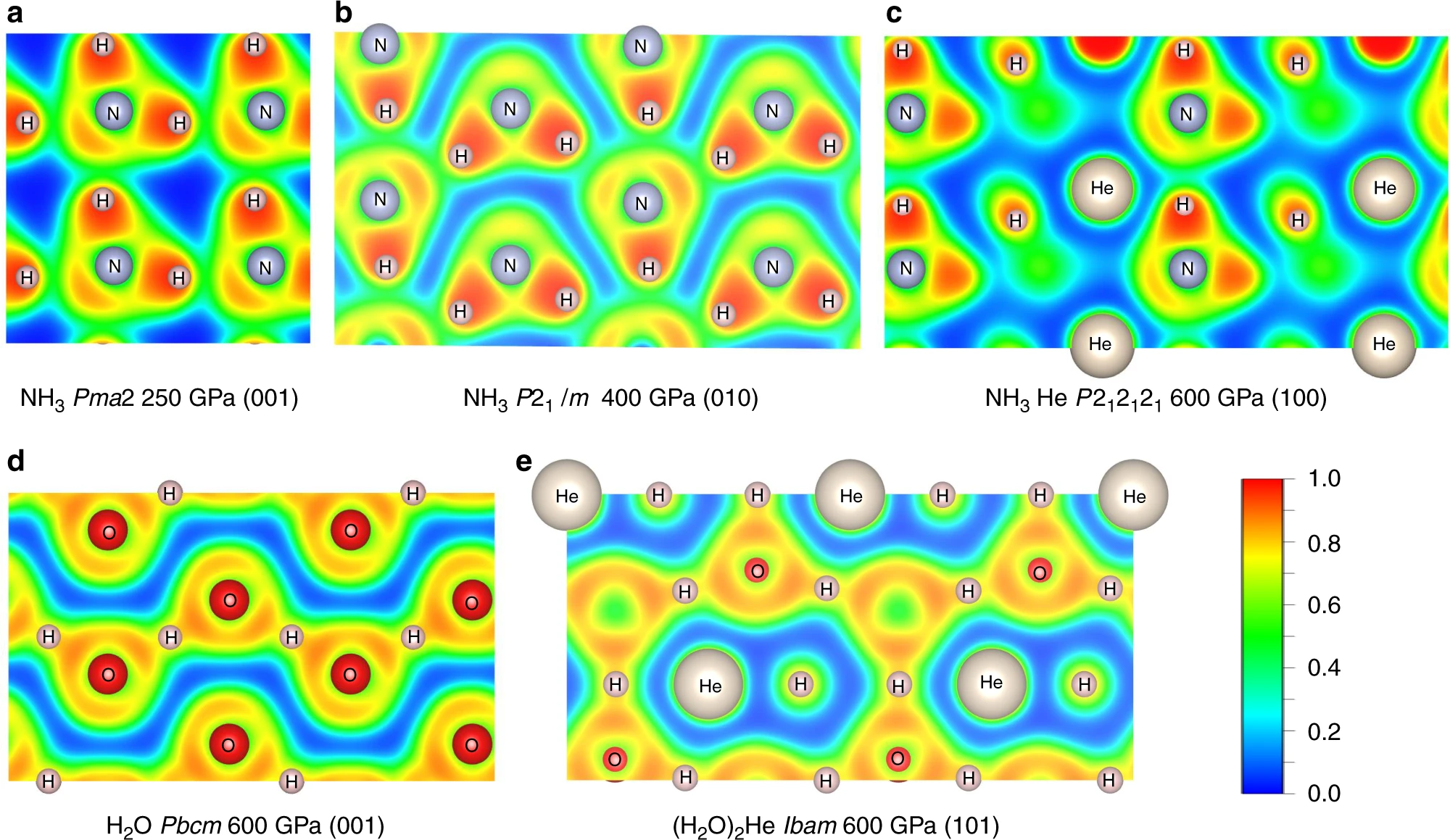
Electron localisation functions show that ammonia and helium can form thermodynamically stable complexes above 45 GPa — a pressure that can be experimentally generated by powerful high-explosives. Molecular water crystals and helium can form such complexes above 300 GPa, comparable to the pressure at the Earth’s inner core. Yet, the group finds hardly any electron density in the regions between the helium atoms and the water or ammonia molecules, indicating that helium does not form any bonds. The helium insertion does, however, result in a band gap change, simply by pushing neighboring water or ammonia molecules further apart.
Both water and ammonia are non-linear, polar molecules with unequal numbers of positively and negatively charged atoms. These features induce changes in the electrostatic interactions, which are driving the helium insertion under pressure. Particularly, the group finds that with ammonia, the insertion of helium leads to a rearrangement of the ammonia molecules and reorientation of their dipoles. The corresponding gain in the electrostatic energy (Madelung energy) and the compression work term ΔPV are the major driving forces for the formation of NH3He. Looking at the insertion of He in ice, the governing pressure needs to be high enough to ionize the water molecules. The insertion mechanism of He into ice to form (H2O)2He is hence similar to an insertion of He in an A2B ionic crystal like Na2O.
Even though the conditions under which these predictions work are extreme, they are not unrealistic. The generated insight helps in exploring planetary evolution and dynamics - which is inherently hard to probe, so smart models are crucial. Helium, ammonia and ice are among the major components of giant gas planets, and hence central subjects to study.

Follow the Topic
-
Communications Chemistry
An open access journal from Nature Portfolio publishing high-quality research, reviews and commentary in all areas of the chemical sciences.

Related Collections
With Collections, you can get published faster and increase your visibility.
Chemical modification of proteins
Publishing Model: Open Access
Deadline: Sep 30, 2026
Peptide drug design
Publishing Model: Hybrid
Deadline: Jan 28, 2027



Please sign in or register for FREE
If you are a registered user on Research Communities by Springer Nature, please sign in