Learning Healthcare Organizations: Why Improvement Must Become a System Capability
Published in Healthcare & Nursing, Public Health, and Arts & Humanities

Explore the Research
lyag022?utm_campaign=related_content&utm_source=HEALTH&utm_medium=communities
Healthcare organizations continuously implement improvement initiatives. New protocols are introduced, accreditation standards are adopted, digital technologies are incorporated, and multidisciplinary teams receive ongoing training.
Yet one observation remains remarkably consistent across healthcare systems.
Some hospitals improve continuously.
Others repeatedly solve the same problems.
This raises an important question:
What distinguishes organizations that learn from those that simply react?
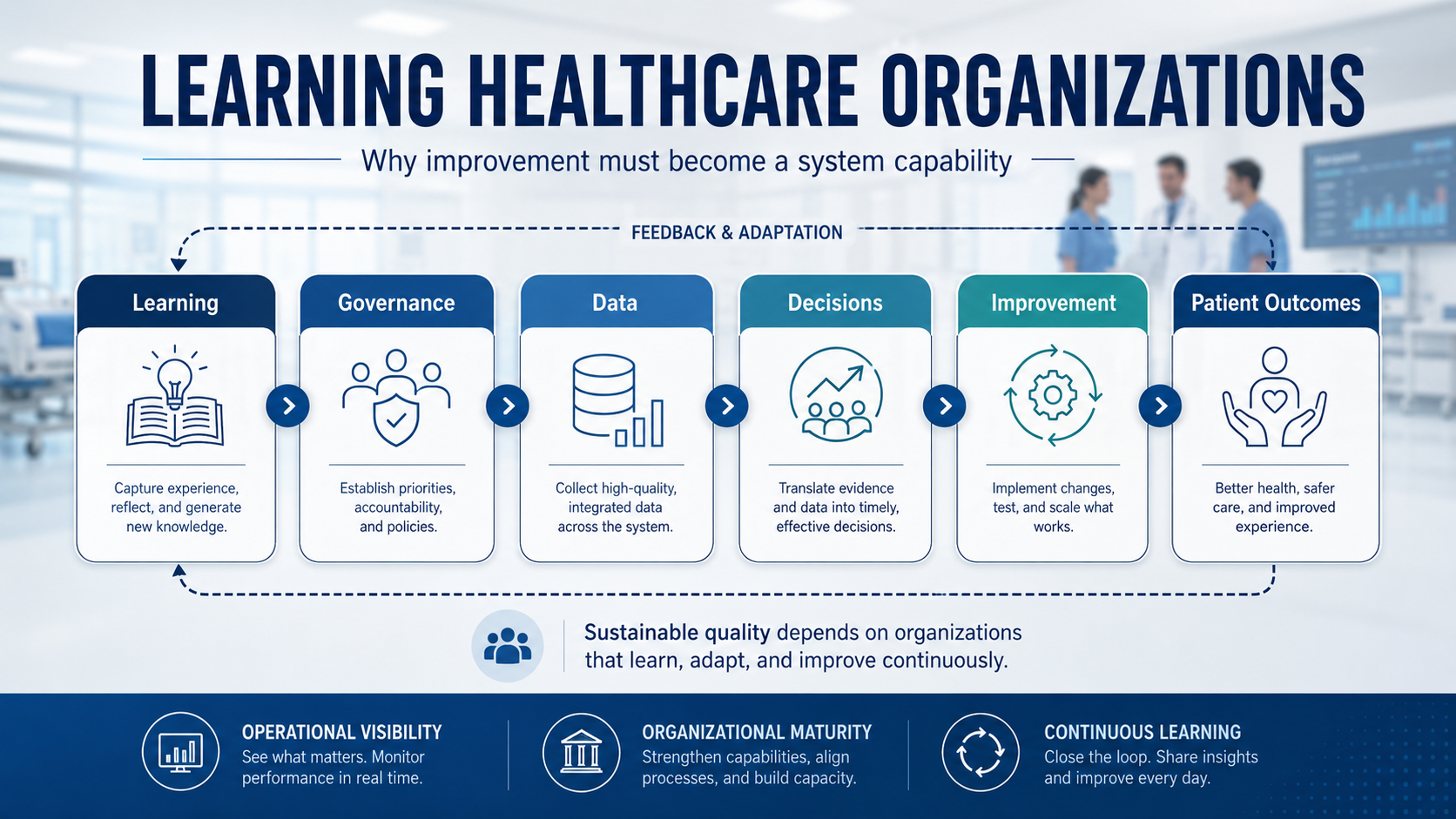
Recent discussions on Learning Health Systems suggest that sustainable improvement depends on more than isolated quality projects. It requires organizations capable of systematically generating knowledge, integrating evidence into practice, evaluating outcomes, and continuously adapting their operations.
In other words, improvement itself must become an organizational capability.
This perspective closely aligns with my recent research on organizational maturity and healthcare governance.
In our longitudinal study, Organizational Maturity as a Tool for Quality Governance: A Longitudinal Study in a Brazilian Hospital, we observed progressive improvements in governance structures, organizational coordination, and quality-related domains over four years. Rather than reflecting the impact of a single intervention, these findings suggested that organizations develop capabilities that enable continuous improvement over time.
Organizational maturity, therefore, should not be understood simply as a measurement tool.
It represents an organization's ability to learn.
- To coordinate.
- To standardize.
- To adapt.
- To improve consistently.
This concept became even more evident during another quality improvement initiative involving visual management of nursing schedules and workforce balancing.
Instead of increasing staffing levels, the intervention focused on improving operational visibility. By integrating staffing data, absenteeism, hospital occupancy, and overtime monitoring into a unified management system, leaders were able to identify workforce imbalances earlier and make faster operational decisions.
The result was a substantial reduction in overtime events and associated costs, achieved primarily through better coordination of existing resources rather than workforce expansion.
These experiences reinforce an important principle.
Healthcare transformation rarely occurs because organizations implement isolated solutions.
It occurs because organizations become better at learning from their own operations.
Learning organizations create governance structures that facilitate decision-making.
- They generate reliable operational data.
- They encourage multidisciplinary collaboration.
- They transform information into organizational knowledge.
Most importantly, they continuously refine their systems instead of repeatedly correcting the same failures.
As healthcare systems become increasingly complex, organizational learning may become one of the most valuable strategic capabilities hospitals can develop.
Quality is not simply the product of better protocols.
It is the product of organizations capable of learning faster than the challenges they face.
Perhaps this is the next stage of healthcare quality improvement—not implementing more projects, but building organizations that continuously improve themselves.
Related research
Rodrigues Filho RND, Morais LG. Organizational Maturity as a Tool for Quality Governance: A Longitudinal Study in a Brazilian Hospital. International Journal for Quality in Health Care Communications. 2026. DOI: 10.1093/ijcoms/lyag022
Rodrigues Filho RND et al. Visual Management of Nursing Schedules for Workforce Balancing and Reduction of Overtime Coverage: A Longitudinal Quality Improvement Study. Research Square. DOI: 10.21203/rs.3.rs-10121229/v1

Follow the Topic
-
BMC Global and Public Health
An open access, transparent peer review journal publishing outstanding and influential research and opinion of broad interest to all professional communities involved in global and public health research, policy-making, implementation and delivery worldwide.
-
Nature Communications
An open access, multidisciplinary journal dedicated to publishing high-quality research in all areas of the biological, health, physical, chemical and Earth sciences.
-
BMC Nursing
This is an open access, peer-reviewed journal that considers articles on all aspects of evidence-based nursing care; nursing research methods; nursing service delivery, utilization, and evaluation; nursing administration and human resources.
-
Journal of Health Service Psychology
Related Collections
With Collections, you can get published faster and increase your visibility.
Nursing and midwifery
BMC Nursing is calling for submissions to its Collection, Nursing and Midwifery. Nursing and midwifery are critical components of healthcare systems worldwide, playing an essential role in promoting health, preventing disease, and providing care across diverse populations. This Collection aims to highlight the latest research and advancements in these fields, focusing on the practices, challenges, and innovations that shape the experiences of nurses and midwives. By fostering collaboration and knowledge sharing, we hope to elevate the discourse surrounding nursing and midwifery, ensuring that these professions continue to evolve and adapt to the changing landscape of healthcare.
Research in nursing and midwifery is vital for improving patient outcomes and enhancing the quality of care provided to people and families. Recent advances have included the integration of evidence-based practices, the development of specialized roles, and the incorporation of technology into patient care. These efforts have demonstrated significant improvements in areas such as prenatal and neonatal care, patient education, and the empowerment of people in childbirth. Understanding these advancements helps to inform future training and policy decisions that can further enhance the effectiveness of nursing and midwifery practices.
As this research continues to evolve, we may witness innovative approaches that further integrate nursing and midwifery into interdisciplinary healthcare teams. Future studies may uncover effective models for collaborative care, improved birth plans, and enhanced patient engagement strategies. Additionally, ongoing research could lead to the development of new educational frameworks that prepare nurses and midwives to meet the complex needs of patients in an increasingly diverse and globalized world.
Topics of interest include, but are not limited to:
- Innovations in prenatal care
- Best practices in neonatal care
- The contribution of midwives to reproductive health education
- The impact of telehealth on nursing and midwifery practices
- Cultural competency in nursing and midwifery
- Evidence-based interventions for postpartum care
- The role of nurses and midwives in addressing health disparities
- The integration of technology in patient care, education and empowerment
- Innovative midwifery service models
- Community and public health nursing and midwifery
All manuscripts submitted to this journal, including those submitted to collections and special issues, are assessed in line with our editorial policies and the journal’s peer review process. Reviewers and editors are required to declare competing interests and can be excluded from the peer review process if a competing interest exists.
Publishing Model: Open Access
Deadline: Feb 08, 2027
Person-centered care in nursing 2026
BMC Nursing is calling for submissions to its Collection, Person-centered care in nursing 2026. Person-centered care (PCC), often embraced as part of the culture change movement, describes a shift from staff-centric task-based and disease-centered care to a focus on the individual. This philosophy is characterized by health care professionals’ (such as nurses’) knowledge of the individual with various care needs and a close and trusting relationship between care professionals and recipients. Furthermore, this integrates a clinical perspective with a broader understanding that recognizes the unique experiences of each person with various care needs. Particular attention is required for populations such as older adults in long-term and home-care settings and individuals with complex, multi-morbid conditions, where coordinating person-centered, inter-professional care is critical. In recent years, PCC has gained traction as a “gold standard” in nursing and healthcare, fostering improved communication between individuals with various care needs and healthcare professionals, enhancing the quality of nursing, and promoting better health outcomes. The integration of the perspectives of individuals with various care needs and their loved ones into care planning and decision-making is vital for the successful implementation of PCC.
Advancements in technology (e.g., artificial intelligence) seems to provide promising contributions to the evolution of person-centered care, allowing for greater autonomy and empowerment of individuals with various care needs and involvement in their own care. Research has shown that when people with various care needs are actively engaged in their care, they are more satisfied with it. Moreover, the emphasis on gender and ethnic competence and health equity within PCC frameworks highlights the need for nurses to tailor care interventions to diverse populations, ensuring that all individuals receive equitable treatment that respects their unique backgrounds.
As research in PCC continues to evolve, new methodologies and frameworks are anticipated to further empower individuals with diverse care needs and their loved ones in their care. Future advancements may include innovative digital tools that enhance care communication, more comprehensive approaches to informed consent, and strategies to ensure that care delivery is equitable and gender- and culturally sensitive. Such developments will likely transform how nurses engage with individuals receiving care, ultimately leading to improved health outcomes and a more inclusive healthcare system.
We call for studies contributing to the investigation of topics relating to person-centered care, including but not limited to:
- Empowerment strategies through PCC for individuals with diverse care needs
- Development of innovative PCC interventions and their implementation
- Enhancing health equity through PCC
- Gender and cultural competence in PCC
- PCC approaches in aged-care and long-term residential facilities
- PCC models for dementia, frailty and multimorbidity
- Coordination of complex care across settings (acute, community, home)
- Technology-enabled PCC for older and complex-care populations (e.g., remote monitoring, AI-supported care planning)
- Innovative PCC outcomes
All manuscripts submitted to this journal, including those submitted to collections and special issues, are assessed in line with our editorial policies and the journal’s peer-review process. Reviewers and editors are required to declare competing interests and can be excluded from the peer review process if a competing interest exists.
Publishing Model: Open Access
Deadline: Jan 15, 2027
Please sign in or register for FREE
If you are a registered user on Research Communities by Springer Nature, please sign in