Lifestyle Medicine Is No Longer Optional in the Era of 3PM
Published in Social Sciences and Public Health

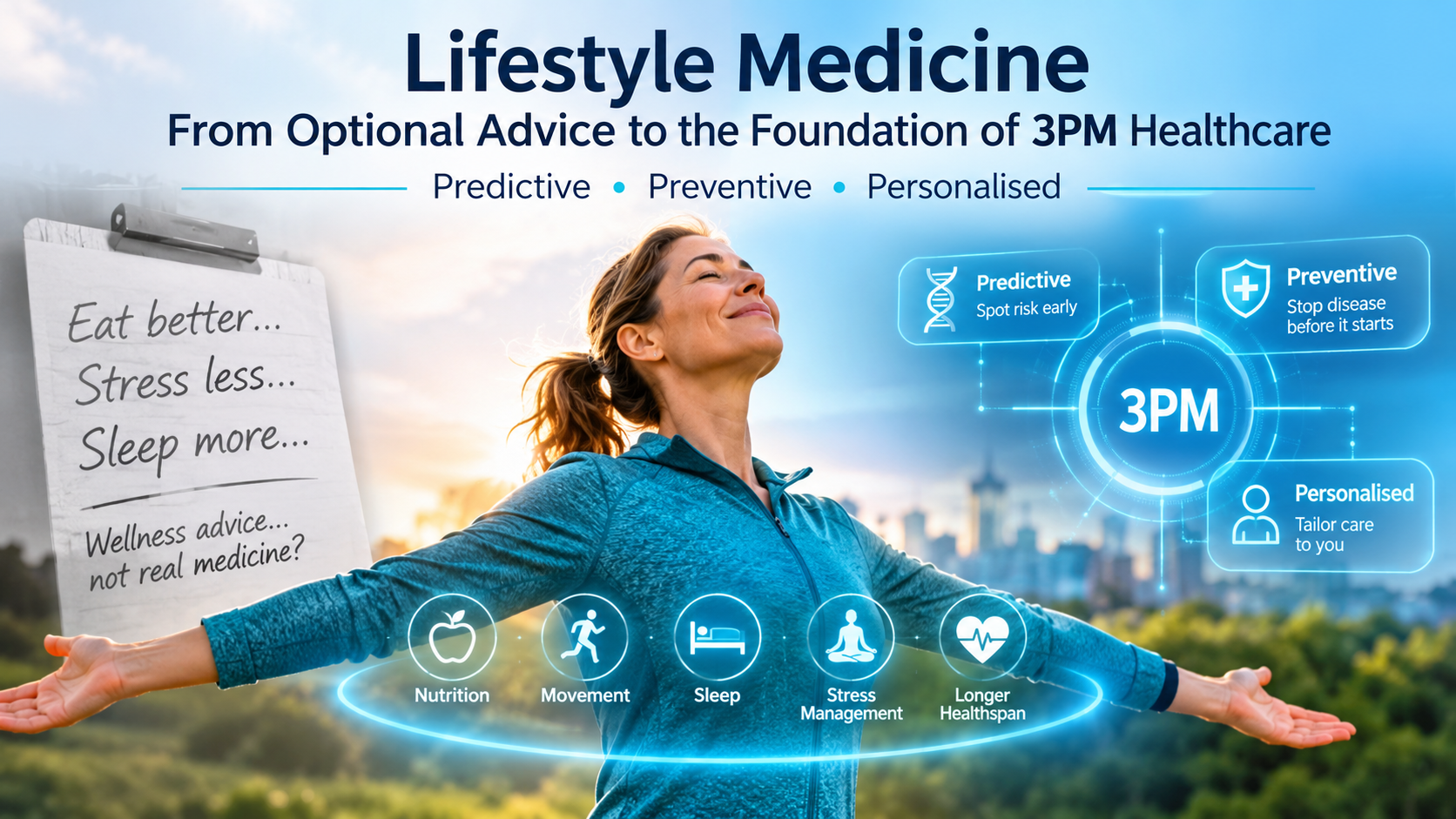

As healthcare undergoes a massive paradigm shift toward Predictive, Preventive, and Personalised Medicine (3PM), Lifestyle Medicine has transformed. It has matured from well-meaning advice into a scientifically grounded, clinically actionable, and technologically enabled discipline.
Within the framework of 3PM, Lifestyle Medicine isn't just an addition to the system, it is the very foundation.
1. The 3PM Framework Meets Lifestyle Science
Predictive, Preventive, and Personalised Medicine promises to move us away from reactive "sick care" and toward proactive health span optimisation. But algorithms and advanced diagnostics can only take us so far if we don't have actionable levers to pull.
That’s where Lifestyle Medicine steps in as the primary operational tool for 3PM:
- Predictive: Biomarkers, genomic sequencing, continuous glucose monitors (CGMs), epigenetic clocks, methylation capacity and inflammaging measurements allow us to detect metabolic dysfunction long before clinical symptoms appear.
- Preventive: Instead of waiting for a diagnosis to initiate therapy, targeted lifestyle interventions (nutrition, movement, circadian alignment, restorative sleep, self-care) modify disease trajectories decades in advance.
- Personalised: Micro-data allows us to tailor interventions to the individual. We no longer prescribe a generic "healthy diet"; we prescribe specific macro- and micro-nutrient profiles based on microbiota dynamics, metabolic flexibility, and genetic predispositions.
2. From "Advice" to Precision Interventions
The misconception that lifestyle interventions lack rigor is being dismantled by modern systems biology. We now understand the precise molecular pathways through which lifestyle habits alter gene expression and cellular function:
- Epigenetics: Sleep deprivation and chronic psychological stress directly alter DNA methylation patterns, accelerating biological aging.
- Metabolic Health: Targeted exercise protocols reverse insulin resistance at the cellular level by optimising mitochondrial function.
- Gut Microbiome Science: Targeted dietary fiber and polyphenol protocols modulate the gut-brain axis, reducing systemic inflammation, the core driver of cardiovascular disease, neurodegeneration, and type 2 diabetes.
Lifestyle interventions are no longer "soft science." They are metabolic and epigenetic interventions with predictable, measurable doses and outcomes.
3. Technology: The Great Accelerator
Why now? Why is Lifestyle Medicine finally taking center stage?
The answer is technological enablement.
Historically, doctors couldn't track whether a patient followed lifestyle recommendations, nor could they measure the real-time impact. Today, the convergence of consumer health tech and clinical data has changed everything:
- Wearables & Biometrics: Continuous monitoring of heart rate variability (HRV), sleep architecture, and glucose dynamics provides continuous feedback loops.
- AI & Digital Therapeutics: AI-driven platforms can analyse millions of data points to deliver real-time, hyper-personalised behavioral nudges.
- Remote Patient Monitoring: Health professionals can now monitor lifestyle interventions with the same precision as pharmaceutical drug levels.
Technology has turned daily habits into quantifiable, trackable, and scalable clinical data.
THE OPPORTUNITY
The Shared Upstream Drivers: Reimagining Chronic Disease Causation
One of the most compelling aspects of modern Lifestyle Medicine within 3PM lies in how it completely reshapes our understanding of the cause of chronic disease. Rather than focusing on downstream disease labels, such as Type 2 diabetes, cardiovascular disease, or neurodegeneration, the focus shifts to the shared, upstream mechanisms that quietly drive multiple conditions simultaneously.
Chronic low-grade inflammation, hormonal dysregulation, mitochondrial inefficiency, vascular dysfunction, and epigenetic instability are not isolated problems. They are deeply interconnected biological processes. When one system degrades, it creates a cascade that impacts the others. The message is simple yet profound: chronic disease is rarely singular, and almost never sudden.
A defining feature of this paradigm is its embrace of early and subtle dysfunction, specifically states that fall well below conventional diagnostic thresholds. For years, these suboptimal health states (such as mild insulin resistance, disrupted heart rate variability, or elevated hs-CRP that is still deemed "normal") have been routinely dismissed or normalised in standard care.
Within the 3PM framework, these subtle shifts are reframed as critical windows of opportunity. They represent the precise moment for intervention, when biological systems are still resilient, adaptable, and reversible change is most achievable.
By treating the shared root drivers through precision lifestyle interventions rather than waiting to manage named diseases, we shift healthcare from reactive damage control to proactive biological optimisation.
References
Khan, M., Grech, G., Boyko, N. (2026). Dysbiosis Testing and Chronic Intestinal Inflammation. In: Grech, G. (eds) The Impact of Lifestyle Medicine on Chronic Disease Prevention, Reversal and Management. Advances in Predictive, Preventive and Personalised Medicine, vol 19. Springer, Cham. https://doi.org/10.1007/978-3-032-32838-0_15
Grech, G. (2026). Wearables for Predictive, Preventive, and Personalized Medicine. In: Grech, G. (eds) The Impact of Lifestyle Medicine on Chronic Disease Prevention, Reversal and Management. Advances in Predictive, Preventive and Personalised Medicine, vol 19. Springer, Cham. https://doi.org/10.1007/978-3-032-32838-0_14