Light-switchable Enzyme-mimetic Organocatalysis in water via Supramolecular Assembly



Sophisticated functions from simple molecules – Light, water and a simple question
When we started this project, we were driven by a simple question: Can we build an artificial catalyst that behaves a little like an enzyme, works in water, and whose activity can be controlled by shining light?
Picture perfect. Nature has perfected chemistry over billions of years. Enzymes carry out extraordinarily complex reactions with remarkable speed and selectivity, yet they are rarely active all the time. Instead, their activity is precisely regulated by environmental cues such as light, temperature, pressure. Plants provide a beautiful example, using light not only for photosynthesis but also to control growth, flowering and many other biological processes. Inspired by these natural systems, we wondered whether enzyme-like regulation and light responsiveness could be combined in a simple artificial catalyst operating in water (the natural medium of life).
Doing more with less. This project began with both ambition and practical limitations. We wanted to design an enzyme-inspired molecular architecture without relying on highly elaborate synthetic targets or sophisticated laboratory infrastructure that is beyond our reach – we simply don’t have it or cannot have an access. Instead, we challenged ourselves to ask a slightly different question: Could relatively simple molecules, if designed carefully, organize themselves into something much more sophisticated? This idea led us to supramolecular chemistry, where the collective behavior of molecules often exceeds the capabilities of the individual building blocks.
A simple molecular design. Our design was intentionally straightforward. We combined an imidazole unit, chosen for its well-known catalytic role in many natural enzymes, with an azobenzene unit, one of chemistry's most reliable molecular photoswitches. The resulting molecule, which we named Azo-Imd, was expected to respond to light while retaining catalytic activity. At first, it appeared to be a relatively simple molecule. However, its most interesting behavior only emerged once it was placed in water.
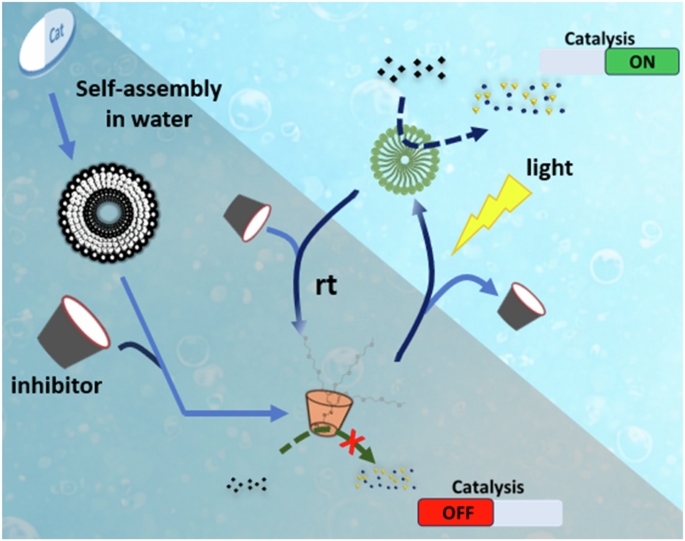
When self-assembly took over. What we did not fully appreciate at the beginning was how Azo-Imd would reorganize itself in an aqueous environment. Instead of remaining as individual molecules, it spontaneously assembled into microscopic vesicles. Upon light irradiation, the azobenzene units underwent trans → cis photoisomerization, triggering a complete transformation of the supramolecular structure from vesicles → micelles.
This was one of the most exciting moments of the project because light was doing far more than changing the shape of a single molecule—it was reorganizing the entire (catalytic)environment. A tiny structural change at the molecular level was amplified into a large-scale structural transformation through self-assembly.
Where is the switch? Although this behavior was exciting, something was still missing. Natural enzymes are not simply active catalysts—they are carefully regulated, switching between Inactive and Active states when required. We wanted our artificial catalyst to exhibit the same type of control. The breakthrough came from introducing β-cyclodextrin (β-CD), a cyclic sugar molecule widely known as an excellent molecular host because of its hydrophobic internal cavity. We wondered whether β-CD could selectively recognize and temporarily "hide" our catalyst!
A molecular gatekeeper. The answer was – Yes! In the absence of light, β-CD selectively encapsulates the trans form of Azo-Imd. While the amphiphilic portion of the molecule remains exposed to water, the catalytic imidazole group becomes buried inside the β-CD cavity and is no longer accessible to substrate molecules. In this state, the catalyst is effectively switched OFF.
Upon light irradiation, Azo-Imd is converted into its cis form, which no longer fits inside the β-CD cavity and is released from its molecular host and spontaneously self-assembles into catalytically active micelles. In this ON state, it efficiently promotes ester hydrolysis. Watching this reversible molecular choreography unfold exactly as we had envisioned was one of the most rewarding moments of the project.
An artificial enzyme in action. Our excitement grew further when we analyzed the catalytic behavior of the system. Despite being built from relatively simple molecular components, the catalyst followed Michaelis–Menten kinetics (the same kinetic framework commonly used to describe natural enzymes). Although our system is far simpler than a biological enzyme, it reproduces the characteristics features of enzyme-like catalysis through supramolecular organization and external regulation.
Behind the scenes. Of course, the published paper tells a “clean” story than the research itself. Behind every figure are hours of optimization, failed experiments and repeated adjustments. One of the earliest hurdles was synthesizing Azo-Imd. Even after obtaining the target molecule, optimizing its light-responsive behavior proved equally demanding. Identifying the optimal wavelength, light intensity and irradiation time required many rounds of experimentation. The ratio between Azo-Imd and β-CD also had to be carefully balanced.
Perhaps the most time-consuming task was demonstrating that the system could repeatedly cycle between its OFF and ON states. Using UV–Vis spectroscopy, we monitored numerous switching cycles to confirm that light activation remained reversible and that thermal back-isomerization reliably restored the inactive state.
Molecule → Supramolecule. Looking back, the most satisfying outcome was realizing that the remarkable behavior of our system does not arise from any single molecule. Instead, it emerges from the way relatively simple molecular building blocks communicate through supramolecular self-assembly. A small light-induced structural change propagates through the entire assembly, creating an entirely new catalytic environment. To us, this beautifully illustrates one of the central ideas of supramolecular chemistry: Sophisticated functions can be obtained from simple molecules working together.
Operating entirely in water and controlled only by light, our system also offers a sustainable strategy for programmable catalysis. We hope that this approach will inspire future developments in adaptive catalytic systems, dynamic reaction networks, and smart materials, where chemical reactions need to occur only at the right place and right time.
A simple question sparked the journey. Through curiosity, persistence, and countless rounds of optimization, it evolved into an aqueous molecular system that can switch catalysis ON and OFF using nothing more than light.
A greater scientific outlook and related results can be found in our recent publication in Communication Chemistry (https://doi.org/10.1038/s42004-026-02117-0)
Follow the Topic
-
Communications Chemistry
An open access journal from Nature Portfolio publishing high-quality research, reviews and commentary in all areas of the chemical sciences.

Related Collections
With Collections, you can get published faster and increase your visibility.
Peptide drug design
Publishing Model: Hybrid
Deadline: Jan 28, 2027
Synthetic approaches to carbon nanomaterials
Publishing Model: Open Access
Deadline: Nov 30, 2026