Living life through a brain-computer interface
Published in Neuroscience and Computational Sciences

The words you're about to read
Nick:
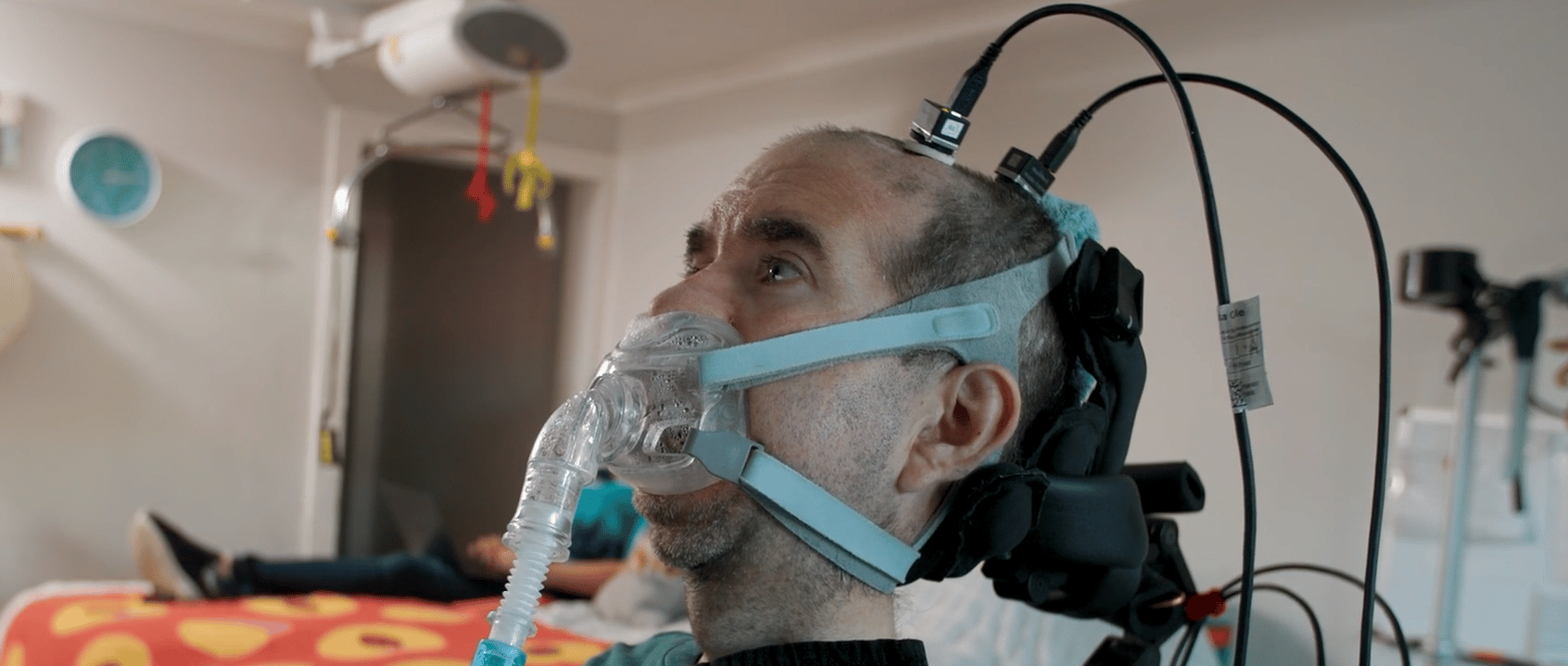
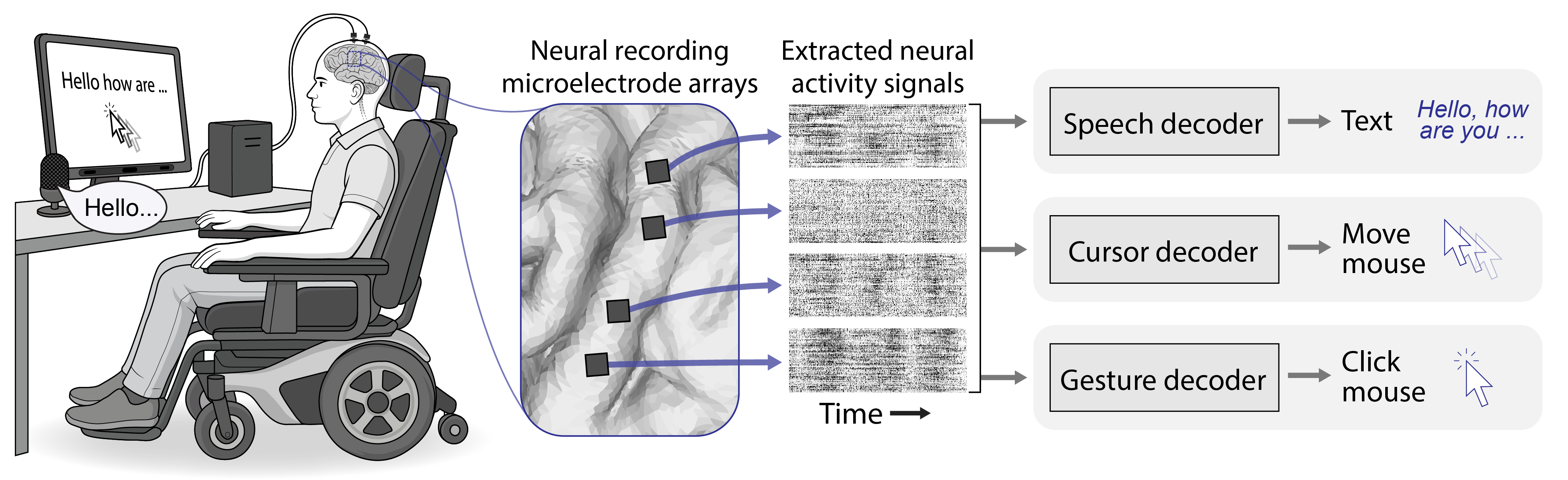
The words you're about to read in Casey Harrell's voice were not spoken aloud, and they were not typed. Casey has amyotrophic lateral sclerosis (ALS) and cannot reliably move his mouth or hands. He composed his portions of this post by attempting to speak and to move a computer cursor — intentions that fail to reach his muscles, but still produce distinctive activity in his motor cortex, where four arrays of tiny electrodes record his brain signals. A brain-computer interface (BCI) translates those signals into words and digital actions in real time. He has been doing this almost every day for nearly two years. Here's how he got here, in his words and mine.
Before the BCI
Nick:
Casey was diagnosed with ALS in 2020. The disease degrades the connections between brain and muscle, slowly stripping away the ability to move. Casey first lost the ability to walk, then to use a mouse and keyboard, and then, perhaps most devastatingly, to speak.
In 2023, he joined the BrainGate2 clinical trial, volunteering to have small neural recording devices surgically placed in the part of his brain that controls speech. The goal was to develop a BCI that could restore his ability to communicate by translating the neural activity of his attempted speech into the words he is trying to say.
Casey:
When you are diagnosed with a disease like ALS at 41, you think, this can't happen to me. This is a disease for someone who has already lived a long life. I was a new father in the prime of my career, not much older than the namesake of the disease, Lou Gehrig. You begin to count what you cannot do every new day. I miss a lot of things that I used to be able to do. But the thing that really gutted me was waking up one day and not being able to sing to my daughter anymore. She was only two years old at the time.
I heard about the trial in early May of 2023, just after the fourth anniversary of my diagnosis (5.5 years after symptom onset). Having lived longer than most people with ALS, I was ineligible for most trials, but not this one. I was intrigued by the chance to move science forward, and the more I researched those who had come before me, the more I realized the technology was on the cusp of a breakthrough. Why not me? People always ask why I would undergo brain surgery. I tell them that when you have ALS, you have a different calculation of risk. I was losing my voice and my ability to be understood by almost anyone, even the assistant who translated for me. If I lost my voice completely, I would lose my livelihood and my ability to communicate with society. I would just be cut out, and I was desperate to avoid that. The decision was both very easy and very prolonged, because I wanted to kick the tires on the team to be sure they would do well by me in the surgery and the follow-up research. I found them to be excellent people, who are now friends of mine, who held their research participants in the highest regard. We would be doing this together.
What we showed first: speech, and a cursor
Nick:
In 2024, we published in the New England Journal of Medicine the first results from Casey's participation in the trial: a system that translated the neural activity in his speech motor cortex into text with high accuracy, after a quick calibration each session. For the first time since losing his voice to ALS, Casey could "speak" through a computer, in a voice that sounded like his own, with an unrestricted vocabulary.
Shortly after, we published a result in the Journal of Neural Engineering showing that the same electrodes could also control a computer cursor — Casey could move and click by attempting hand movements. This surprised the field, which had assumed you'd need electrodes in a different brain region to do that.
Both results proved the concept. But they were research demonstrations, run on a schedule with our team in the room to set up and tear down the equipment. The harder question came next: could any of this become something Casey actually uses in daily life?
Casey:
If you look up my name and brain-computer interface, the most likely image or video will be of me in the first research session. The speech decoder simply worked. It was pure elation. What people do not see is that it was only half of the puzzle. I needed to use a computer mouse to be able to work independently. This came later and is actually surprising, as Nick says, and also equally elating.
From research demo to daily life
Nick:
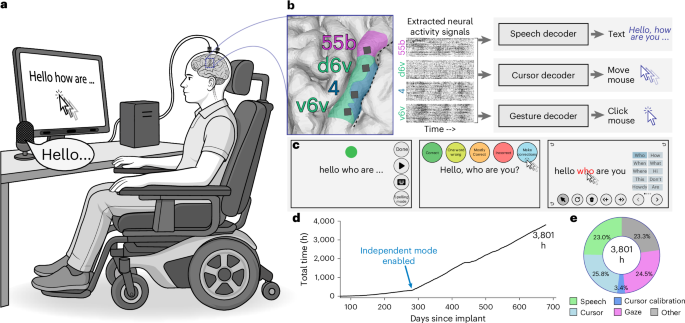
The new paper, in Nature Medicine, reports on what happened next: nearly two years of Casey using the BCI at home, on his own, almost every day. There was no researcher in the room and no extensive daily recalibration ritual. Decoding accuracy was stable over hours of use per day, across speech and cursor, holding up over a timescale measured in years. We think that's the threshold this technology has to cross to become a real-world assistive device. To make this possible, we developed new higher-accuracy decoding algorithms, smarter and more efficient background decoder calibration, and a more stable and feature-rich system infrastructure.
Casey:
When I get out of bed in the morning, I transfer to my wheelchair and head to my desk. It is time to get plugged into the matrix. My wife, who does a lot of unpaid labor supporting me, starts up the computers next to my desk, cleans the area on my head where the pedestals are, switches out the two caps for Neuroplexes, then plugs them into the machine. After that, I do a few calibration exercises, which take about five minutes, then I am able to talk. I check my messages and see what the day has in store. I spend the time on emails, text messages, and meetings over video. I am consulting part time after a long career in climate advocacy, because I can do everything a normal computer user does, just slower.
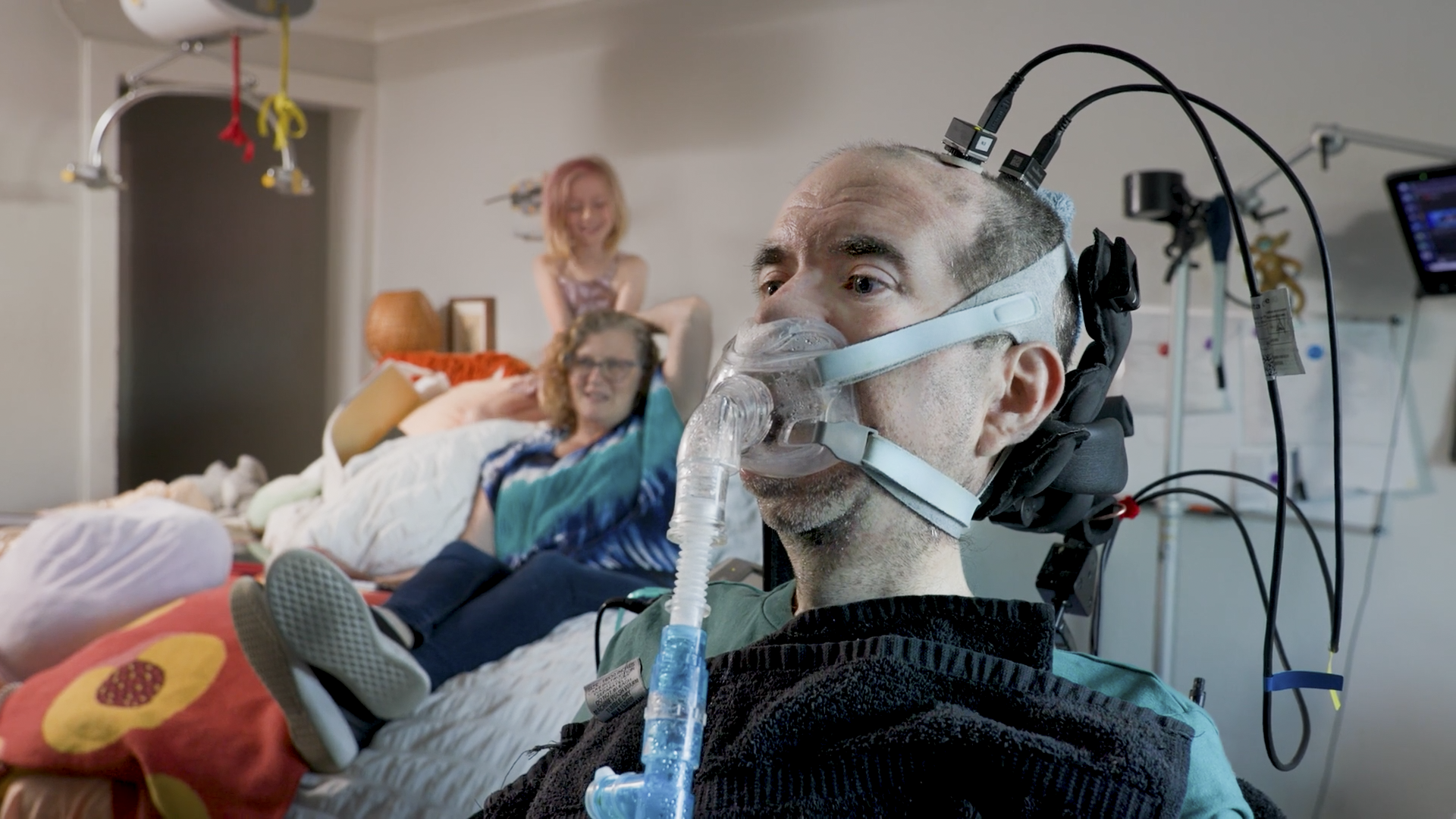
My favorite time of the day is when my daughter, who is seven and just finished first grade, gets home. They are so loud, and if they have a friend with them, even louder. I love it so much, the life that they have, hearing them giggle and play. Before the decoder, I was relegated to having a tiny percentage of what I wanted to express painstakingly translated for me, in an almost silent environment. Keeping up with a conversation was out of the question. Now I am part of the conversation.
Now I can actually parent my daughter, who can't remember a time when I could talk to them naturally. I can read them a book, listen as they talk, and help them troubleshoot a problem at school. I can shift some of the burden from my wife, who does so much as it is. I am able to play games and do the silly stuff, which is actually the important stuff, too. Our family game these days is Wordle.
I find explaining my day-to-day life with the BCI a little boring, because I have been doing it for almost three years now. That it is boring is a good sign: this technology simply works, and that is what you want in a product. I am very grateful to have access to it, and I cannot fathom my life without it. That said, it is not perfect. The top three things I would improve are making it portable, making it wireless so no one has pedestals sticking out of their head, and making it a real-time brain-to-voice decoder instead of a brain-to-text-to-voice one.
Nick:
Casey's three suggested improvements — portable, wireless, real-time brain-to-voice — are exactly where the field is headed. What strikes me most, though, is that he finds his daily routine with the BCI boring. That's the whole point. A technology becomes assistive not when it dazzles in a demo, but when it recedes into the background of an ordinary day.
Why this matters
Nick:
For years, the headline question about BCIs has been how accurate can they get? That's the right question for a research demo. Here, we go beyond that and ask can BCIs restore function in daily life? Casey is evidence that they can. The BCI helps him connect with his family and friends, continue his career, and navigate the digital world, day after day, without researchers in the room. The point of this work is to build something that holds up across years of ordinary life and quietly gives a person back to the people who love them. Casey crossed that threshold first. Our job now is to make sure he isn't the last.
Casey:
My hope is that you never read about me again, at least in terms of this phenomenon. Evil laugh. In other words, I do not want to be special any longer. I think this is good enough technology that people who have ALS should have access to it right now. Sadly, that is not the case yet.
As the world's first super user of a speech neuroprosthesis, I have lots of feedback to give. My hope and energy will be spent helping the industry evolve to create products that are truly portable, wireless, and are able to do accurate brain-to-voice decoding so that the people who have the medical need for such devices can access them with a doctor's note.
Follow the Topic
-
Nature Medicine
This journal encompasses original research ranging from new concepts in human biology and disease pathogenesis to new therapeutic modalities and drug development, to all phases of clinical work, as well as innovative technologies aimed at improving human health.

Related Collections
With Collections, you can get published faster and increase your visibility.
Clinical Research in Respiratory Medicine
Publishing Model: Hybrid
Deadline: Feb 18, 2027
Cancer Prevention and Control
Publishing Model: Hybrid
Deadline: Feb 19, 2027