Looking for the few cells that matter
Published in Cancer and Computational Sciences



How it started
I'm a nuclear physicist. My day job is measuring beta-decay spectra and the radius of the proton, and I have never taken a biology class. Not even in high school. So how did my group end up on a breast cancer paper in Nature? A colleague asked me to look at some data.
Efrat Shema and I were both Adams Fellows as graduate students, a few years apart, and in 2021 we met at an alumni seminar. Her lab at the Weizmann Institute was using mass cytometry (CyTOF) to measure dozens of chemical tags on histones, the proteins DNA is wound around, one cell at a time. The tags help set which genes a cell uses, and they can change while the DNA stays the same. She asked me to look at new data from DIPG, a childhood brain tumour.
I didn't understand the biology, but I recognised the data. It was big and noisy, with dozens of numbers per cell, and nuclear physicists handle that all the time with machine learning and statistics. That analysis went into the Harpaz et al. paper on these gliomas in 2022, and we never really stopped.
The hunch
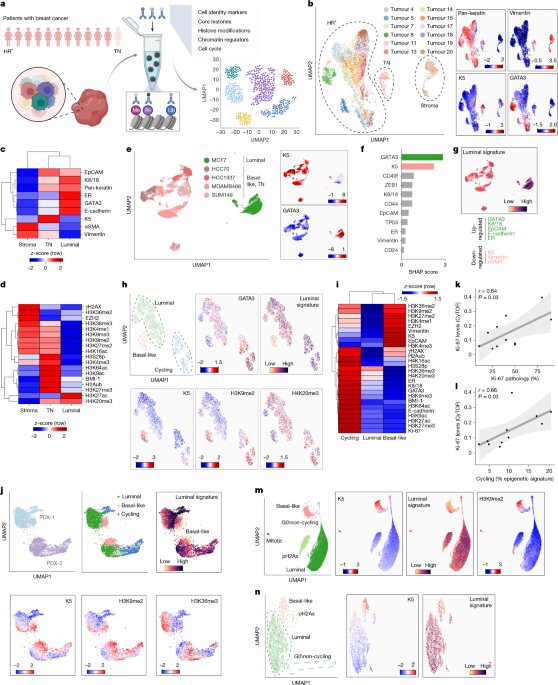
Breast cancer came next, through Efrat's collaboration with clinicians at Kaplan Medical Center. We concentrated on luminal tumours, which usually respond well to hormone therapy, though some patients relapse anyway. We suspected that a small, aggressive group of cells hides inside these tumours and has something to do with treatment failing.
The hard part happened nowhere near my office. The tags start degrading soon after a tumour comes out, so whenever a surgery began Noa Furth got a call, and she had the sample in the lab and the analysis running that same day. Twelve women, none yet treated, gave tumours this way.
In Jerusalem, my PhD student Yishai Arieli built the CyTOF analysis framework. After a physics master's at the Hebrew University he spent a few years doing machine learning in industry, and brought those methods back with him.
To say whether a cell is really running the aggressive, basal-like programme, the standard tools give you a score but not its significance. So we wrote our own method, PermCell. For every cell it compares the signature's markers with lots of random marker sets of the same size from that cell. If the real signature sits well above the random ones, we believe it. Physicists call this estimating the background before claiming a signal.
Finding the cells, then finding them in blood
When a small basal-like population turned up inside the luminal tumours, I was more pleased than surprised. We had bet on it being there. It also refused to go away. We saw it in patient after patient and in tumours grown in mice. Christina Riemenschneider even grew a breast cancer cell line back up from single cells, and the basal-like cells reappeared. So this doesn't look like a separate genetic clone. It looks like cells changing state epigenetically, and two tags at a histone position called H3K4 were the ones most tied to that change.
Does any of this show up in blood? Dying cells, tumour cells included, release nucleosomes into the bloodstream: short pieces of DNA still wrapped around their histones. Efrat's lab developed EPINUC, which captures them from plasma and reads the tags one molecule at a time.
In plasma from 77 women with luminal breast cancer and 30 healthy women, a classifier trained on EPINUC measurements told the two groups apart with an AUC, or area under the curve, of 0.95. (1 is a perfect test and 0.5 a coin toss.) It did just as well on small, early-stage tumours, and reached 0.96 on 188 samples pooled from several medical centres.
And the same H3K4 tags that marked the basal-like cells were higher in the blood of women whose cancer came back within five years. EPINUC separated the women who relapsed from those who didn't with an AUC of 0.81, and 0.92 in a second, much smaller group of 30 women.
A caution
Some readers will be patients, so let me be plain. Everything above comes from stored samples, from women whose outcomes we already knew. To translate this into a clinical diagnostic test takes bigger studies that follow patients forward in time. EPINUC is a research tool. Nobody can order it, and we're hoping it will take the next step.
For the record, Yeda, Weizmann's technology-transfer company, has filed a patent application on EPINUC, licensed exclusively to Epivision Genetics, with Efrat among the named inventors.
Sixteen months in review
We submitted in May 2025 and were accepted in September 2026. I'd love to complain about that, as is traditional, but I can't. The reviewers were excellent. They asked for many more experiments, more EPINUC cohorts and kinds of data we hadn't included at all. The published paper has more than twice the data and analysis of our first submission, and it's much better.
What I took from it
The biologists always seemed happy to have a physicist in the room, and they were very patient with someone who had skipped their subject entirely. I had never realised how complicated biology is. Or how fulfilling. A physicist's instinct is to strip a system down until only one effect is left. You can't do that with a tumour. Every cell is slightly different from its neighbour, and here those differences were the thing we were measuring. I'm still getting used to that. I am now a part-time biologist, and I intend to stay one.
Noa, Christina and Yishai led this work, and Efrat is my co-corresponding author. We owe a lot to the clinicians at Kaplan, Sheba and the Mayo Clinic, to our collaborators abroad and at Epivision Genetics, and most of all to the women who gave tissue and blood.
You can read more about our group’s work at funint.page and about Efrat's lab here https://www.weizmann.ac.il/dept/irb/shema/
Header photo, left to right: Guy Ron, Efrat Shema, Yishai Arieli, Christina Riemenschneider and Noa Furth. Credit: Ido Eitan.
Follow the Topic
-
Nature
A weekly international journal publishing the finest peer-reviewed research in all fields of science and technology on the basis of its originality, importance, interdisciplinary interest, timeliness, accessibility, elegance and surprising conclusions.