Lost an Election Recently? Here's How to Move Beyond Winners versus Losers.
Published in Behavioural Sciences & Psychology





Why Is this Research Valuable?
To understand our work, it helps to first break down what we mean by "collective mental time travel". Just as you or I can mentally travel back to a childhood birthday or project forward to next year's vacation, societies remember certain past events to project a future. We share a mental network of historical milestones and collective future imaginations, but our sociopolitical identity colors this network. Some events are more central than others for particular groups, which leads to a distinct network of past and future events. Even the same event is likely to be remembered differently due to our identities. For instance, when one is asked to recall Obama’s Election as the first African American president, it may activate different pathways. African Americans remembering Obama’s election may be more likely to recall other race-related events that highlight a possible shift in agency toward their racial group; non-African Americans may be reminded of other highly important events in American politics. In other words, remembering the same event may activate different pathways based on sociopolitical identity.
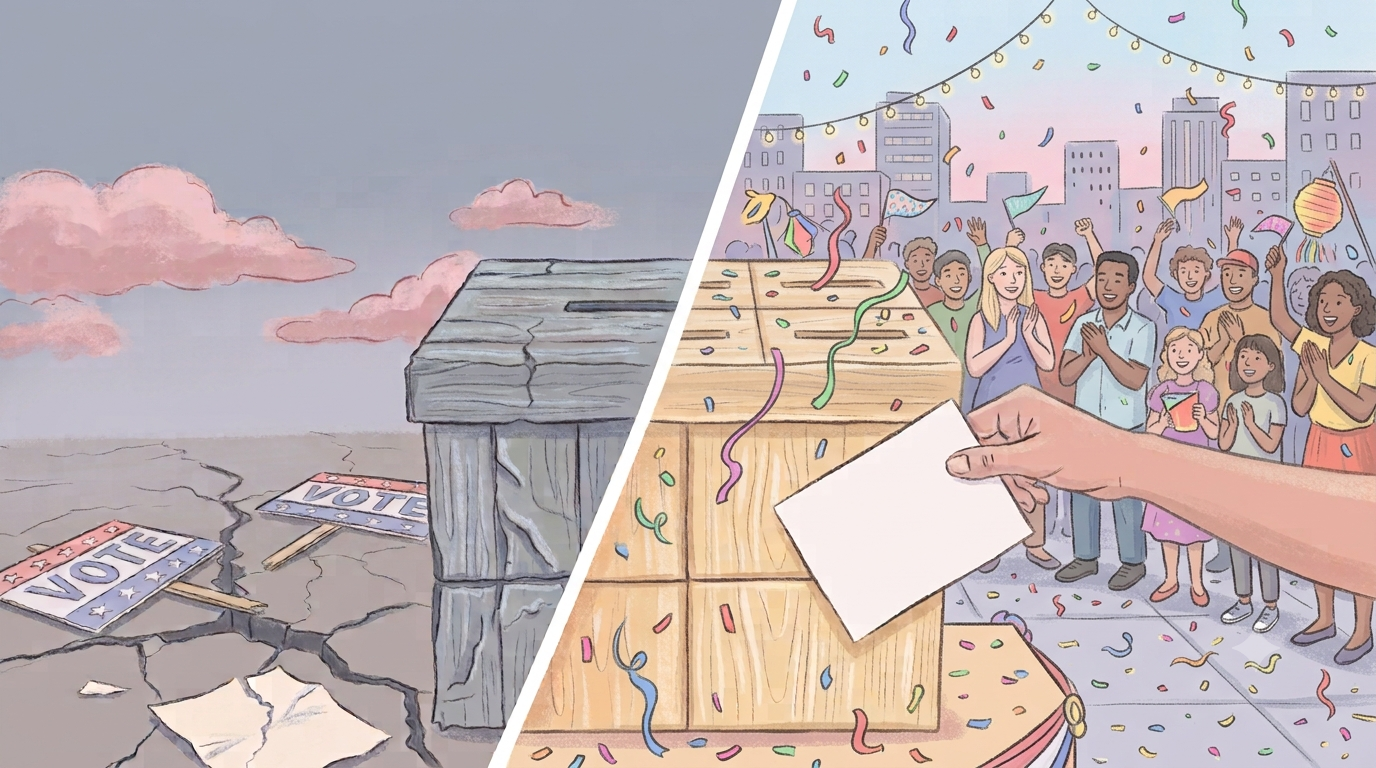
While it is true that election outcomes spark drastically different emotional reactions, human memory is far more complex than a simple scorecard. We wanted to move past this dichotomy and look at the "big picture". Our study took place against the backdrop of the highly consequential 2023 Turkish Presidential Election. Amidst economic anxieties and intense polarization, a diverse coalition of opposition parties sought a shift in the status quo but ultimately lost to the incumbent. By using this emotionally charged event as an anchor, our paper asks how an intense public event can help group a community's mental networks. Understanding this is crucial for learning how societies build collective resilience, process democratic grief, and cope with overwhelming political polarization.
What Did We Do?
To map these mental timelines, we designed a two-part investigation. In Study 1, we partnered with a local polling firm to conduct in-person interviews with a representative sample of 403 Istanbul residents just a few months after the 2023 election. We chose Istanbul because its rich socioeconomic and political diversity mirrors the broader shifts of the country.
We asked participants to reflect on the election night and rate its characteristics, such as its emotional tone (valence), its clarity (vividness), its importance, and their agency power to shape it ("agency"). We then asked them to mentally travel to a national past event and project a future event of equal significance to the election night. They rated these past and future events using the same event characteristic questions. We identified how these event characteristics were linked and assigned participants to those “pathways” based on how well they fit the characteristics of that pathway.
Instead of seeing a simple split between winners and losers, our analysis of event characteristics revealed four distinct collective mental time travel pathways bridging the past and the future:
- Election Glorification: Predominantly composed of incumbent voters, these individuals remembered a highly positive election night where they felt their political group held substantial power.
- Election Reflection: Made up of opposition voters who were still processing the defeat. They vividly remembered and frequently discussed the election night with their close circle, emphasizing the agency of the nation as a whole. Surprisingly, this pathway was linked to a resilient sense of future personal agency.
- Recent Past Importance: Also opposition-heavy, but these individuals felt emotionally detached. They pivoted away from the election, anchoring their timelines to a separate, highly important historical event from the recent past.
- Agentic Past Achievement: The most surprising finding. This was a bipartisan pathway where winners and losers organically converged. They jointly focused on a positive past event where individuals, political groups, and the nation achieved something great together (high agency).
To have an understanding of a non-electoral context, we conducted Study 2 two years later in 2025, with 201 participants. This time, we didn't mention the election at all. Without that political anchor, participants had memory "clusters" separated by importance or agency instead of the four nuanced pathways with sociopolitical nuances.
What Are the Implications of This Study?
Our findings help in understanding political coping and societal cohesion. By breaking down the single identity of an “election loser” into distinct pathways like Election Reflection, those who reflect on the election, and Recent Past Importance, those who think of important recent events, we show that people may be using different cognitive strategies to handle electoral loss. While some actively process the event and preserve their individual agency, others emotionally distance themselves. More importantly, the Agentic Past Achievement pathway offers a silver lining for deeply polarized nations. It demonstrates that even in an era of intense division, cross-party groups can still share pride over historical achievements to some extent, and some of the “losers” in that pathway maintain high future political agency.
Of course, our study has its caveats. It focuses on a singular, highly unique electoral landscape within Turkey, and our sample was gathered in Istanbul. We cannot definitively state whether these exact four pathways emerge across different democratic systems globally. But it’s a first step to understanding how voters deal with election outcomes in diverse ways.
Ultimately, our study reveals that our collective past and future are not static: they are active psychological networks that are impacted by current events. By understanding the way groups of people think about those events, we can better appreciate the ways of winning and losing beyond simply looking at dichotomies like winners vs losers, liberals vs conservatives, or left-wing vs. right-wing.
Follow the Topic
-
Communications Psychology
An open-access journal from Nature Portfolio publishing high-quality research, reviews and commentary. The scope of the journal includes all of the psychological sciences.

Related Collections
With Collections, you can get published faster and increase your visibility.
Replication and generalization
Publishing Model: Open Access
Deadline: Dec 31, 2026
Stress and Health
Publishing Model: Open Access
Deadline: Nov 30, 2026


