Mach Independence of Entropy Layer Instabilities
Published in Physics, Mathematical & Computational Engineering Applications, and Mathematics
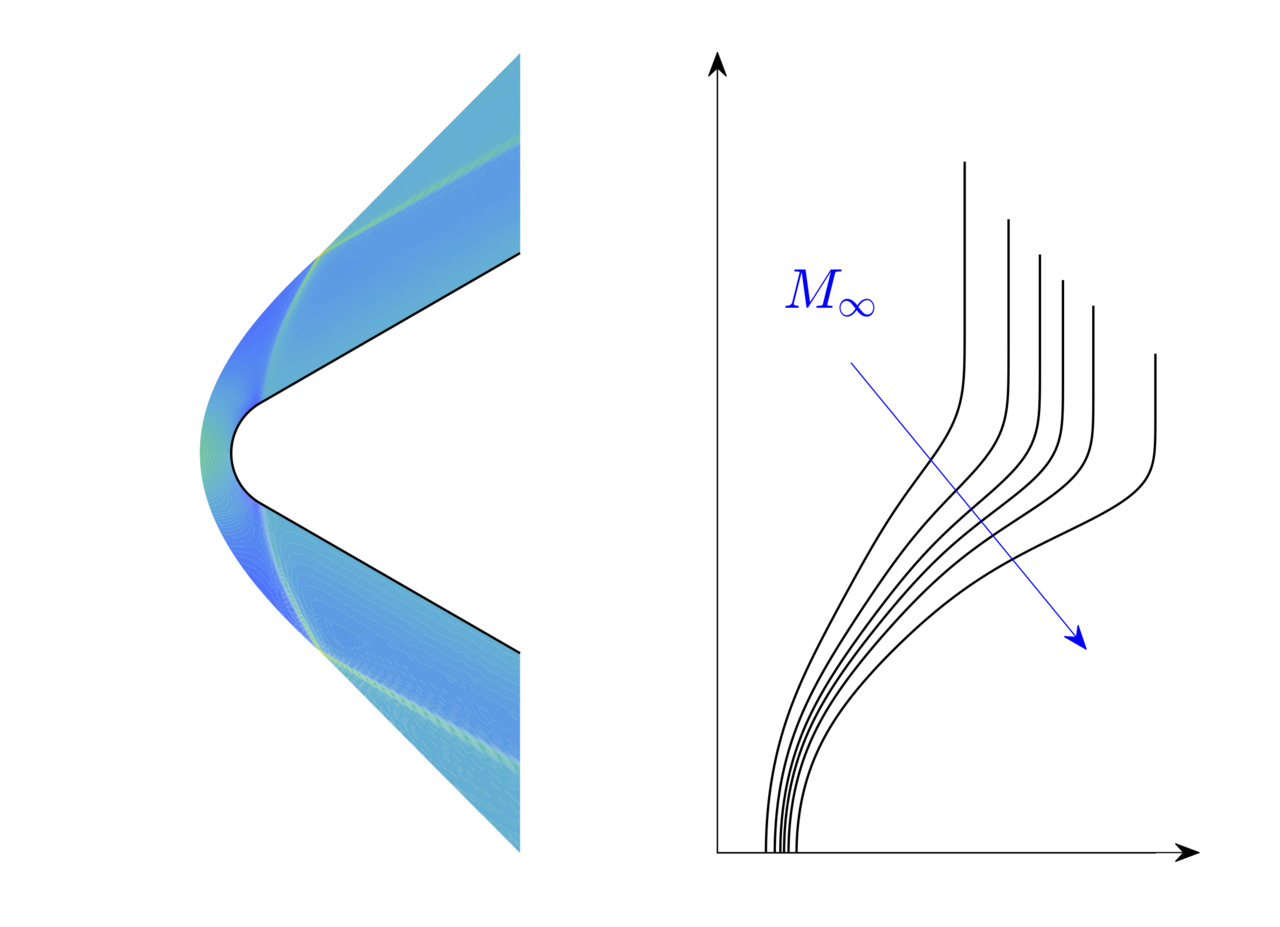
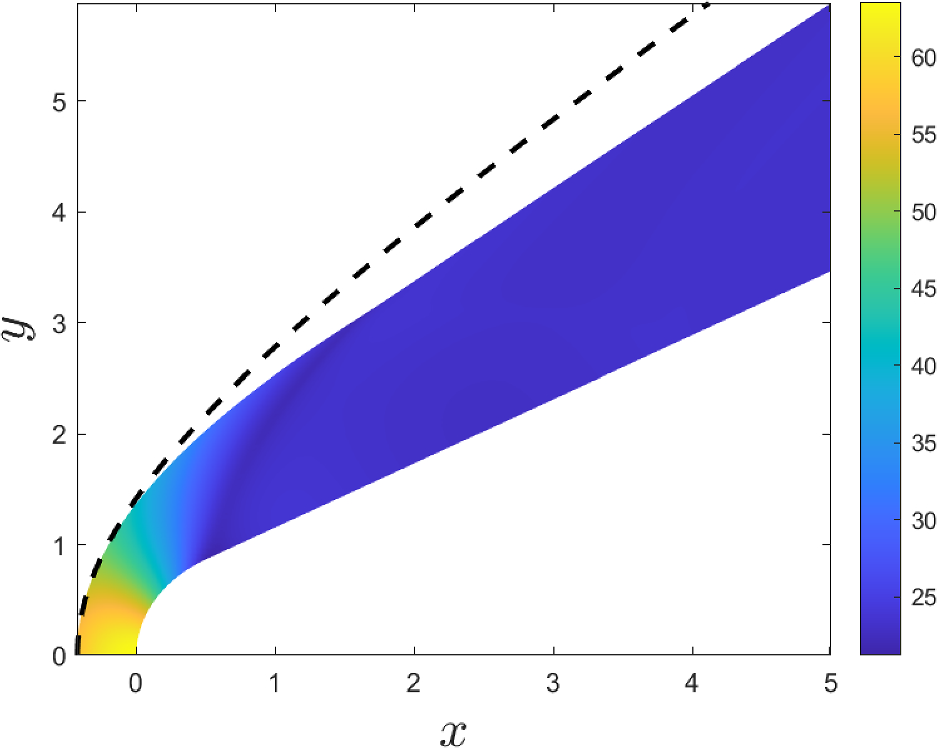

Check out our latest research paper, discussing the Mach Independence of entropy layer instabilities in hypersonic flight.
When studying transition to turbulence in hypersonic flows, it is extremely challenging to relate the results at different Mach numbers. The current theoretical work offers a step in this direction by proposing a way to relate entropy layer instabilities across a range of Mach numbers. The theoretical findings may be particularly useful for relating experimental results at different Mach numbers.
The proposed methodology to relate beween entropy layer instabilities at various Mach numbers relies on proper normalization, inspired by the work of Oswatitsch, leading to Mach independence for very large Mach numbers. In addition, normalization by a representative thickness of the entropy layer leads to a much earlier onset of the Mach indepdence, for freestream Mach numbers as small as 5.

My research focuses on theoretical and computational investigation of flow physics, with emphasis on transition to turbulence. My aim is trying to explain complex phenomena using a minimal number of elements.
My research interests include aerodynamics, fluid mechanics, flow instabilities and transition, flow control and flight mechanics.
Follow the Topic
-
Theoretical and Computational Fluid Dynamics

This journal provides a forum for the cross fertilization of ideas, tools and techniques across all disciplines in which fluid flow plays a role.
Related Collections
With Collections, you can get published faster and increase your visibility.
Special Issue: Stable and unstable time dependent flows of viscoplastic fluids
Viscoplastic materials are a distinct class of complex fluids that exhibit a yield stress. When subjected to stresses smaller than a critical value, such materials exhibit a solid solid- like behavior (they deform but do not flow) and, for imposed stresses exceeding this threshold, they exhibit a fluid like flow behavior. This special class of materials is quite broad and includes emulsions, foams, pastes, colloidal and non-colloidal gels, suspensions of particles that have a number of key applications in pharmaceutics, cosmetics, food, oil, and construction industries. Biofluids, such as mucus, blood and saliva, and geophysical materials, e.g., sea ice, snow, muds, volcanic lava also belong to this class.
Within this special issue, we would like to provide a well-selected overview of the current state of theoretical and numerical research on flows of viscoplastic materials and highlight future developments. Topics of relevance include (but are not restricted to) dynamics of the solid-fluid transition in time dependent flows with a particular emphasis on the role of elasticity, transient flows over complex topographies, hydrodynamic instabilities, mixing, two phase flows, flows in porous media.
We intend to have a well-balanced mix of methodological papers focused on new numerical/theoretical developments and physics-oriented papers with authors from various communities (applied mathematics, physics, chemical and mechanical engineering etc.) working on the fluid mechanics of yield stress materials.
Submission deadline: 1.12.2024
Projected publication: 1.05.2025
Submission guidelines
All papers must be prepared in accordance with the Submission Guidelines. Articles for this Topical Collection should be submitted via our submission system, SNAPP. During the submission process you will be asked whether you are submitting to a Collection, please select “Special Issue: Stable and unstable time dependent flows of viscoplastic fluids” from the dropdown menu.
Submitted papers should present original, unpublished work, relevant to one of the topics of the Topical Collection. All papers will be evaluated on the basis of relevance, significance of contribution, technical quality, scholarship, and quality of presentation by at least two reviewers. It is the policy of the journal that no submission, or substantially overlapping submission, be published or be under review at another journal or conference at any time during the review process. Final decisions on all papers are made by the Editor-in-Chief.
Publishing Model: Hybrid
Deadline: Ongoing
Special Issue: Vortex Dominated Flows
A colloquium on vortex dominated flows (DisCoVor 2022) was held in May 2022 in Switzerland (Co-chairs Karen Mulleners (EPFL) and Rajat Mittal (JHU)) which had over 60 participants and presenters from US, Europe, South America, Canada and India. At the culmination of this meeting, there was a consensus that there existed an opportunity to put together a special issue on this topic and solicit high-quality papers from this group of attendees as well as from the wider community of researchers involved in research in vortex dominated flows. DisCoVor 2023 was held in Colorado in May 2023 with nearly 90 participants from all over the world, and the special collection has been reopened to accept articles till the end of 2023.
Submission guidelines
All papers must be prepared in accordance with the Submission Guidelines. Articles for this Topical Collection should be submitted via our submission system, SNAPP. During the submission process you will be asked whether you are submitting to a Collection, please select “Special Issue: Vortex Dominated Flows” from the dropdown menu.
Submitted papers should present original, unpublished work, relevant to one of the topics of the Topical Collection. All papers will be evaluated on the basis of relevance, significance of contribution, technical quality, scholarship, and quality of presentation by at least two reviewers. It is the policy of the journal that no submission, or substantially overlapping submission, be published or be under review at another journal or conference at any time during the review process. Final decisions on all papers are made by the Editor-in-Chief.
Publishing Model: Hybrid
Deadline: Ongoing

Please sign in or register for FREE
If you are a registered user on Research Communities by Springer Nature, please sign in