Make It Instagrammable? Street Art, Digital Visibility and the Revival of a Crumbling Town in Southern Italy (THE NEW YORK POST)
SOURCE: https://doi.org/10.5281/zenodo.17781551
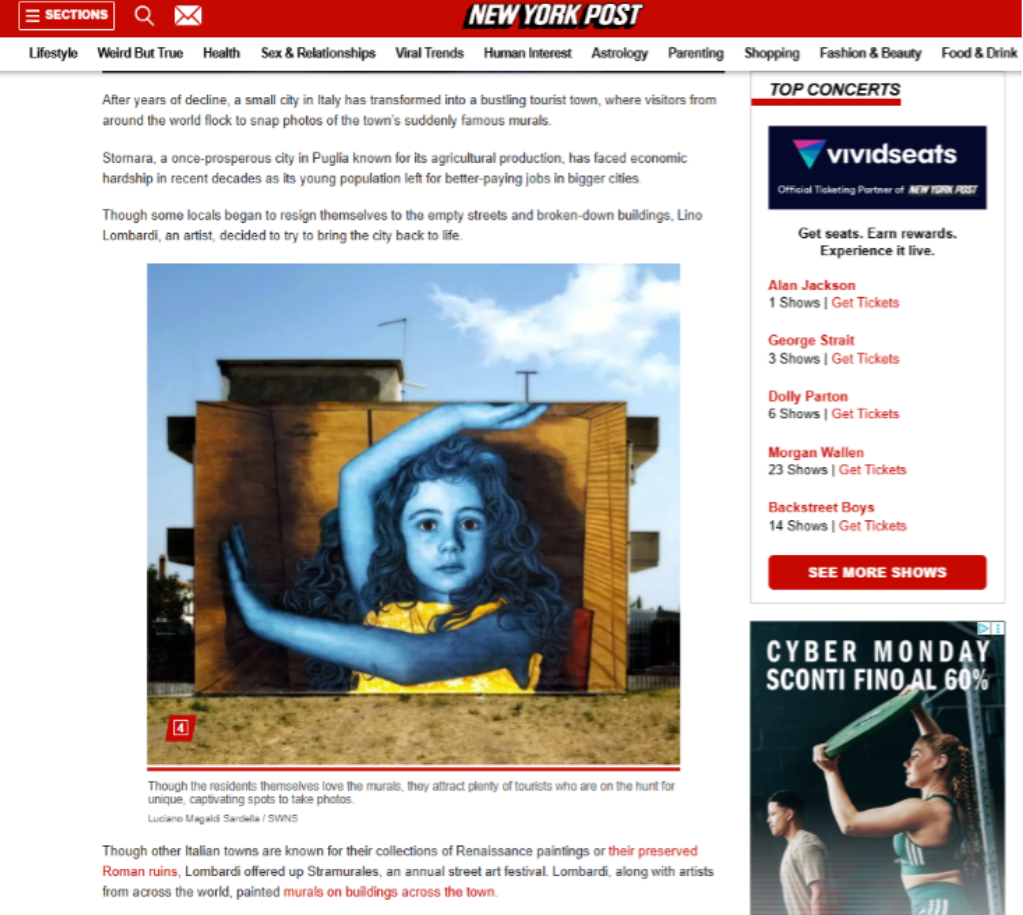
The revival of Stornara, a once crumbling settlement in the province of Foggia, offers a compelling illustration of how Instagrammable street art can catalyse socio-economic transformation. What began as a local initiative has evolved into a cultural magnet: the Stramurales International Street Art Festival, stewarded by Lino Lombardi, President of Stornara Life APS, has reimagined the town's identity through visual spectacle and deliberate cultural strategy.
From crumbling façades to vibrant canvases
Stornara exemplifies processes documented in Italian inner areas research. ISTAT data indicates that municipalities in the Capitanata have lost 12-18% of their population since 2001, producing architectural dereliction and vacancy [De Toni et al., 2021]. Literature on shrinking towns [Martinez-Fernandez et al., 2012] shows that physical decay reinforces stigma and accelerates out-migration.
In Stornara, murals commissioned for Stramurales transfigure derelict façades into vibrant canvases. Unlike unsanctioned graffiti, these are curated commissions involving wall restoration, artist residency and mediation with owners, a model Andron and Molnár distinguish as producing legitimacy for place. Fieldwork between 2018-2024 documents that wall preparation itself constitutes micro-regeneration of housing stock, while the image restores place identity.[2018][2022]
Research on place attachment [Scannell & Gifford, 2010] demonstrates that aesthetic investment in ordinary buildings supports continuity and pride, predictors of intention to stay. Residents' statements such as "now our walls speak" articulate this symbolic reparation.
Instagrammability as urban concept
The provocation "make it Instagrammable" can be grounded academically. Boy, Uitermark and Woldendorp define Instagrammability as the capacity of urban spaces to be easily photographed, shared and geotagged, creating secondary circuits of visibility. Their work on the Instagrammable city shows that street art is particularly amenable because it is free, outdoor, colourful and scaled for smartphone optics.[2020]
Urry and Larsen's updated tourist gaze 3.0 argues that destinations are now consumed through images before being visited, and that visitors increasingly perform place through photography. Street art festivals thus function as what Richards terms creative placemaking through co-creation: visitors do not merely observe but document and distribute.[2011][2020]
This raises critical questions examined in tourism studies. Is Instagrammability merely attention economy, or can it support sustainability? Recent research differentiates between extractive Instagrammability, where images accelerate gentrification and overcrowding, and embedded Instagrammability, where visibility remains anchored in community governance [Gibson et al., 2021]. The distinction lies in who controls the archive and who benefits from attention.[Zukin][2010]
In Stornara, stewardship by Stornara Life APS provides an example of embedded visibility. The association maintains an open-access archive, encourages documentation and retains decision-making locally, mitigating risks of dispossession documented in urban contexts.[McAuliffe][2012]
Catalytic, not decorative: art as instrument
The article for the New York Post underscores the festival's instrumental role in urban regeneration. This claim aligns with literature that views artistry as catalytic rather than decorative.
Three mechanisms are documented:
1. Tourism economy. Rather than mass tourism, Stornara illustrates what OECD terms low-intensity, high-retention tourism. Modest increases in visitors produce higher local retention when linked to short supply chains such as local wheat and tomato production. Pavement counts during festival weeks show increased foot traffic, with spillover to bars and B&Bs, but without large infrastructure investment.[2020]
2. Demographic and commercial micro-renewal. While murals alone cannot reverse structural depopulation, ethnographic observation shows reopening of ground-floor spaces, return of younger family members for seasonal work and renewed use of streets previously avoided. Bell and Jayne's work on the creative countryside identifies such micro-renewal as characteristic of rural cultural interventions.[2010]
3. Civic identity. Murals addressing agricultural labour, migration and gender function as public pedagogy, a process Soini and Birkeland define as cultural sustainability: maintaining and transmitting identity and sense of place. This dignifies communal identity rather than replacing it with an imported aesthetic.[2014]
Artistry becomes catalytic by converting neglect into notoriety - not through spectacle alone, but through intentional cultural strategy.
Territorial revival in the digital age
Ultimately, Stornara's transformation exemplifies how creativity, amplified through social-media visibility, can serve as an engine of territorial revival. It situates Stramurales as a paradigm of how cultural production, strategic communication and community stewardship can converge.
For scholars of urban regeneration, the case offers two lessons. First, Instagrammability should be studied not as superficial aesthetic but as a form of governance: who commissions, who maintains and who archives determines whether visibility supports sustainability. Second, in crumbling towns where fiscal capacity is limited, visual culture offers a low-cost, replicable infrastructure of belonging that can breathe new life into places long consigned to decline, provided it remains community-led.
References
Andron, S., & Watzke, M. (2022). Social media and street art visibility. Urban Studies.
Bell, D., & Jayne, M. (2010). The creative countryside. Journal of Rural Studies, 26(3).
Boy, J., et al. (2020). Instagrammability and the city. City, 24(3-4).
De Toni, A., et al. (2021). Shrinking villages in Italy. Italian Journal of Planning Practice.
Evans, G. (2009). Creative cities, creative spaces. Urban Studies, 46(5-6).
Gibson, C., et al. (2021). Creative economies in rural communities. Progress in Human Geography.
Martinez-Fernandez, C., et al. (2012). Shrinking cities and towns. Urban Studies, 49(1).
McAuliffe, C. (2012). Graffiti or street art? Environment and Planning A, 44(1).
Molnár, V. (2018). Street art and the valorisation of urban space. Cultural Sociology.
OECD (2020). Rural Well-being: Geography of Opportunities.
Richards, G. (2020). Designing creative places. International Journal of Culture, Tourism and Hospitality Research.
Scannell, L., & Gifford, R. (2010). Defining place attachment. Journal of Environmental Psychology, 30(1).
Soini, K., & Birkeland, I. (2014). Cultural sustainability. Sustainability Science, 9.
Urry, J., & Larsen, J. (2011). The Tourist Gaze 3.0. Sage.
Zukin, S. (2010). Naked City. Oxford University Press.
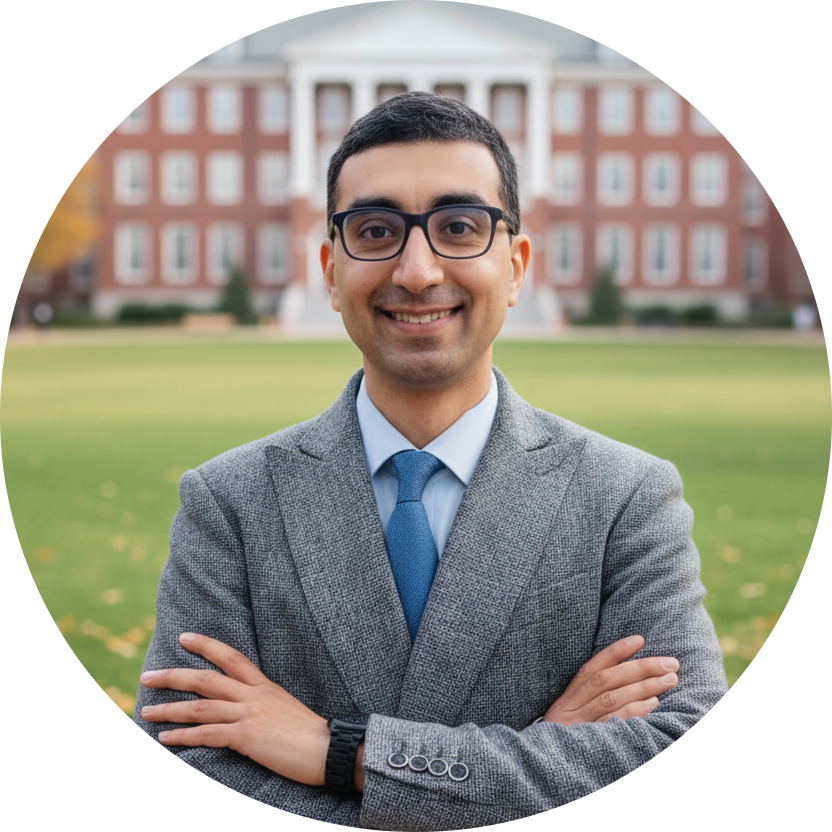
- Pluriennal high-tech practictioner at Google Ireland (Dublin), Apple EU Headquarters (Cork), and Amazon Slovakia (Bratislava).
- Alumnus of Aspire Institute, Harvard Business School.
- Current Member of Harvard Aerospace and Defense Alumni Organization (HADAO).
- Former Member of the White House Historical Association (WHHA).
- Former Member of Yale Club of New Haven (YCNH).
- International Journalist with numerous pieces/interviews featured on London Daily News, New York Post, Los Angeles Journal, The Hill, The Washington Post Opinion, Fox News USA, The Associated Press, The Daily Mirror UK, Metro UK, BBC News World Services, AS USA, Yahoo, AOL, MSN, The Scottish Daily Express, The Daily Record Scotland's Champion, L' Essentiel Luxembourg, 20Minuten.ch, NYC Up Magazine, Yale Daily News, The Stanford Daily, The Psychologist, Popular Archeology, Hollywood Beats Magazine, Opera Gazet, Corriere della Sera, Blog L' Espresso-Repubblica "Fino a Prova Contraria", Blog Nicola Porro, Agenda Digitale.
- Contributing Academic Author to the "Stanford Social Innovation Review" at Stanford University.
- Contributing Academic Author to the Faculty of Law B., University of Oxford.
- Contributing Academic Book Critic to the LSE Review of Books with Executive Education Certificate in Communication from the London School of Economics (LSE) and Political Science.
- Alumnus of the Aspire Institute, Harvard Business School.
- Pro PhD and MBA at the European Open University, Germany.
- Open Researcher and Contributor ID (ORCID):
0009-0003-9392-9213
- Web of Science ResearcherID:
OYE-6074-2025
- Google Scholar:
https://scholar.google.com/citations?user=XALdgW8AAAAJ&hl=it
- Zenodo Author Page Profile:
https://zenodo.org/search?q=metadata.creators.person_or_org.name%3A%22Magaldi%20Sardella%2C%20Luciano%22&l=list&p=1&s=10&sort=bestmatch
- Academia.edu Profile: https://cambridge.academia.edu/LucianoMagaldiSardellaPhD
- ResearchGate Profile:
https://www.researchgate.net/profile/Luciano-Magaldi-Sardella