Making a social-media customer engagement study more reusable: a public companion repository
Published in Computational Sciences, Arts & Humanities, and Business & Management
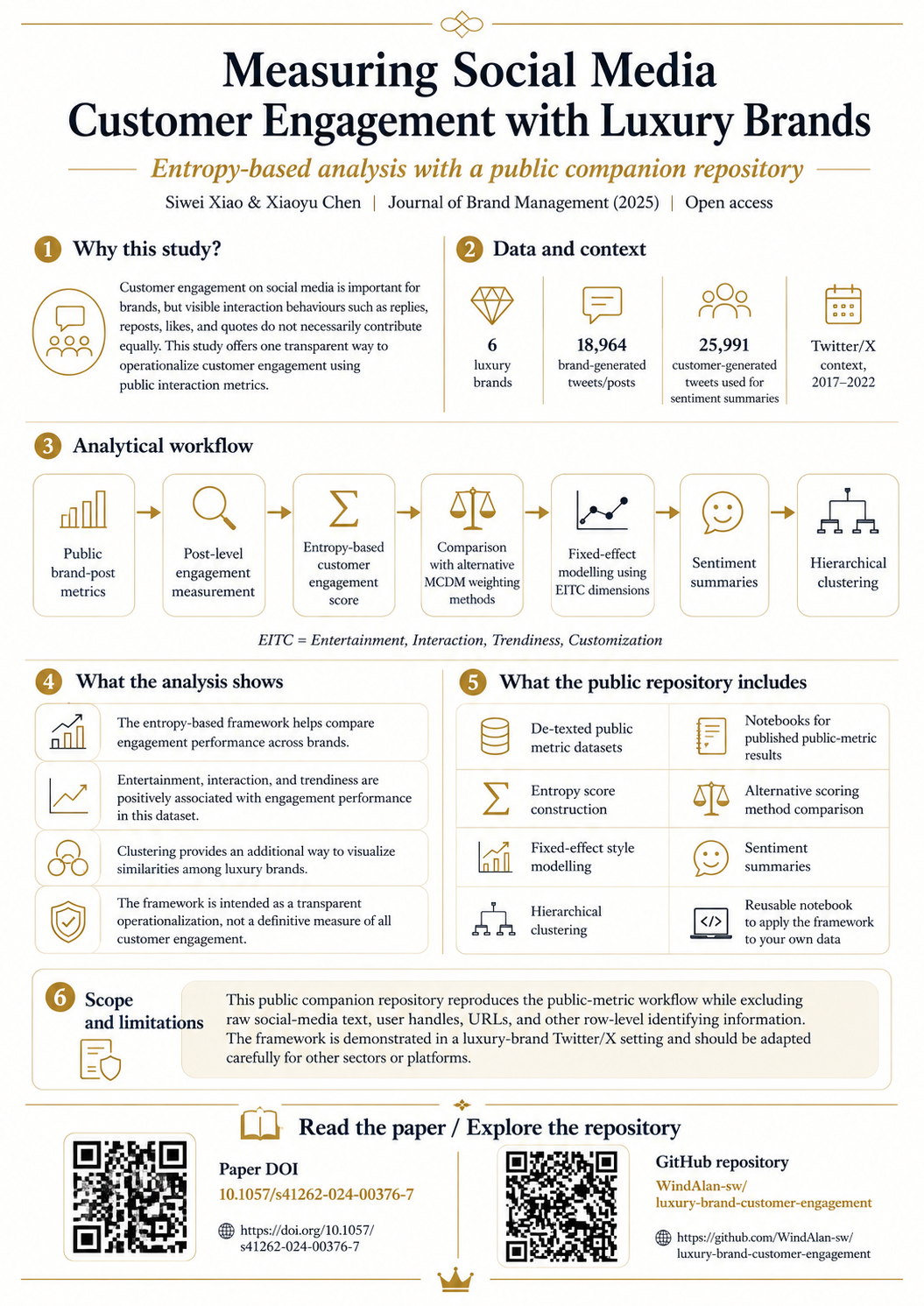



Customer engagement is an important concept in branding and marketing research, but it is not always easy to measure in empirical social-media settings. Public interaction metrics such as likes, replies, reposts, and quotes are visible and widely used, but they do not necessarily contribute equally to engagement. This creates a practical measurement question: how can we combine different observable engagement behaviours in a transparent and interpretable way?
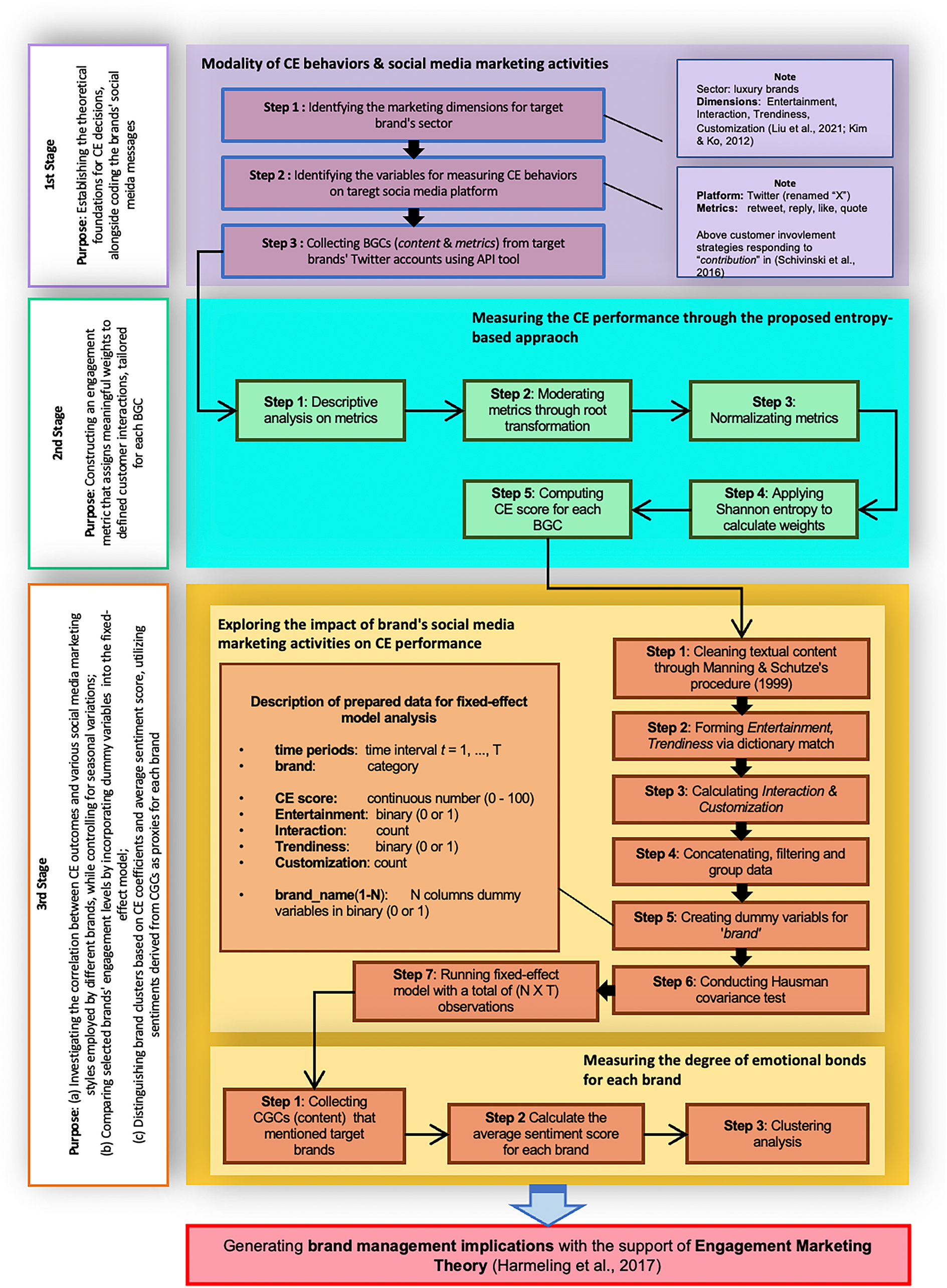
In our article, “Measuring social media customer engagement with brands based on information entropy: an application case of luxury brand,” we explored one possible approach. The study applied an entropy-based weighting method to public Twitter/X interaction metrics from six luxury brands. The goal was not to claim a universal measure of customer engagement, but to offer one structured way to operationalise observable engagement behaviours and compare engagement performance across brands and time.
After the paper was published, I felt that a public companion repository could make the work easier to inspect, learn from, and adapt. Academic articles often describe methods and results in detail, but readers may still find it difficult to understand how the data were processed, how the scores were calculated, or how the workflow could be reused in a related context. The repository was created to reduce some of that friction.
The repository includes de-texted public metric datasets and Jupyter notebooks for several parts of the analysis workflow. These include entropy-based customer engagement scoring, comparison with alternative multi-criteria decision-making weighting methods, fixed-effect style modelling, sentiment summaries, and hierarchical clustering. I have also included a notebook intended to help readers apply the framework to their own brand or campaign data.
At the same time, the repository has important limitations. Because the original research involved social-media text and user-related information, the public repository does not redistribute raw tweet text, user handles, URLs, or row-level customer records. Some text-dependent parts of the study therefore cannot be fully reproduced from the public files alone. Instead, the repository focuses on the public-metric workflow and provides documentation on what is included, what is restricted, and why.
I see the repository as a companion resource rather than a complete replacement for the article. It may be useful in several ways. For readers of the paper, it offers a more concrete view of the analytical workflow. For students, it may serve as an applied example of customer engagement measurement and marketing analytics. For researchers, it may provide a starting point for adapting or critiquing the framework in other contexts. For practitioners, it may offer a cautious example of how public engagement metrics can be combined and compared across brands, campaigns, or time periods.
The study's context is also important. The empirical application focuses on luxury brands and Twitter/X data. The framework should therefore be adapted carefully before being used for other sectors, platforms, or forms of engagement. Public social-media metrics can capture some visible engagement behaviours, but they do not represent the full richness of customer engagement, including private interactions, offline experiences, or deeper psychological and relational dimensions.
For this reason, I hope the repository is viewed as one transparent operationalisation rather than a definitive solution. My aim is to make the research a little more open, inspectable, and reusable where possible, while also being clear about the limits of what can be shared publicly.
Paper: https://doi.org/10.1057/s41262-024-00376-7
GitHub repository: https://github.com/WindAlan-sw/luxury-brand-customer-engagement
Feedback, suggestions, and careful reuse are very welcome.

Follow the Topic
-
Journal of Brand Management
This is a peer-reviewed publication, focusing on the multifaceted field of brand management and strategy.