Mechanistic insights into the dissemination of antibiotic resistance genes in biofilms under combined sulfonamides stress
Published in Earth & Environment

- The Spark: A Hidden World Within Biofilms and a Critical Question
This study began with a simple but intriguing observation during our investigations of aquatic microbial systems. Biofilms are commonly found on submerged surfaces, from natural sediments and aquatic plants to artificial structures in water environments. Although they often appear as thin and inconspicuous microbial layers, these communities harbor complex interactions among microorganisms, extracellular polymeric substances (EPS), and genetic elements. As researchers studying environmental antibiotic resistance, we wondered whether these hidden microbial ecosystems could serve as overlooked hotspots for the dissemination of antibiotic resistance genes (ARGs), particularly under realistic conditions where multiple antibiotics coexist.
Previous studies have demonstrated that individual antibiotics can modulate biofilm structure composition, potentially influencing the ARGs dissemination, the effects of combined antibiotic exposures have yet to be systematically evaluated. This question motivated us to investigate how combined antibiotic exposures reshape biofilm structure composition and regulate ARGs dissemination risks. By integrating advanced spectroscopic analyses with metagenomics, we aimed to how combined antibiotic regulate EPS secretion and microbial community, thereby driving the ARGs dissemination potential in biofilm.
- Exploring the EPS matrix
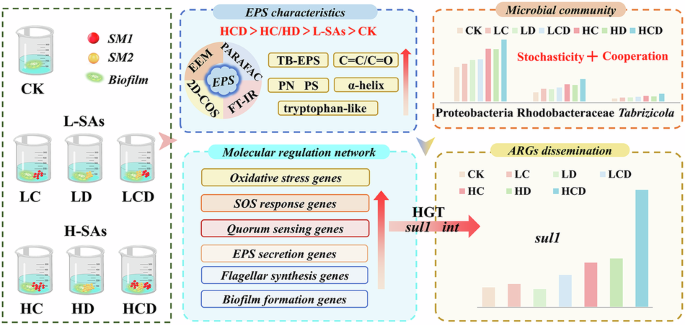
One of the most fascinating things about biofilms is that they act like a miniature ecosystem. Different microorganisms occupy different ecological niches, communicate through chemical signals, compete for resources, and exchange genetic materials. The EPS matrix not only provides physical protection but also affects how microbes and genetic material move and interact. A key discovery was the important role of the EPS matrix. Under combined H-SAs stress, biofilms produced higher proportions of tightly bound EPS (TB-EPS), accompanied by increased protein and polysaccharide contents, thereby creating a microenvironment favorable for HGT. These molecular changes may improve the retention of antibiotic molecules and ARG carriers within biofilms, thereby increasing opportunities for genetic exchange. Importantly, these observations were directly supported by conjugative transfer experiments. Different EPS fractions enhanced plasmid transfer, with TB-EPS exhibiting the strongest promotion effect. This provided experimental evidence that EPS is not merely a passive protective layer but an active regulator of ARG mobility.
- Connecting Microbial Communities with Resistance Gene Dissemination
Antibiotic mixtures also reshaped the microbial community structure. High-concentration combined sulfonamides reduced microbial diversity but selectively enriched specific tolerant microorganisms. Many of these taxa were associated with EPS production and ARG carriage, suggesting that antibiotic stress promoted the emergence of microbial groups with enhanced resistance and transmission potential. Metagenomic binning further linked ARGs with their potential hosts, with sul1 and golS were identified in Proteobacteria-related genomes and were frequently associated with mobile genetic elements such as integrases, transposons, and plasmids. The increased abundance of plasmid-associated ARGs and ARGs–MGE co-occurrence patterns under H-SAs exposure highlighted a greater risk of horizontal gene transfer.
- From Molecular Evidence to Ecological Implications
Our findings reveal that ARG dissemination in biofilms is not driven by a single factor, but rather emerges from the complex interplay among microbial adaptation, EPS remodeling, and genetic mobility. At the molecular level, we observed the simultaneous activation of functional pathways involved in oxidative stress responses, SOS responses, quorum sensing, flagellar motility, EPS secretion, and biofilm formation. Together, these pathways formed an interconnected regulatory network linking environmental stress perception with genetic exchange processes.
In particular, antibiotic-induced oxidative stress may stimulate cellular responses that increase membrane permeability and create opportunities for DNA exchange. Meanwhile, quorum sensing and EPS-related pathways further enhanced biofilm development and interactions among microorganisms. These findings highlight the dynamic and multifaceted nature of ARG dissemination within biofilms. Understanding these interconnected mechanisms may provide new perspectives for developing strategies to reduce antibiotic resistance risks in wastewater treatment systems and aquatic environments.
- Challenges and Lessons from the Research Journey
Like many scientific discoveries, this study involved numerous challenges. Biofilms are highly heterogeneous systems. Small variations in environmental conditions can influence microbial composition and functional activity. Developing experimental systems that could reproduce environmental complexity while maintaining reliable control required extensive optimization.
Another challenge was interpreting complex multi-omics datasets. Sequencing technologies generate enormous amounts of information, but transforming these data into ecological understanding requires interdisciplinary knowledge and collaboration. Throughout this research journey, we learned that ARGs is not only a microbiological issue but also an ecological challenge. Understanding resistance dissemination requires considering microorganisms within their environmental context rather than studying them in isolation.
- Looking Ahead
Although our study focused on sulfonamide mixtures, aquatic environments contain diverse combinations of antibiotics and other contaminants. Future research should explore how different antibiotic classes, environmental factors, and long-term exposure scenarios collectively influence ARG dissemination. Developing predictive models that integrate antibiotic concentrations, EPS characteristics, microbial community traits, and ARG mobility will be essential for improving ecological risk assessment. In addition, regulating EPS-mediated gene transfer represents a promising direction for future pollution mitigation strategies. Rather than targeting ARGs alone, managing the ecological conditions that facilitate their dissemination may provide a more effective approach for mitigating antibiotic resistance risks.
- Final Reflection
This study has reshaped our understanding of biofilms, revealing that they are not merely passive reservoirs of antibiotic resistance genes but dynamic ecological systems that actively regulate resistance dissemination. By uncovering the coordinated roles of EPS, microbial communities, and mobile genetic elements, we demonstrated how antibiotic mixtures reshape biofilm ecosystems and enhance ARG transmission potential. The challenge of antibiotic resistance extends beyond a microbial issue; it is also a broader ecological concern. Understanding the complex interactions within microbial communities is essential for predicting and mitigating the future spread of resistance in a rapidly changing environment.
References
Li, L., An, Q. & Yan, C. Mechanistic insights into the dissemination of antibiotic resistance genes in biofilms under combined sulfonamides stress. Commun Earth Environ (2026). https://doi.org/10.1038/s43247-026-03893-2


Please sign in or register for FREE
If you are a registered user on Research Communities by Springer Nature, please sign in