More Than a Score: What Rectal Cancer Survivors Taught Us About Recovery




What matters more after rectal cancer surgery: the score we record, or the experience our patients describe?
More than half of the patients in our study had severe bowel dysfunction after rectal cancer surgery. However, nearly three-quarters still described themselves as satisfied with their bowel function.
This unexpected finding challenged a question we often assume we already know the answer to: do symptom scores always reflect how patients actually feel?
For many people diagnosed with rectal cancer, one of the biggest worries is whether they will need a permanent stoma. Fortunately, sphincter-preserving surgery has transformed rectal cancer care. By avoiding a permanent stoma, it offers patients the possibility of maintaining normal defecation.
However, life after surgery can come with its own challenges.
Some patients experience changes in bowel habits after surgery. They may need to use the toilet more frequently (frequency), have a sudden urge to go (urgency), pass stools multiple times within a short period (clustering), pass stool in small, unsatisfying installments (fragmentation), or occasionally struggle with leakage (incontinence). These symptoms are collectively known as Low Anterior Resection Syndrome (LARS).
The LARS score, a validated patient-reported outcome measure, is widely used to quantify these symptoms and has consistently been associated with impaired quality of life. Higher scores indicate a greater impact on bowel function. In our study, we wanted to understand not only what the scores showed, but also how patients themselves felt about their lives after surgery.
What did we study?
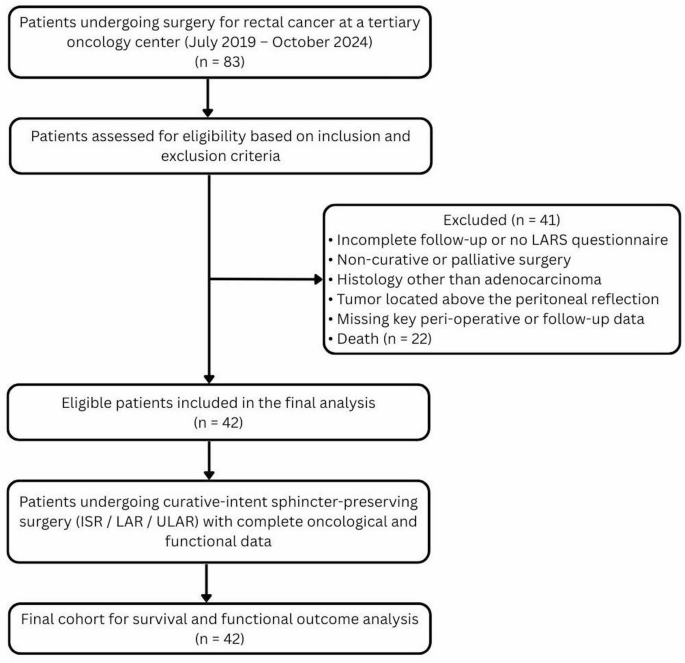
We evaluated 42 Indian patients who had undergone sphincter-preserving surgery for rectal cancer - a population the LARS literature has largely overlooked.
We found that bowel symptoms after surgery were common:
- 4% of patients had major LARS, meaning they experienced more severe bowel dysfunction.
- 2% had minor LARS.
- 4% had no LARS symptoms.
- Patients with tumors located closer to the anal opening were more likely to have worse LARS scores.
- Those undergoing lower rectal resections also tended to report more severe symptoms.
These findings were in line with what previous studies around the world have shown.
Nevertheless, another result surprised us.
When the numbers and the patient's experience do not match
Despite experiencing bowel symptoms:
- 8% of patients reported that they were satisfied with their bowel function overall.
- Even among patients with major LARS, 63.6% still reported feeling satisfied and having adapted well to life after surgery.
In other words, a high symptom score did not always mean that patients felt their quality of life was poor.
Why Might This Happen?
Several factors may contribute to this disconnect.
Survival often outweighs inconvenience.
Many patients expressed gratitude simply for being cancer-free. After confronting a life-threatening diagnosis, occasional urgency or increased frequency may be perceived as a reasonable trade-off.
Adaptation changes perception
Patients frequently develop coping mechanisms over time. Adjusting diet, scheduling daily activities around bowel habits, and learning about symptom triggers can improve confidence and satisfaction despite persistent symptoms.
Family and social support matter
In many Indian households, strong family support systems may ease the practical and emotional burden associated with bowel dysfunction.
Cultural context may influence symptom interpretation.
The LARS questionnaire was developed and validated predominantly in Western populations. It places significant emphasis on symptoms such as urgency and clustering.
Whether lifelong differences in diet, bowel habits, expectations of normality, and sociocultural attitudes influence how Indian patients interpret these symptoms remains uncertain. This hypothesis warrants further investigation in larger, multicentre cohorts.
What Does This Mean for Clinical Practice?
Our findings highlight an important message:
Scores matter, but so do conversations.
A high LARS score should prompt clinicians to explore how symptoms affect an individual's daily life rather than assume poor quality of life.
Conversely, patients who report satisfaction despite major LARS should not be dismissed as "doing well" without ongoing support and surveillance.
The score provides structure and comparability. The patient's voice provides meaning.
Looking Ahead
This was a single-center study involving a relatively small cohort, and our findings should be interpreted within these limitations. Larger prospective studies are needed to determine whether these observations are reproducible across diverse populations.
Nevertheless, our patients reminded us of an important truth that can easily be overlooked in survivorship care:
Recovery after cancer is not defined solely by the absence of symptoms. It is also shaped by resilience, adaptation, expectations, and the personal meaning individuals attach to their experiences.
As clinicians, we should continue to carefully measure bowel function.
However, we should also ask a simpler question:
"How are you living with it?"
Because the score tells us something important.
And so does the person sitting across from us.
Read the full article.
Our study, "Functional Outcomes After Sphincter-Preserving Surgery for Rectal Cancer: Exploring the Relationship Between LARS Severity and Patient Satisfaction in an Indian Cohort", is now available online through Springer Nature.
For researchers, clinicians, and survivorship specialists interested in patient-reported outcomes after rectal cancer surgery, we invite you to read the complete manuscript:
Article link: https://link.springer.com/article/10.1007/s12672-026-05000-5

Follow the Topic
-
Discover Oncology
This is a fully open access general oncology journal that aims to provide a unified forum for researchers and clinicians. The journal spans from basic and translational science, to preclinical, clinical, and epidemiology, and welcomes content that interfaces at all levels of cancer research.

Related Collections
With Collections, you can get published faster and increase your visibility.
Advanced in Therapy Targeting Cancer and Cancer Stem Cells [Volume II]
This Collection is dedicated to exploring the intricate landscape of cancer, with a special emphasis on cancer stem cells, reactive oxygen species (ROS), antioxidants, and the crucial roles of endoplasmic reticulum stress and oxidative stress in the progression and treatment of cancer. It seeks to uncover the complex biological mechanisms and pathways that are fundamental to the onset, development, and persistence of cancer, spotlighting the pivotal science behind cancer stem cells. These cells, a small but significantly impactful subset within tumors, have the capacity for self-renewal and are key drivers of tumor growth and metastasis, thereby playing a crucial role in the challenge of combating cancer recurrence. Additionally, the Collection delves into the nuanced role of ROS, which serves not only as agents of cellular damage but also as essential signaling molecules that can promote or inhibit cancer progression. This exploration sheds light on the delicate balance between oxidative stress and the body's antioxidant defenses, which is vital in the development and progression of cancer.
Moreover, this Collection investigates the impact of oxidative stress and endoplasmic reticulum stress on cellular health, particularly focusing on how an imbalance in ROS can lead to DNA damage, and how stress from misfolded proteins can trigger cellular responses that affect cell survival, apoptosis, and cancer development. These discussions aim to connect these stress mechanisms to the broader understanding of cancer biology.
Intended for researchers, clinicians, and students, this collection provides a comprehensive overview of current research findings and theoretical models at the intersection of cancer biology and cellular stress mechanisms. It aims to offer insights into potential therapeutic targets and interventions, with a pronounced emphasis on the role and therapeutic potential of targeting cancer stem cells. This focus is envisioned to contribute significantly to the development of more effective treatments for cancer, addressing both its onset and recurrence.
Keywords: cancer, cancer stem cells, reactive oxygen species, antioxidants, endoplasmic reticulum stress, oxidative stress
Publishing Model: Open Access
Deadline: Aug 31, 2026
Tumor Metabolism and Microenvironmental Adaptations: Emerging Targets for Cancer Therapy
Tumor cells thrive in hostile environments by rewiring their metabolism and dynamically adapting to microenvironmental stressors such as hypoxia, nutrient deprivation, acidosis, and immune surveillance. These metabolic adaptations not only support survival and proliferation, but also contribute to immune evasion, metastasis, and resistance to therapy. Simultaneously, the tumor microenvironment (TME), composed of stromal, endothelial, and immune cells, actively participates in shaping these metabolic landscapes through complex signaling and metabolic crosstalk.
This Collection aims to explore the intricate interplay between tumor metabolism and the TME, highlighting how these adaptive mechanisms can be exploited as novel therapeutic opportunities. We welcome original research articles and reviews that address, but are not limited to, topics such as metabolic plasticity in cancer, immunometabolism, metabolic interactions within the TME, hypoxia-driven pathways, metabolic targets in drug-resistant tumors, and innovative therapeutic strategies aimed at disrupting tumor metabolic networks. Submissions focusing on translational approaches or integrating multi-omics data to uncover actionable metabolic vulnerabilities are particularly encouraged. By advancing our understanding of these hallmarks of cancer, this Collection seeks to foster the development of metabolism-based therapies capable of overcoming current therapeutic limitations.
Keywords: tumor metabolism, tumor microenvironment, metabolic plasticity, drug resistance, cancer therapy
Publishing Model: Open Access
Deadline: Dec 04, 2026


Please sign in or register for FREE
If you are a registered user on Research Communities by Springer Nature, please sign in