More Than a Score: What Rectal Cancer Survivors Taught Us About Recovery




What matters more after rectal cancer surgery: the score we record, or the experience our patients describe?
More than half of the patients in our study had severe bowel dysfunction after rectal cancer surgery. However, nearly three-quarters still described themselves as satisfied with their bowel function.
This unexpected finding challenged a question we often assume we already know the answer to: do symptom scores always reflect how patients actually feel?
For many people diagnosed with rectal cancer, one of the biggest worries is whether they will need a permanent stoma. Fortunately, sphincter-preserving surgery has transformed rectal cancer care. By avoiding a permanent stoma, it offers patients the possibility of maintaining normal defecation.
However, life after surgery can come with its own challenges.
Some patients experience changes in bowel habits after surgery. They may need to use the toilet more frequently (frequency), have a sudden urge to go (urgency), pass stools multiple times within a short period (clustering), pass stool in small, unsatisfying installments (fragmentation), or occasionally struggle with leakage (incontinence). These symptoms are collectively known as Low Anterior Resection Syndrome (LARS).
The LARS score, a validated patient-reported outcome measure, is widely used to quantify these symptoms and has consistently been associated with impaired quality of life. Higher scores indicate a greater impact on bowel function. In our study, we wanted to understand not only what the scores showed, but also how patients themselves felt about their lives after surgery.
What did we study?
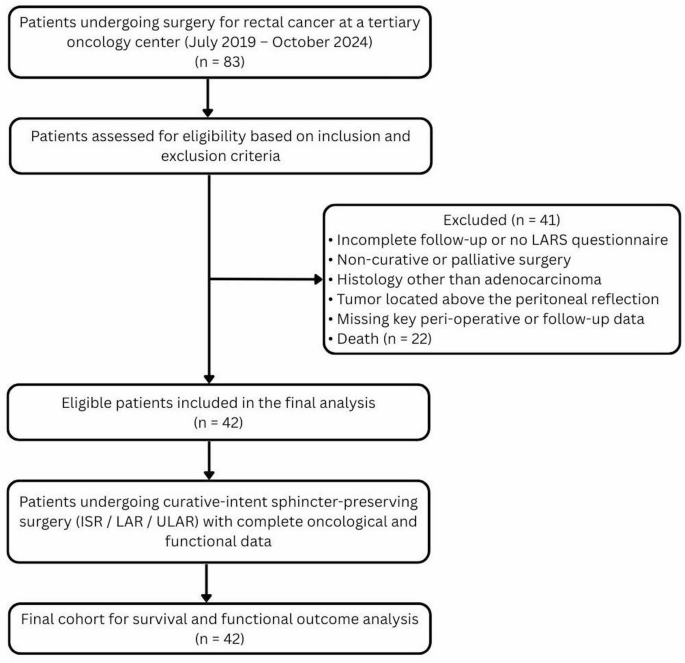
We evaluated 42 Indian patients who had undergone sphincter-preserving surgery for rectal cancer - a population the LARS literature has largely overlooked.
We found that bowel symptoms after surgery were common:
- 4% of patients had major LARS, meaning they experienced more severe bowel dysfunction.
- 2% had minor LARS.
- 4% had no LARS symptoms.
- Patients with tumors located closer to the anal opening were more likely to have worse LARS scores.
- Those undergoing lower rectal resections also tended to report more severe symptoms.
These findings were in line with what previous studies around the world have shown.
Nevertheless, another result surprised us.
When the numbers and the patient's experience do not match
Despite experiencing bowel symptoms:
- 8% of patients reported that they were satisfied with their bowel function overall.
- Even among patients with major LARS, 63.6% still reported feeling satisfied and having adapted well to life after surgery.
In other words, a high symptom score did not always mean that patients felt their quality of life was poor.
Why Might This Happen?
Several factors may contribute to this disconnect.
Survival often outweighs inconvenience.
Many patients expressed gratitude simply for being cancer-free. After confronting a life-threatening diagnosis, occasional urgency or increased frequency may be perceived as a reasonable trade-off.
Adaptation changes perception
Patients frequently develop coping mechanisms over time. Adjusting diet, scheduling daily activities around bowel habits, and learning about symptom triggers can improve confidence and satisfaction despite persistent symptoms.
Family and social support matter
In many Indian households, strong family support systems may ease the practical and emotional burden associated with bowel dysfunction.
Cultural context may influence symptom interpretation.
The LARS questionnaire was developed and validated predominantly in Western populations. It places significant emphasis on symptoms such as urgency and clustering.
Whether lifelong differences in diet, bowel habits, expectations of normality, and sociocultural attitudes influence how Indian patients interpret these symptoms remains uncertain. This hypothesis warrants further investigation in larger, multicentre cohorts.
What Does This Mean for Clinical Practice?
Our findings highlight an important message:
Scores matter, but so do conversations.
A high LARS score should prompt clinicians to explore how symptoms affect an individual's daily life rather than assume poor quality of life.
Conversely, patients who report satisfaction despite major LARS should not be dismissed as "doing well" without ongoing support and surveillance.
The score provides structure and comparability. The patient's voice provides meaning.
Looking Ahead
This was a single-center study involving a relatively small cohort, and our findings should be interpreted within these limitations. Larger prospective studies are needed to determine whether these observations are reproducible across diverse populations.
Nevertheless, our patients reminded us of an important truth that can easily be overlooked in survivorship care:
Recovery after cancer is not defined solely by the absence of symptoms. It is also shaped by resilience, adaptation, expectations, and the personal meaning individuals attach to their experiences.
As clinicians, we should continue to carefully measure bowel function.
However, we should also ask a simpler question:
"How are you living with it?"
Because the score tells us something important.
And so does the person sitting across from us.
Read the full article.
Our study, "Functional Outcomes After Sphincter-Preserving Surgery for Rectal Cancer: Exploring the Relationship Between LARS Severity and Patient Satisfaction in an Indian Cohort", is now available online through Springer Nature.
For researchers, clinicians, and survivorship specialists interested in patient-reported outcomes after rectal cancer surgery, we invite you to read the complete manuscript:
Article link: https://link.springer.com/article/10.1007/s12672-026-05000-5

Follow the Topic
-
Discover Oncology
This is a fully open access general oncology journal that aims to provide a unified forum for researchers and clinicians. The journal spans from basic and translational science, to preclinical, clinical, and epidemiology, and welcomes content that interfaces at all levels of cancer research.

Related Collections
With Collections, you can get published faster and increase your visibility.
Advances in Gastrointestinal and Neuroendocrine Malignancies
Gastrointestinal (GI) cancers and neuroendocrine neoplasms (NENs) represent a diverse and clinically challenging group of malignancies with rising global incidence especially among younger individuals. Colorectal, gastric, pancreatic, biliary tract, and hepatocellular carcinomas together account for a major proportion of cancer-related deaths worldwide. Similarly, NENs—once considered rare—are rising in incidence with heterogeneity in biology, clinical course, and response to therapy. Despite major progress in systemic treatments, surgical techniques, and molecular profiling, outcomes remain suboptimal for many patients.
In recent years, comprehensive molecular profiling has not only provided novel insights into tumor biology and resistance mechanisms but also helped uncover several actionable therapeutic targets. Parallel advances in immunotherapy, targeted therapies, and radiopharmaceuticals have reshaped the treatment landscape for select patient populations. At the same time, efforts to better understand tumor–microenvironment interactions, clonal evolution, and mechanisms of therapeutic resistance are yielding new opportunities for translational research.
This Collection aims to highlight recent advances in the biology, diagnosis, and management of GI cancers and NENs. We invite contributions spanning molecular and cellular mechanisms, biomarker discovery, innovative therapeutic strategies, clinical trial design, and translational approaches that bridge the gap from bench to bedside. Together, these works will underscore the evolving paradigms that hold promise for improving outcomes in these complex diseases.
Keywords: Gastrointestinal cancers, neuroendocrine neoplasms, biomarkers, tumor microenvironment, immunotherapy, radiopharmaceuticals, precision oncology, translational research
Publishing Model: Open Access
Deadline: Nov 06, 2026
The Evolving Landscape of Lung Cancer: Advances in Diagnosis, Treatment Strategies, and Simultaneous Care
Lung cancer remains one of the leading causes of cancer-related mortality worldwide, although recent years have seen remarkable progress in its clinical management. This Collection aims to deepen the evolving landscape of lung cancer through a comprehensive lens, including early diagnosis, molecular profiling (through liquid and tissue), therapeutic innovation, and simultaneous care strategies. The Collection will gather original research, reviews, short reports or letters and case studies focused on:
advances in early detection and biomarker discovery and development;
the evolution of precision oncology and molecular profiling;
updates on systemic therapies, including immunotherapy and targeted agents;
novel treatment combination strategies,
the increasing integration of simultaneous care into multidisciplinary models for improving patient outcomes.
Keywords: lung cancer; precision oncology; immunotherapy; molecular diagnostics; simultaneous care
Publishing Model: Open Access
Deadline: Dec 04, 2026