New insights into protective malaria vaccine responses: antibody specificity identifies children who are protected from malaria
Published in Microbiology, General & Internal Medicine, and Immunology


Explore the Research

Page Not Found | PLOS Medicine
Article by Alessia Hysa, Burnet Institute

Several malaria control measures exist including antimalarial drugs, insecticides and now two licensed paediatric malaria vaccines: RTS,S and R21. Despite this, malaria remains one of the most devastating infectious diseases globally, resulting in 240 million infections and 600,000 deaths annually, predominantly in young children under the age of 5.
The two current available vaccines RTS,S and R21 provide modest and short-lived protection against malaria in children (about 55-75% over 12-months), highlighting the need to understand how these vaccines work and which immunological responses drive protection in some children but not all.
In our recent study, “Antibody fine specificity correlates with protection from malaria for the RTS,S vaccine in young African children”, we asked:
what are the specific immunological responses occurring in young children who are protected against malaria and how does this compare to vaccinated children who remain unprotected following vaccination?
Looking beyond antibody magnitude.
RTS,S and R21 vaccines both target the Plasmodium falciparum circumsporozoite protein (CSP), the most abundant protein present on the parasite surface at the pre-erythrocytic stage (post mosquito bite and pre-entry into the liver). The CSP is composed of “N-terminal”, “central repeat” ,and “C-terminal” regions. The vaccine constructs include only a portion of the CSP “central repeat” region and the entire “C-terminal” region.
Typically, RTS,S and R21 immunogenicity studies define immune responses in young, vaccinated children by measuring antibody magnitude to the “central repeat” region. However, this is unable to consistently differentiate between vaccinated children who are protected and not protected from malaria.
Therefore, in our study, we focused on measuring antibody responses to specific CSP targets (epitopes) to evaluate if this could better identify protective immune responses. The specific CSP targets included:
- A short sequence from the “central repeat” region composed of NANPNANP amino acids (referred to as NANP2).
- A short sequence that overlaps the “N-terminal” and “central repeat” regions composed of KQPADGNPDPNANPN amino acids (referred to as the Junction) which is excluded from the vaccine construct.
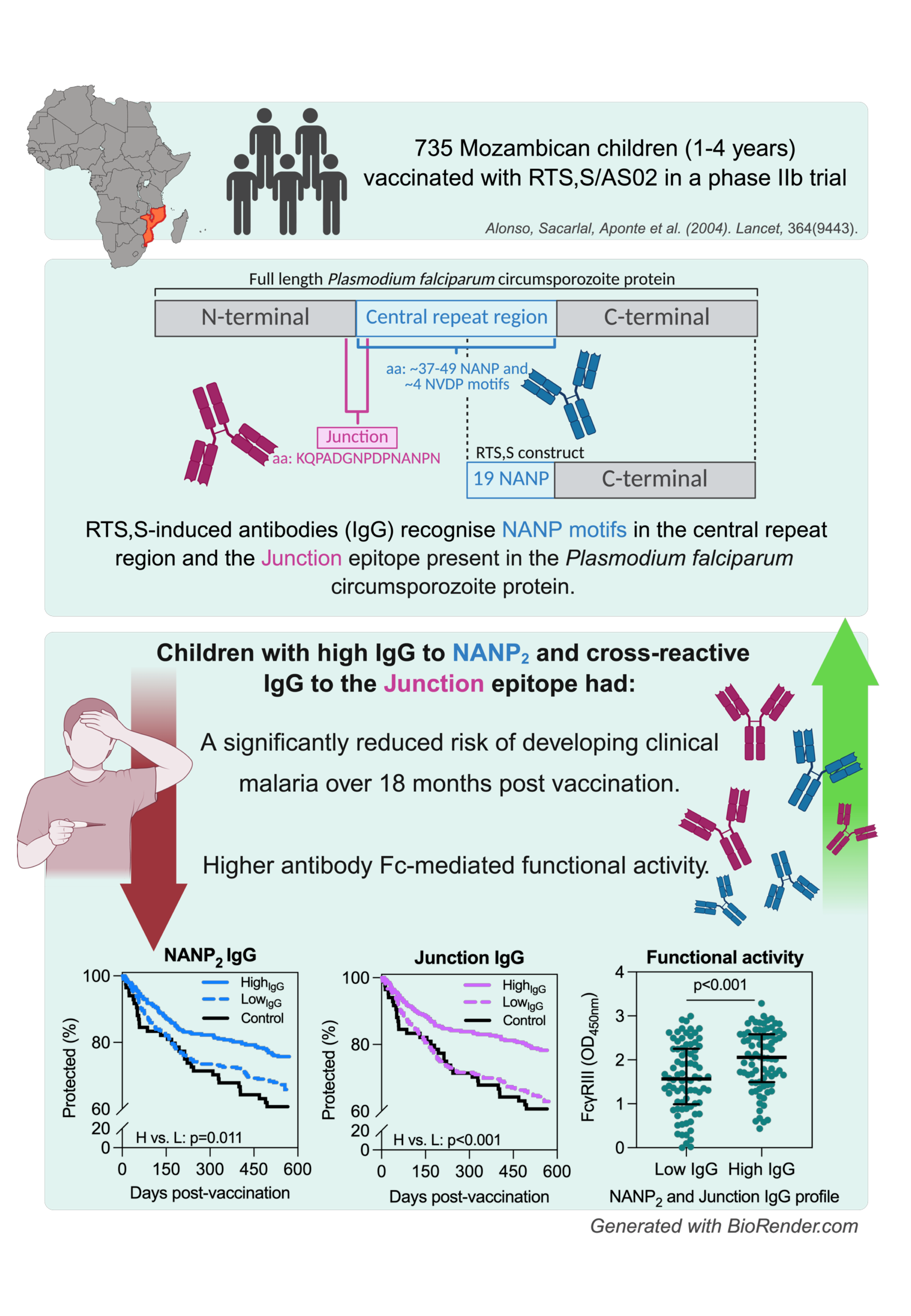
We measured antibody responses to NANP2 and antibody cross-reactivity to the Junction in 735 Mozambican children aged 1-4 years old who received one of the currently licensed vaccines (RTS,S) in a phase IIb trial.
A surprising finding: antibody specificity to a short NANP sequence and cross-reactivity to the Junction sequences were associated with protection from malaria.
RTS,S-vaccinated children developed antibodies that could bind the short NANP2 sequence and interestingly recognise (or cross-react) the Junction sequence even though that sequence is excluded from the vaccine construct.
A major finding was that children with high antibody responses to both the NANP2 and Junction sequence had a significantly reduced risk of developing clinical malaria over a period of 18 months post vaccination compared to children who had low responses to these important parasite targets. However, we found that measuring antibody responses to a sequence that represented the “central repeat” region could not effectively discriminate between protected and not protected children. The strongest protection was observed in children who generated high responses to both NANP2 and Junction sequences simultaneously and strikingly, children with low responses to both NANP2 and Junction had malaria rates similar to children who did not receive the RTS,S vaccine. Additional analysis demonstrated that children with high antibody responses to both NANP2 and Junction sequences also had enhanced antibody Fc-mediated functional activities including C1q complement fixation and FcgRIII binding, important immune responses linked with Plasmodium falciparum parasite elimination.
The specific antibody signatures we identified were able to effectively identify vaccinated children who were protected from malaria.
Only a sub-set of children develop protective immune responses post vaccination.
Despite all children receiving the same vaccine schedule within the same RTS,S trial, we observed high heterogeneity of responses. Only 19% of children in the study developed high antibody levels to both the NANP2 and Junction sequences, which we identified as the most protective antibody response profile. A majority of children (41%) demonstrated antibody specificity to a sequence that represents the “central repeat” region and was not linked with protection in our study, and a concerning subset of children (21%) demonstrated low antibody responses overall.
The differences we observed in antibody specificity may explain why not all children are protected following vaccination with the RTS,S vaccine.
Implications for future vaccine trials and next-generation vaccines.
Our findings have two major implications:
- We have identified valuable immunological correlates of protection which may be used in future vaccine trials to evaluate vaccine efficacy and monitor immune responses in vaccine recipients. Additional studies are required to confirm these results with samples from additional populations and age groups.
- The current malaria vaccine constructs could be optimised to promote higher antibody responses, across more children, to specific CSP targets linked with protection, such as the NANP2 and Junction sequences we identified in this study.
A huge thanks to our colleagues at Burnet Institute, ISGlobal, Universidade Eduardo Mondlane Mozambique, RMIT University, University of Leeds, ARTES Biotechnology and all the families who participated in the trial.
https://journals.plos.org/plosmedicine/article?id=10.1371/journal.pmed.1004877



Please sign in or register for FREE
If you are a registered user on Research Communities by Springer Nature, please sign in