Novel Agents for Chronic Lymphocytic Leukemia to Address Resistance
Published in Cancer and Genetics & Genomics



BTK Degraders
- Mechanism: These agents degrade Bruton tyrosine kinase (BTK), a key protein in B-cell receptor signaling, which is essential for CLL cell survival.
- Examples: NX-2127, BGB-16673, and NX-5948 have shown efficacy in relapsed/refractory (R/R) CLL.
- Non-Covalent BTK Inhibitors
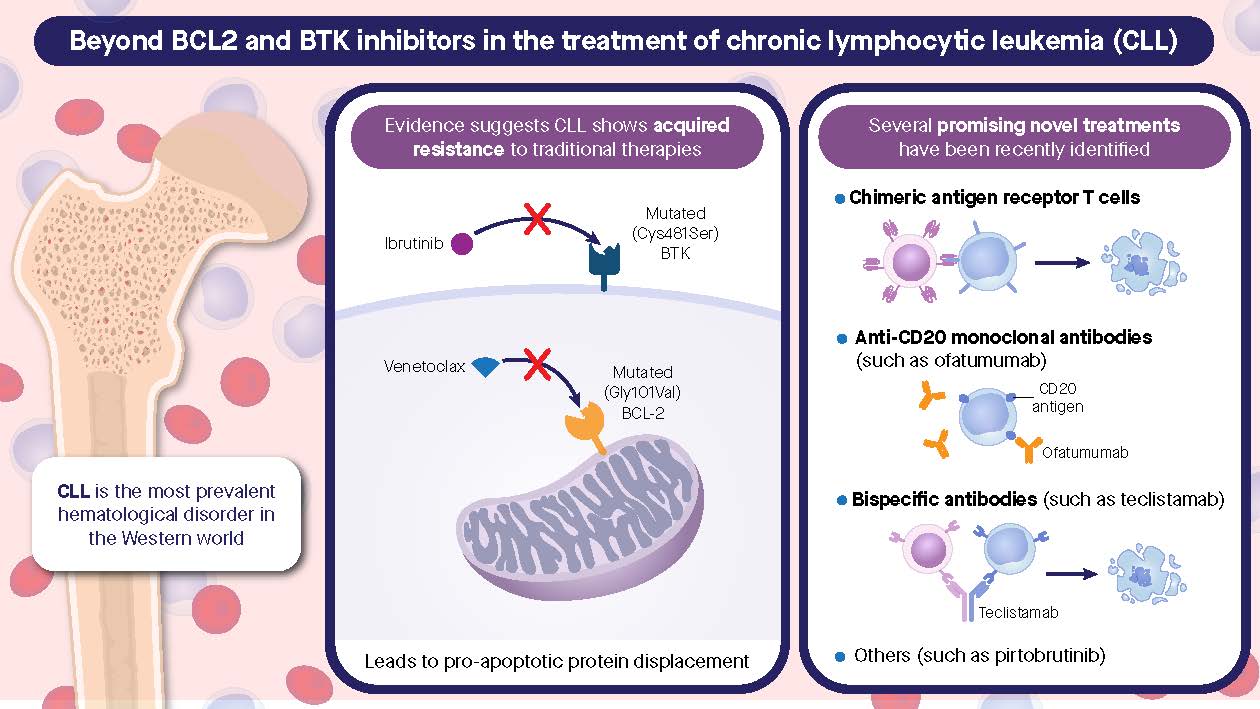
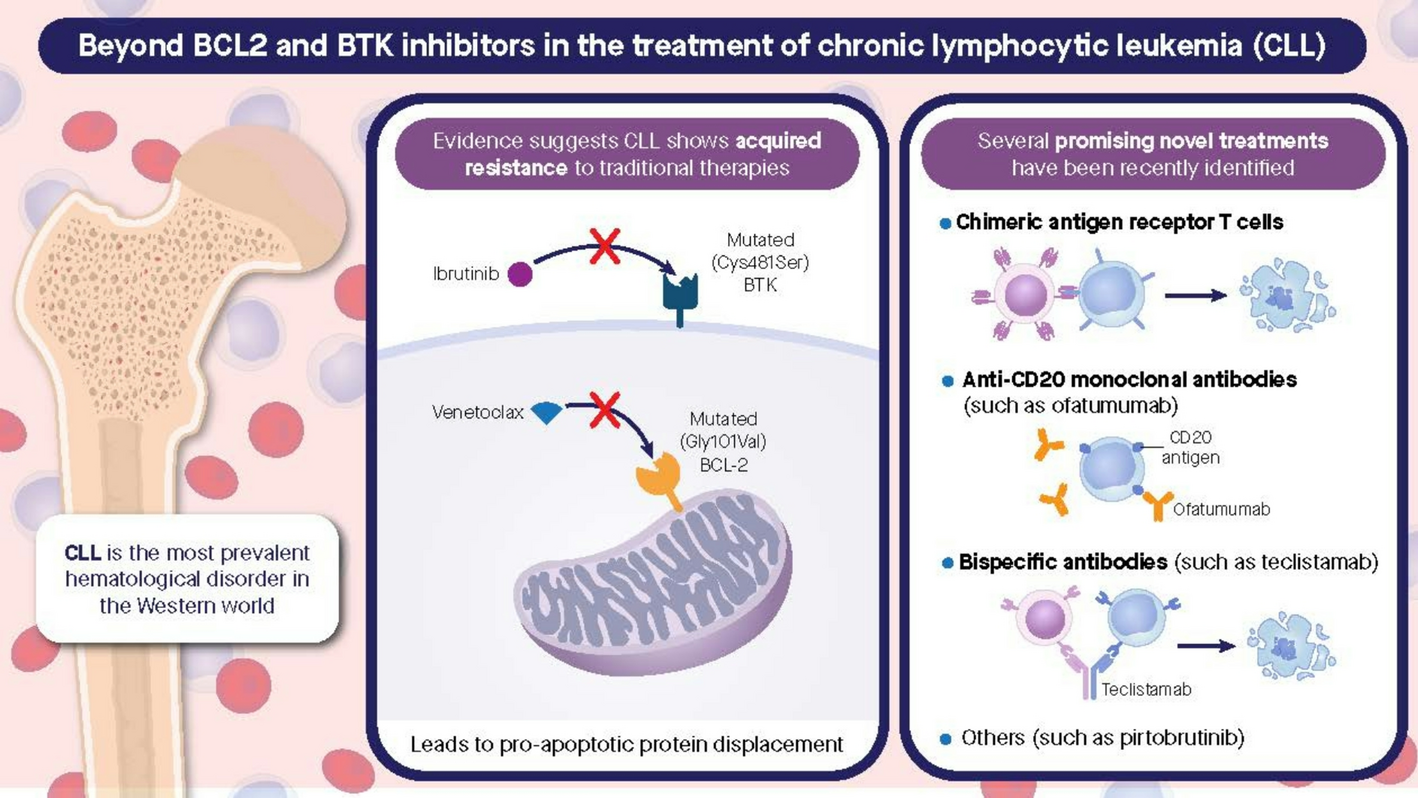
- Mechanism: These reversible inhibitors target BTK without relying on covalent binding, overcoming resistance caused by mutations like C481S.
- Examples:
- Pirtobrutinib: Demonstrates high selectivity and efficacy, even in heavily pretreated patients.
- Nemtabrutinib: Similar efficacy but less well-tolerated compared to pirtobrutinib.
- BH3 Mimetics
- Mechanism: Mimic pro-apoptotic proteins to inhibit anti-apoptotic BCL2 family proteins, promoting cell death.
- Examples: Venetoclax targets BCL2, while newer agents like sonrotoclax aim to overcome resistance caused by mutations like Gly101Val.
- Monoclonal Antibodies
- Mechanism: Target antigens on CLL cells (e.g., CD20, CD19, CD37) to induce apoptosis or recruit immune cells for cytotoxicity.
- Examples:
- Obinutuzumab: Anti-CD20 antibody with improved efficacy over rituximab.
- Otlertuzumab: Anti-CD37 antibody triggering apoptosis and antibody-dependent cell-mediated cytotoxicity.
- Bispecific Antibodies
- Mechanism: Bind both CLL cell antigens (e.g., CD19, CD20, BCMA) and CD3 on T cells, redirecting T cells to kill leukemia cells.
- Examples:
- Blinatumomab: Targets CD19 and CD3.
- Teclistamab: Targets BCMA and CD3.
- Chimeric Antigen Receptor (CAR) T Cell Therapies
- Mechanism: Genetically modified T cells express CARs targeting antigens like CD19, enabling direct killing of CLL cells.
- Examples: Lisocabtagene maraleucel (CD19 CAR T therapy).
- Siglec-6 Monoclonal Antibodies
- Mechanism: Target Siglec-6, a novel antigen absent on healthy cells, to activate T cells and eliminate CLL cells.
- Examples: RC-1 and RC-2 antibodies engineered for high specificity and potency.
- ROR1-Directed Therapies
- Mechanism: Target ROR1, a receptor tyrosine kinase expressed selectively on CLL cells.
- Examples: Cirmtuzumab and zilovertamab vedotin.
- Vg9Vd2-T Cell Engagers
- Mechanism: Activate Vg9Vd2-T cells to lyse CLL cells by targeting CD1d, a molecule expressed on leukemic cells.
- Example: Bispecific single-domain antibodies designed to boost T cell responses.
- Anti-BAFF Antibodies
- Mechanism: Target BAFF, a factor promoting CLL cell survival, to induce apoptosis.
- Examples: Belimumab and ianalumab.
- Precision Medicine Approaches
- Mechanism: Use predictive biomarkers (e.g., TP53, IGHV mutations) and machine learning algorithms to tailor treatments based on tumor heterogeneity and resistance profiles.
These novel agents address unmet clinical needs by targeting specific pathways, overcoming resistance mechanisms, and enhancing immune responses, offering hope for improved outcomes in CLL treatment.

Follow the Topic
-
Discover Oncology
This is a fully open access general oncology journal that aims to provide a unified forum for researchers and clinicians. The journal spans from basic and translational science, to preclinical, clinical, and epidemiology, and welcomes content that interfaces at all levels of cancer research.

Related Collections
With Collections, you can get published faster and increase your visibility.
Advances in Gastrointestinal and Neuroendocrine Malignancies
Gastrointestinal (GI) cancers and neuroendocrine neoplasms (NENs) represent a diverse and clinically challenging group of malignancies with rising global incidence especially among younger individuals. Colorectal, gastric, pancreatic, biliary tract, and hepatocellular carcinomas together account for a major proportion of cancer-related deaths worldwide. Similarly, NENs—once considered rare—are rising in incidence with heterogeneity in biology, clinical course, and response to therapy. Despite major progress in systemic treatments, surgical techniques, and molecular profiling, outcomes remain suboptimal for many patients.
In recent years, comprehensive molecular profiling has not only provided novel insights into tumor biology and resistance mechanisms but also helped uncover several actionable therapeutic targets. Parallel advances in immunotherapy, targeted therapies, and radiopharmaceuticals have reshaped the treatment landscape for select patient populations. At the same time, efforts to better understand tumor–microenvironment interactions, clonal evolution, and mechanisms of therapeutic resistance are yielding new opportunities for translational research.
This Collection aims to highlight recent advances in the biology, diagnosis, and management of GI cancers and NENs. We invite contributions spanning molecular and cellular mechanisms, biomarker discovery, innovative therapeutic strategies, clinical trial design, and translational approaches that bridge the gap from bench to bedside. Together, these works will underscore the evolving paradigms that hold promise for improving outcomes in these complex diseases.
Keywords: Gastrointestinal cancers, neuroendocrine neoplasms, biomarkers, tumor microenvironment, immunotherapy, radiopharmaceuticals, precision oncology, translational research
Publishing Model: Open Access
Deadline: Nov 06, 2026
The Evolving Landscape of Lung Cancer: Advances in Diagnosis, Treatment Strategies, and Simultaneous Care
Lung cancer remains one of the leading causes of cancer-related mortality worldwide, although recent years have seen remarkable progress in its clinical management. This Collection aims to deepen the evolving landscape of lung cancer through a comprehensive lens, including early diagnosis, molecular profiling (through liquid and tissue), therapeutic innovation, and simultaneous care strategies. The Collection will gather original research, reviews, short reports or letters and case studies focused on:
advances in early detection and biomarker discovery and development;
the evolution of precision oncology and molecular profiling;
updates on systemic therapies, including immunotherapy and targeted agents;
novel treatment combination strategies,
the increasing integration of simultaneous care into multidisciplinary models for improving patient outcomes.
Keywords: lung cancer; precision oncology; immunotherapy; molecular diagnostics; simultaneous care
Publishing Model: Open Access
Deadline: Dec 04, 2026