Overlooked upwind greening for urban cooling
Published in Earth & Environment, Ecology & Evolution, and Sustainability
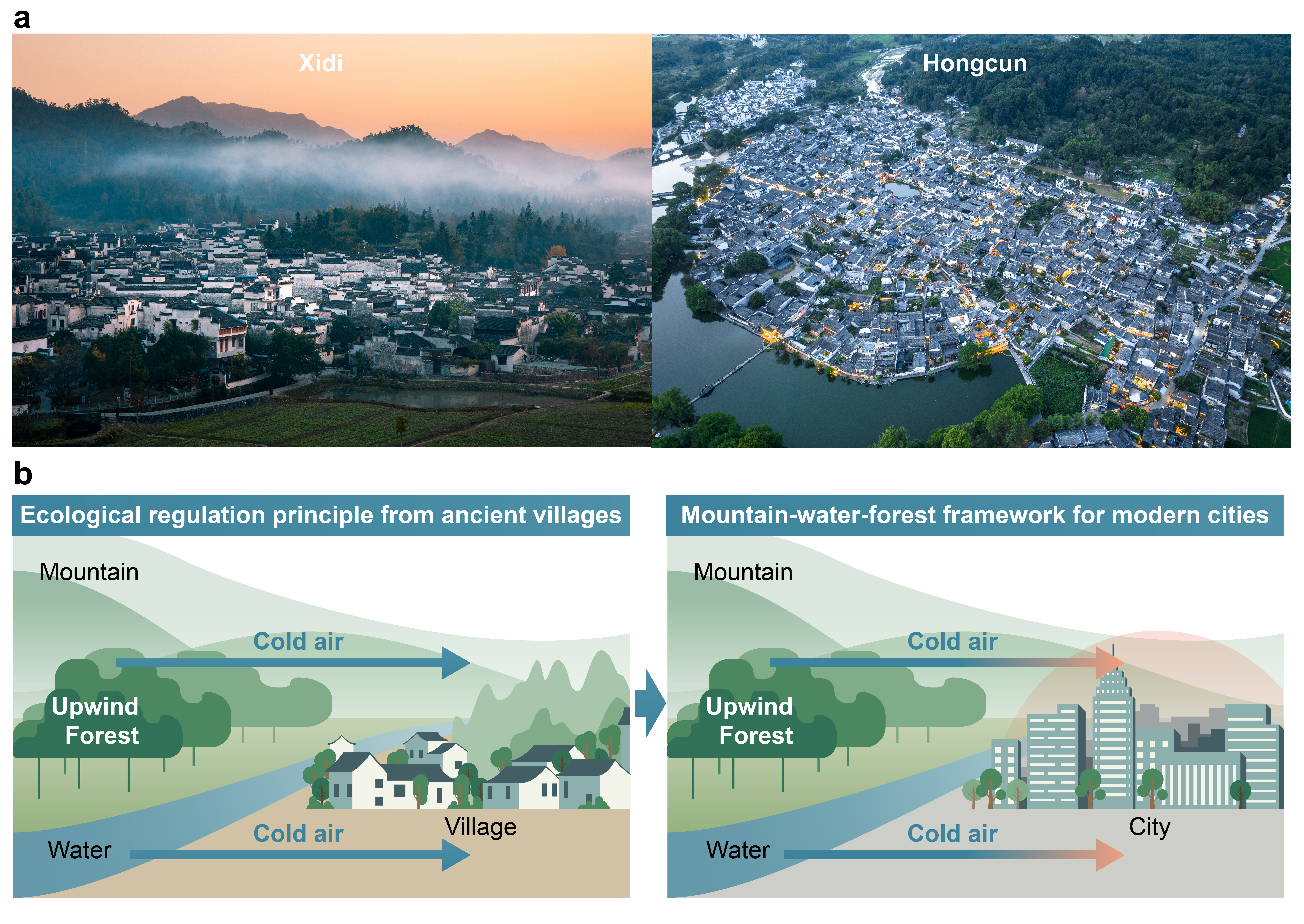
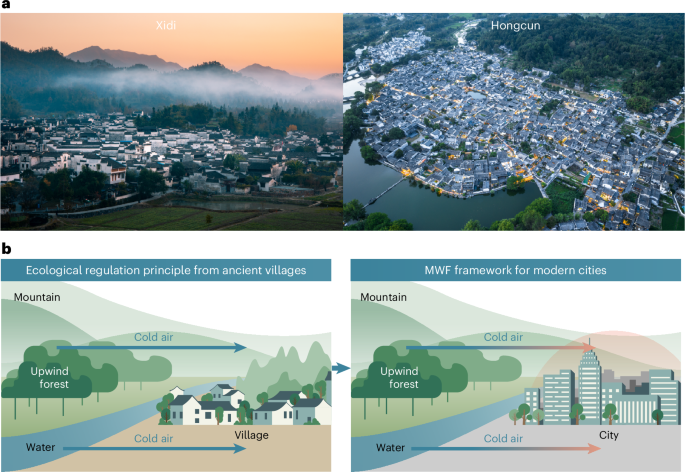

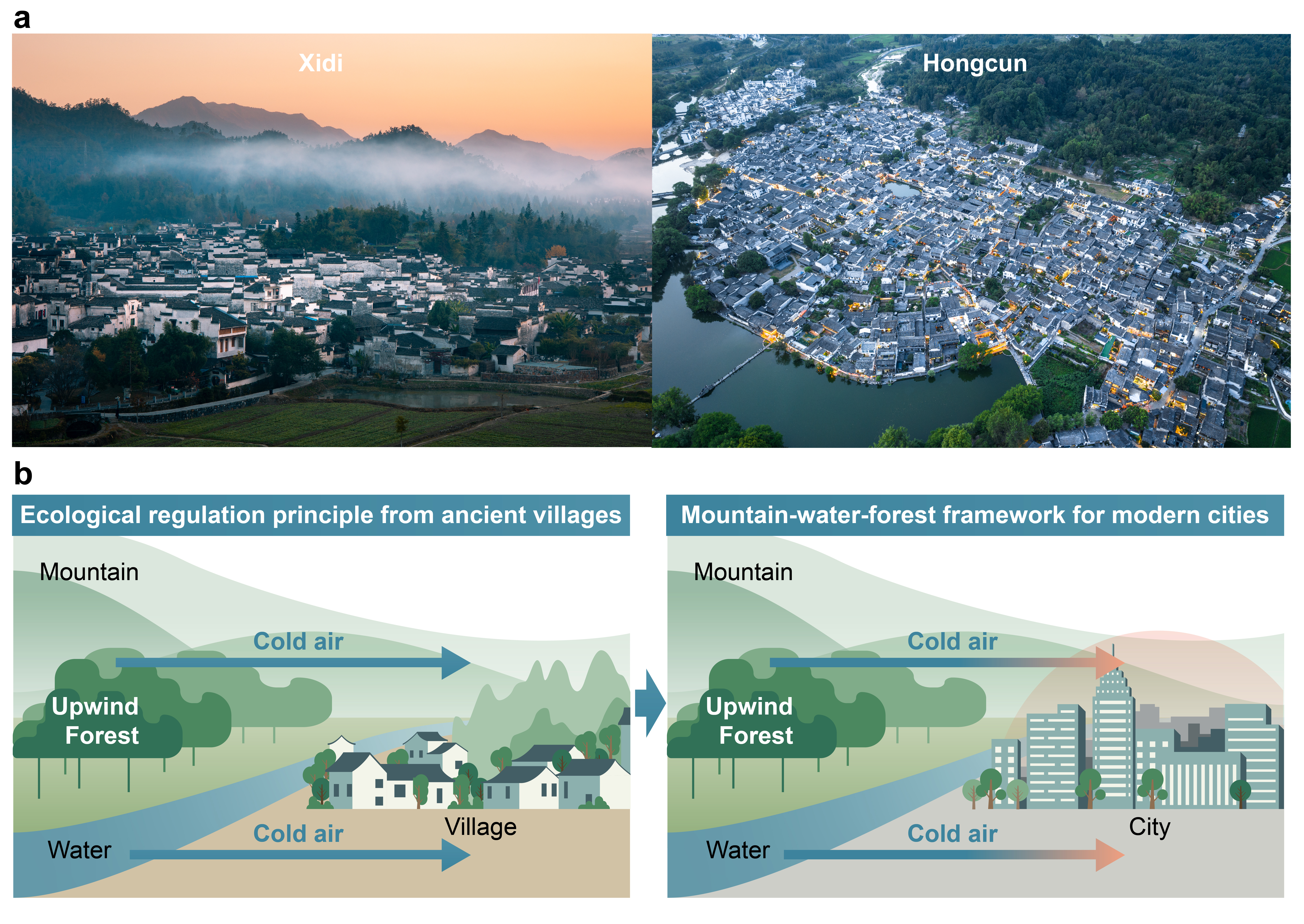
Traditional examples and conceptual illustration of the Mountain–Water–Forest (MWF) framework.
When we think about cooling a city, we usually look within it. We plant street trees, build parks, install green roofs or replace dark surfaces with reflective materials. These measures are valuable, but they are often constrained by dense development and limited space. Our study began with a different question: could landscapes outside a city help cool the city—and the people living within it?
The idea was inspired by traditional Chinese villages such as Xidi and Hongcun. Their spatial organisation is often described through a mountain–water–forest framework: settlements are positioned in relation to surrounding mountains, water bodies and forests, rather than designed as isolated built-up areas. Terrain shapes airflow, vegetation cools the surface and the air above it, and water can further influence local temperature and circulation. Together, these elements form an interconnected climate-regulating system that creates a comfortable living environment for village residents.
In our paper, Overlooked Upwind Greening for Urban Cooling, we asked whether this long-standing spatial principle could be translated into a modern, scientifically testable strategy for megacities.
Can Ancient Wisdom Cool Modern Cities?
Translating this idea to modern megacities was far from straightforward. Megacities are much larger, more spatially fragmented and more thermally complex than traditional villages. They contain dense buildings, extensive road networks, industrial areas and substantial anthropogenic heat emissions. Their local climates are also shaped by regional atmospheric circulation, rainfall, coastlines and topography. At this stage, these complexities led us to focus on one key question: how effectively can the MWF framework mitigate urban heat, and through which physical mechanisms?
To investigate this idea, we selected Beijing, a mountain-adjacent city, and Shanghai, a coastal city, as our primary case studies. In paired numerical experiments, selected suburban surfaces were represented either as woody savannas or as urban and built-up land. Using a diagnostic framework based on surface energy balance and land–atmosphere coupling, we decomposed the resulting changes in urban near-surface air temperature into contributions from radiation, latent heat, sensible heat, ground heat storage and airflow-related transport.
The results showed that advective transport was the dominant mechanism through which suburban greening cooled urban areas, producing urban-core temperature reductions of around 0.7 °C in the primary experiments. The spatial patterns of temperature and wind provided further evidence for this mechanism: cooling occurred mainly downwind of the vegetated zones, could extend across more than half of the urban area and gradually weakened with distance. In contrast, areas located upwind of the vegetation showed little or no temperature change.
Together, these findings demonstrate the potential to adapt the mountain–water–forest framework of traditional Chinese villages to modern megacities and reveal a clear two-step cooling pathway. First, suburban vegetation cools the near-surface air above it through processes such as shading and enhanced evapotranspiration. Prevailing winds then transport these cooler air masses from the city’s upwind surroundings into the urban area, delivering a spatially extensive cooling effect.
Can This Cooling Strategy Work Everywhere?
The initial results were encouraging. However, we soon realised that cities differ substantially in their spatial configurations and climatic backgrounds, and that these variations could influence the cooling performance of upwind greening. To examine whether the strategy could remain effective across diverse urban contexts, we conducted a series of sensitivity experiments.
To investigate spatial heterogeneity, we modified the mountain–plain configuration surrounding Beijing and adjusted the land–water distribution around Shanghai. Despite these changes, the temporal and spatial patterns of cooling induced by upwind greening remained broadly consistent, indicating that the cooling pathway was relatively stable across different surrounding landscapes.
We then expanded our analysis to six additional cities—Cairo, Houston, Kinshasa, London, São Paulo and Sydney—to examine the strategy across different climatic regions. Based on three years of simulations, we found that upwind greening consistently reduced near-surface air temperature and heat stress across all eight cities, although the magnitude and timing of cooling varied with local climatic and geographical conditions. Overall, the framework generated approximately 0.4 °C of cooling across more than half of the urban area.
Together, these results suggest that upwind greening can provide a robust and broadly transferable cooling strategy across cities with diverse geographical and climatic characteristics.
How Can This Idea Shape Urban Planning?
In this study, we translate the mountain–water–forest framework into a scientifically grounded strategy for urban cooling. Its application depends on two relatively straightforward conditions: persistent directional winds and sufficient upwind suburban space for vegetation. This points to a practical and sustainable vision for climate adaptation. Rather than relying solely on intensive interventions within cities, upwind greening can establish a moderate yet spatially extensive background cooling effect that complements urban parks, street trees, highly reflective materials and other heat-mitigation measures.
We also considered how this strategy could be integrated into real-world urban planning. Creating large new suburban forests is not always feasible because of land constraints and competing demands. Instead, upwind greening could be incorporated into existing spatial systems, such as peri-urban parks, highway green buffers, ecological corridors or multifunctional agroforestry landscapes. Each city will require context-specific solutions that consider land availability and ownership, water resources, maintenance costs, biodiversity, air quality and the needs of local communities.
For us, the broader lesson is that cities should not be treated as climatically isolated entities. Their thermal environments are connected to surrounding forests, agricultural land, mountains, rivers, coastlines and regional airflow systems. Traditional settlement knowledge recognised this interdependence long before modern numerical models could quantify it.
By combining this spatial wisdom with contemporary climate modelling, we hope to offer a new way of thinking about nature-based adaptation: the key lies not only in creating more green space, but also in positioning it where it can work in synergy with the wider surrounding environment.

Sustainable Built Environment; Fast Prediction; Sustainable Cities; Climate Change
Follow the Topic
-
Nature Cities
This journal aims to deepen and integrate basic and applied understanding of the character and dynamics of cities, including their roles, impacts and influences — past, present and future.

What are SDG Topics?
An introduction to Sustainable Development Goals (SDGs) Topics and their role in highlighting sustainable development research.
Continue reading announcement