Parsy, a set of parameter symbols constructed from 6 strokes
Published in Arts & Humanities




1. Introduction
In the course of developing a quantum framework for information processing theory (https://www.nature.com/articles/s41598-026-46604-9), my postdoctoral fellow and I encountered a rather interesting challenge: the necessity to define an extensive array of parameters led us to exhaust the available letters and alphabets, thereby risking ambiguity through the repeated use of identical symbols.
The utilisation of diverse typographical styles serves as a conventional means to convey distinct meanings. Capital letters are traditionally employed to denote sets, random variables, and parameters, among other entities. Conversely, lowercase letters are reserved for modelling and experimental variables, certain constants, and functions. Greek letters are often used to represent parameters, specific notations, and constants such as π. However, it is noteworthy that the use of Greek capital letters is somewhat limited due to their visual similarity to Roman capitals. Calligraphic fonts are typically used to signify collections and domains, while blackboard bold fonts are designated for particular sets, such as the real and complex numbers, and functions like expectations. Gothic fonts, though seldom used due to their readability issues, are occasionally applied to specific domains. Furthermore, subscripts and superscripts are employed to denote extensions.
Because our models are so complex - they involve numerous variables, parameters, and sets - we wanted a systematic approach to naming conventions to improve mathematical readability. However, existing conventions often result in a scattered distribution of symbols, particularly when these symbols bear specific meanings. This scattered utilisation poses challenges, as the absence of a coherent system hinders the effective association of symbols, especially when certain symbols are inaccessible. Consequently, there is a compelling need to explore the development of a novel typographical class that could potentially introduce a new dimension in the representation of modelling variables.
2. The invention of the Parsy system
One sleepless night, 12 February 2025, I wondered why numerical systems in their representation of quantities would start out systematically and then give up to randomly use other symbols. For example, the Roman numerals i, ii, iii, iiii became iv for abbreviation, and from there we moved into v, vi, and then the symbol changes again into x, xi, etc. The same representational inconsistency is found in Chinese: 一, 二, 三, and then breaking the system: 四. Alphabets are worse: random constellations of lines and curves without any systematicity to them. Only tallies are systematic but become impossible to write down, the larger the number they represent. They are not compact.
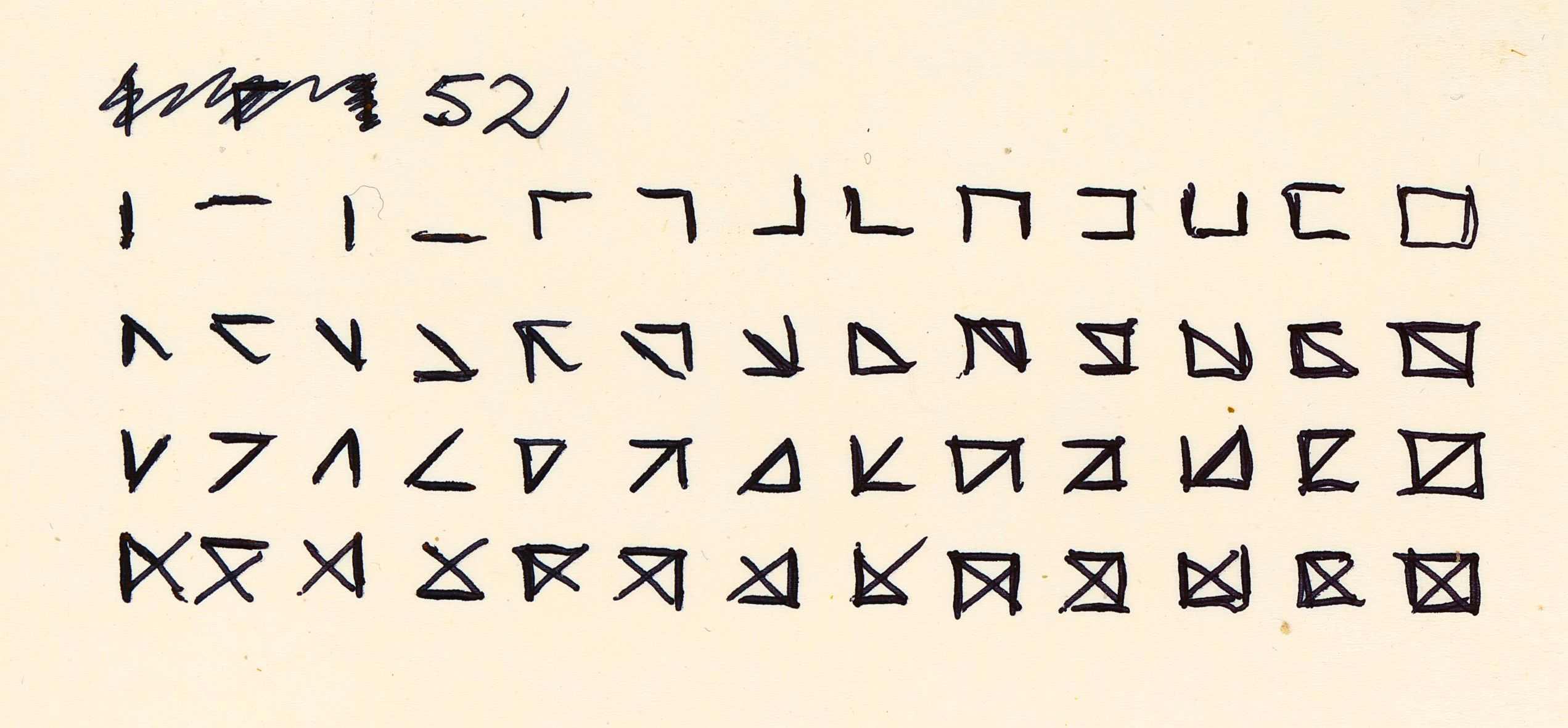
Figure 1. First conception of the parameter-symbol system or ‘Parsy’ (12 February 2025).
That night, I went out of bed and embarked upon some communication design, crafting 52 novel parameter symbols derived from a mere six lines. The first result is depicted in Figure 1. These symbols were partially inspired by Chinese calligraphy grids, which help learners to balance their characters, maintain proper placement of the strokes, and to make sure that sizes stay consistent. Particularly the ‘rice grid’ (米字格) is a box with a cross plus two diagonal lines, creating an 8-section grid that resembles the character for rice: 米. These diagonal lines help align the corners of characters, in support of teaching beginners the structure of Standard Script.
Because each Parsy consists of a block with 1 up to 6 strokes at designated positions within the block, the same strokes put in a circle lead to 104 distinct parameter symbols, &c. If so wanted, Parsy can be expanded to triple or quadruple its current capacity (and beyond if we exchange the ballot ☒ for a cross +).
Presently, I compiled a comprehensive list that encapsulates this symbolic system (Figure 2). For effective discourse and computation, I thought it was imperative that these symbols were endowed with both names and numerical identifiers.
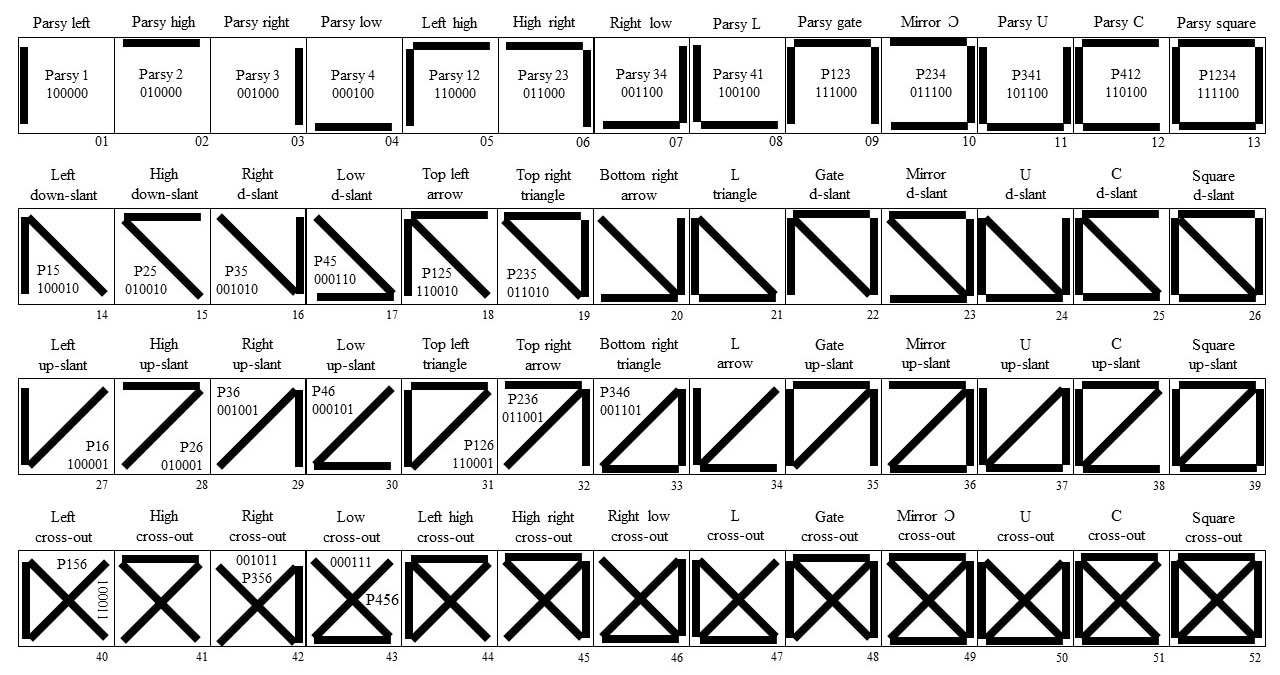 Figure 2. Parsy names and numerical identifiers.
Different from any other ‘alphabet,’ Parsy is completely systematic and predictable, so even without having it designed yet, we already know that Parsy 104 will be a circled diagonal cross, which, to avoid ambiguity, should not be used when the mathematics have a circle with a multiplication sign inside it, known as a ‘circled times’ (e.g., to indicate a tensor product).
3. A bespoke font
For the various Parsy designs I created, one of them depicted in Figure 2, Thomas Ng, a Hong Kong typographer, produced three digital font files . The fonts Parsy Sans Bare, Parsy Sans Circle, and Parsy Sans Square are depicted in Figure 3. The .otf are available upon written request.
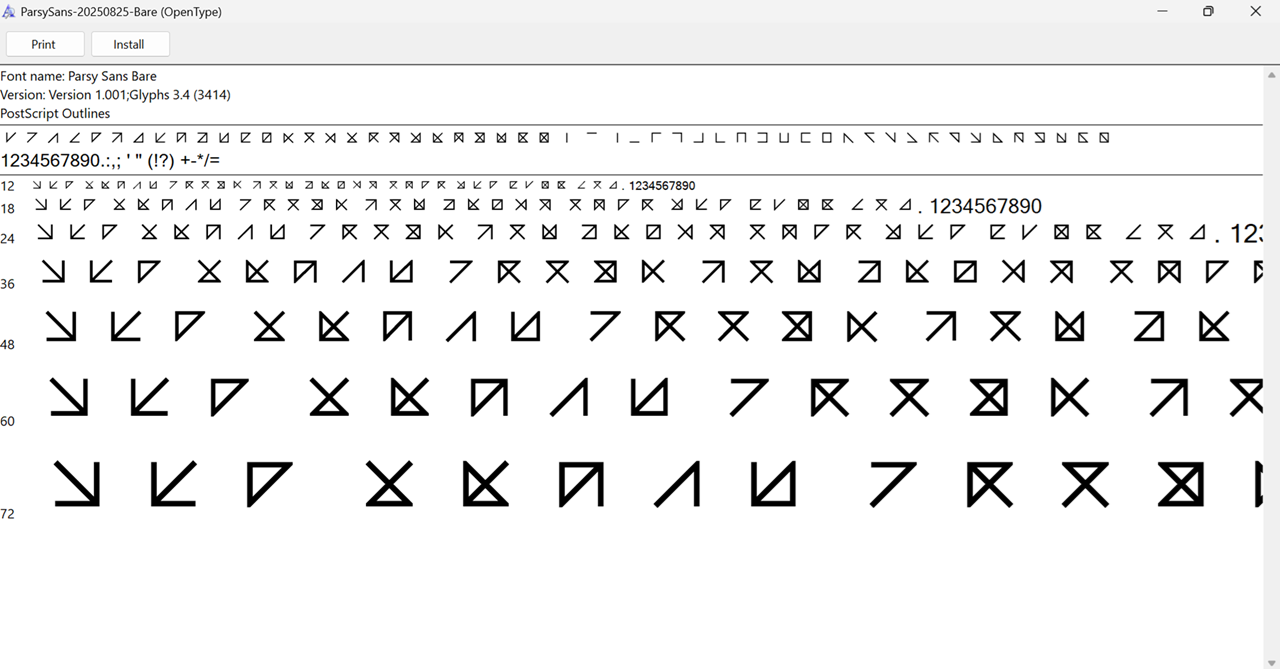
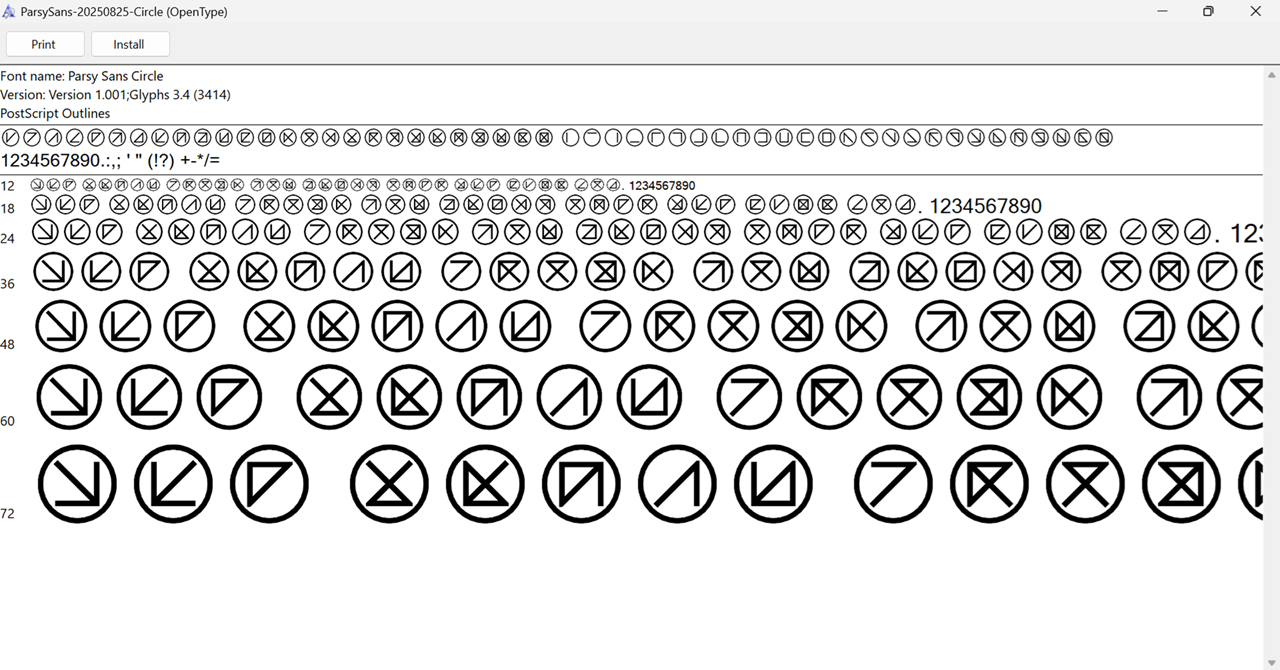
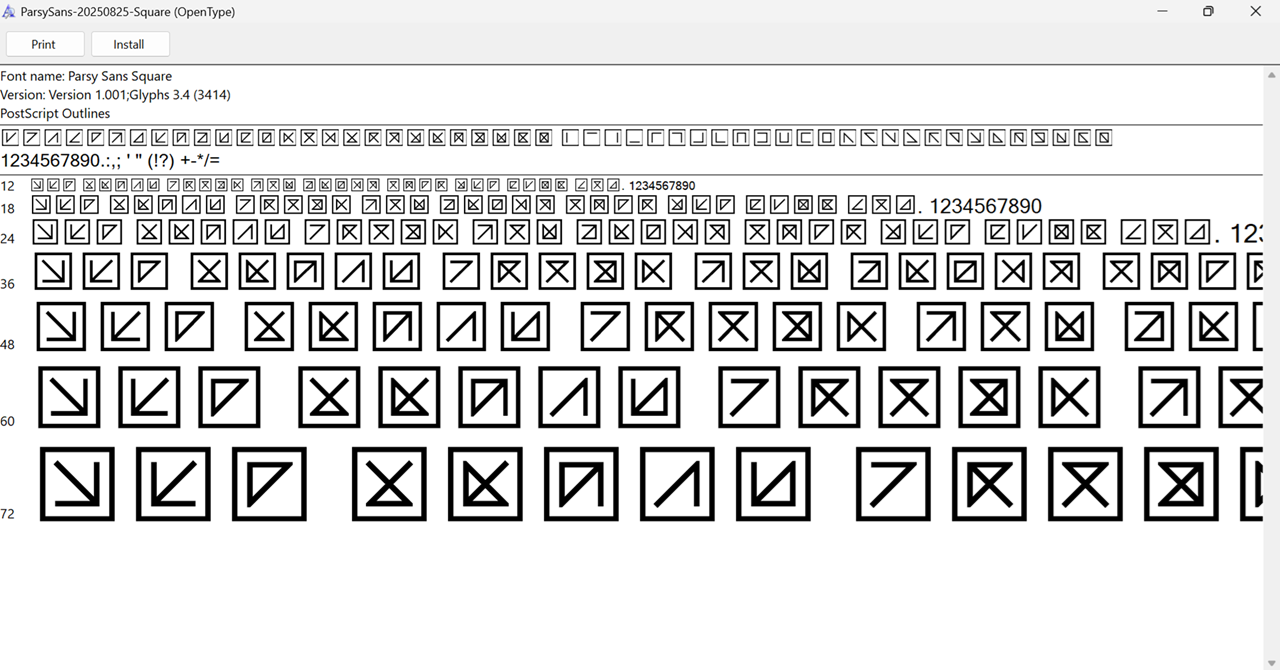
Figure 3. Parsy Sans Bare, Parsy Sans Circle, and Parsy Sans Square. The .otf were made by Thomas Ng.
4. Use case: Parsy system representing quantum probability
The current section will be harder to follow because the contents are about modelling uncertainty, ambiguity, and vagueness while borrowing the logics from quantum dynamics. Thus, the focus will not be on the equations but rather on the use of the Parsy parameter symbols and how they rationalise and clarify the way in which the equations function more than randomly assigning alphabet letters.
I asked my postdoctoral fellow Johnny K. W. Ho to apply Parsy to the formulae in our paper about Quantum Epistemics (https://www.nature.com/articles/s41598-026-46604-9), and report back his experiences in actually using this new and unfamiliar systematic naming of parameters in an equation. Here is what he wrote back to me.
Johnny wrote: The Parsy symbol system can be interpreted as inherently multi-index: the combination may be regarded as a Cartesian product of:

except blank (x000000), diagonal-only strokes (x000010, x000001, x000011) and characters of two and only two parallel strokes (x101000, x101010, x101001, x101011, x010100, x010110, p010101, p010111), forming 26 – 12 = 52 symbols per numerical identifier x (= P,C,D) (Figure 2). The highly geometric and index-nesting properties offer practical contextual usage. For example, in Quantum Epistemics, the construction of positive value-operator measurement (POVM) Π involves a multi-step modelling of similarity-dissimilarity measurement (Π'sim & Π'diss) and category-aligned (Π') and -unaligned (Π'') Hilbert spaces that combine to form the category partite (Πc), as the complement of the observer (Πo). The tensor product of the two partite forms one POVM component (Πm, where m is the index set (c,o)). Rather than denoting the domains with primes (') and long subscript labels, this build-up can be illustrated by assigning Parsy to different domains: ╲ for ‘similar’ and ╱ for ‘dissimilar,’ ‘| ’ (left stroke) as Π'' and ‘F’ as the observer domain. Therefore, the build-up is (1) aligning the Hilbert space of the category (Π'' → Π' ) through the external-feature operator F, which is denoted by ‘__’ (bottom stroke) here, (2) forming the similarity-dissimilarity weighted component Πc from the constituting elements (Π'sim, Π'diss → Πc), and (3) combining the category and observer component (Πc , Πo → Πm). Then, combining the above notations, Eq. (17)
Π'c = R (Π''c ⊗ Fc) (1)
will be written as (2)
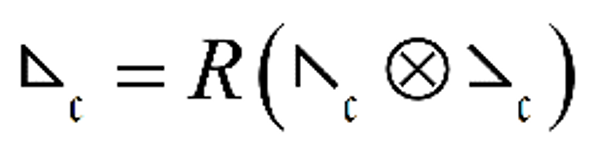
for the similarity domain, and (3)
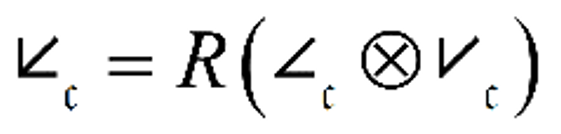
for the dissimilarity component. The similarity–dissimilarity weighted component can be denoted by the cross ╳ , turning Eq. (18) :
 (4)
(4)
into:  (5)
(5)
It can also be inferred that putting 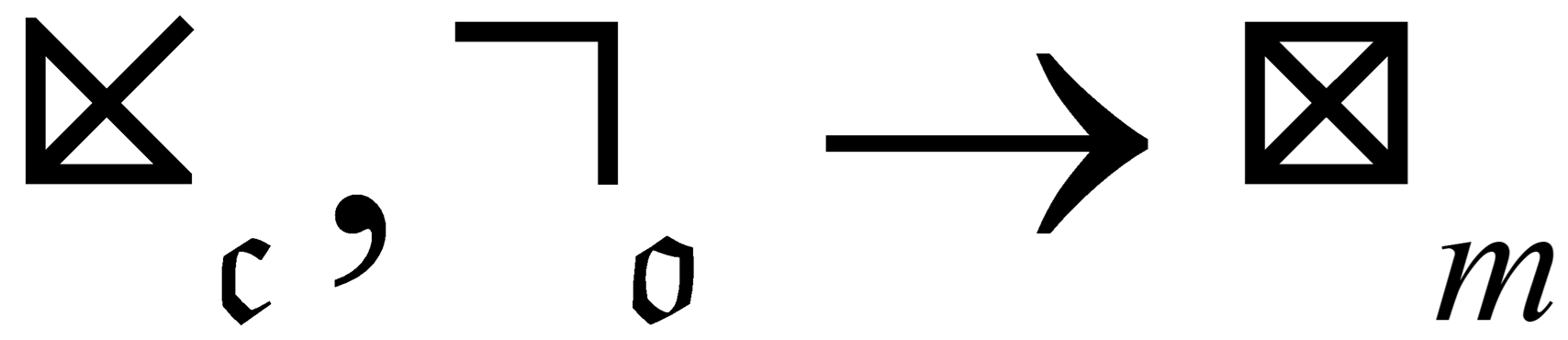 in Eq. (23), turns
 (6)
(6)
into (7)
(7)
The above example shows how Parsy typography allows for geometric visualisation of quantity integration (algorithmic reduction), illustrated by Figure 4.
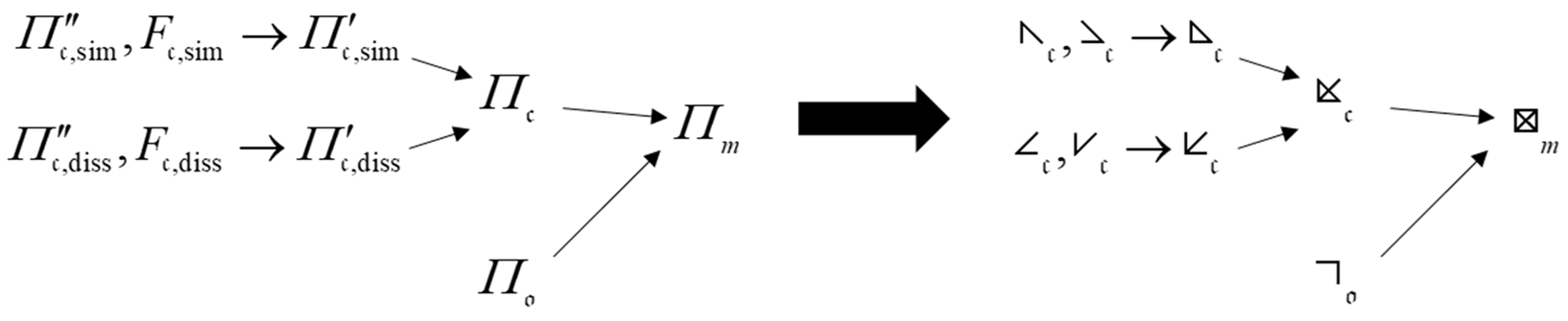 Figure 4. Overview of transforming conventional symbols into the Parsy system. If symbols are chosen well, they graphically show the conceptual synthesis (or reversely, the breakdown) of the quantities.
The merits of using the Parsy symbols is evident: Parsy saves on subscripts such as ‘sim’ and ‘diss,’ and eradicates primes (') by embedding them in the symbol. This makes the symbol concise, where the remaining subscripts c, o can cleanly represent category and observer state as the extrinsic parameters; the intrinsic parameters are absorbed in the Parsy itself. While all Π’s have interrelations, the Parsy parameter symbols are able to represent the role of every symbol and the integration process explicitly. After learning this new ‘alphabet,’ the issue of cognitive overload caused by numerous similar symbols can be mitigated.
In the examples shown so far, all domains are binary. In general, symbol domains also can be combined to represent multi-valued labels (e.g., combining the horizontal and vertical strokes sets to form  or any subset of it). Other polygons can also be derived for specific uses, just like extending the 3-dimensional differential operator, inverted delta, to the 4-dimensional d’Alembert operator (□). That not all geometric Parsy carry conventional, straightforward phonetic names may imply that the use of it has to be carefully considered for effective formalism presentation. Arguably, variables with ‘tagged’ names, especially those defined with the tag, such as E for electric field, G for Gibbs free energy, are well-suited to be assigned with (standard) alphabetical variables (Roman or Greek). However, variables that have elaborated meaning and are nontrivial to be understood with simple jargon, such as the external-feature operator: ‘the operator that spans the Hilbert space containing the complement of that of the truncated category according to the similarity/dissimilarity measure,’ may be appealing candidates to represent through the Parsy system.

Follow the Topic
-
Scientific Reports
An open access journal publishing original research from across all areas of the natural sciences, psychology, medicine and engineering.

Related Collections
With Collections, you can get published faster and increase your visibility.
Cancer Prevention and Control
Publishing Model: Hybrid
Deadline: Feb 19, 2027
Healthy Aging
Publishing Model: Open Access
Deadline: Dec 31, 2026