Perfect Absorption in Hyperfine Levels of Molecular Spins with Hermitian Subspaces
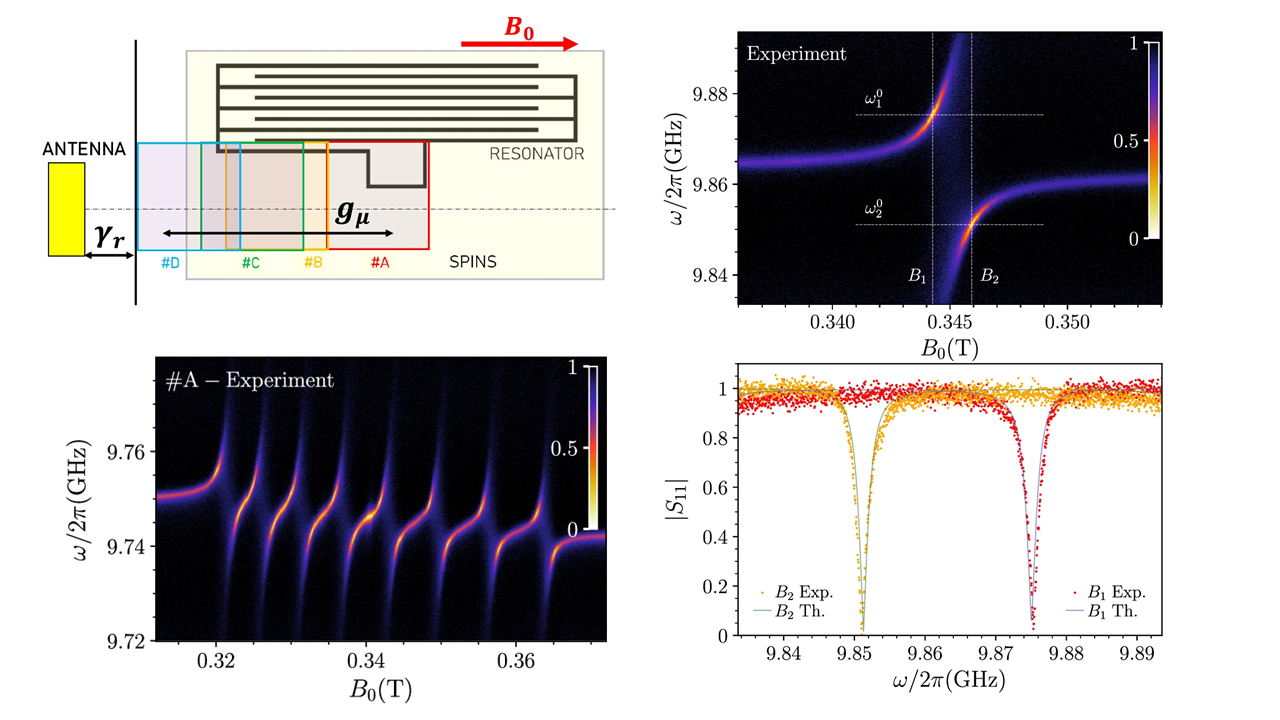

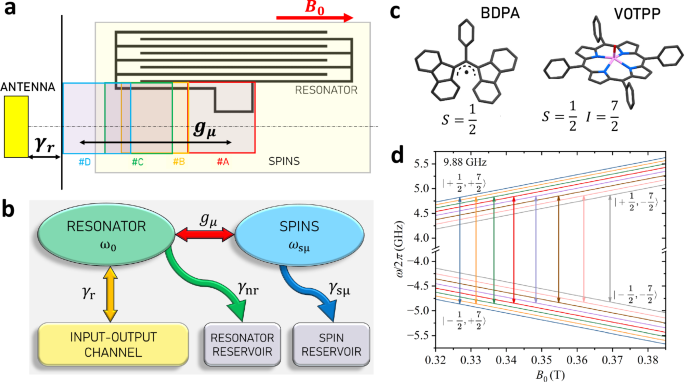

Perfect Absorption (PA) of radiation has been observed in several systems working at optical frequency, such as microdisks, slab waveguides, optical metamaterials or nanostructured semiconductors. A similar phenomenon has been realized also at microwave frequencies, in particular using microwave resonators or cavities coupled to ferromagnetic Yttrium-Iron-Garnet (YIG) spheres. These implementations exploit systems formed by passive components and fed with one or more input signal/s. Here, the necessary balance between incoming energy and losses is achieved by adjusting the coupling of the system with the feeding line/s and/or the losses of the system. Along this line, paramagnetic spin centers diluted in a non-magnetic matrix or crystal have been only marginally investigated.
Molecular spins can have large potential for quantum technologies, especially when embedded into planar microwave superconducting resonators. Here, the encoding of molecular-based spin qubits [C. Bonizzoni et al. npj Quantum Inf. 6, 68 (2020)] and the possibility to perform their readout with dispersive (i.e., non-resonant) techniques [C. Bonizzoni et al. Adv. Quantum Technol. 4, 2100039 (2021)] or by using machine-learning approaches [C. Bonizzoni et al. Phys. Rev. Appl. 18, 064074 (2022)] have been recently demonstrated. In a similar way, molecular spin centers offer a large playground for quantum sensing. For instance, the detection of AC magnetic fields [C. Bonizzoni et al. npj Quantum Inf. 10, 41 (2024)] and of time-dependent magnetic fields [Lanza et al. Phys. Rev. Appl. 25, 034045 (2026)] can pave the way for the realization of local-field sensors to be attached to magnetic species or analytes.
An advantage of molecular spins is the possibility to use ions with large (I>1) nuclear spins and large hyperfine interaction as magnetic centers. We exploit this peculiarity to obtain points of PA of single microwave photons in a system consisting of molecular spin centers coupled to a planar microwave resonator operated at milliKelvin temperature [C. Bonizzoni et al. Nat. Commun. 17, 470 (2026)]. This achitecture allows us to tune the spin-photon coupling and to control the effective dissipation towards the environment over a wide range o parameters (including the use of I=7/2, corresponding to a hyperfine multiplet of eight transitions). We show that PA can occur detuned from resonance and at symmetric positions with respect to it, both in the strong couling as well as in the weak spin-photon coupling regime. This effect can be potentially exploited for the realization of single-microwave-photon switches and modulators.
Our theoretical analysis reveals that the observation of PA corresponds to tailor distinct Hermitian subspaces into our system [C. Bonizzoni et al. Nat. Commun. 17, 470 (2026)]. These are controlled through the resonator-spin detuning which, changing the composition of the polaritons in terms of photon and spin content, allows to recover the balance between the feeding and the loss rates even in the absence of PT-symmetry. Moreover, Hermitian subspaces influence the overall aspect of coherent spectra of cavity QED systems and enlarge the possibility to explore non-Hermitian effects in open quantum systems.

I'm an experimental physicist working on molecular spin qubits and spin qubits. My activity concerns the implementation of spin qubits on hybrid architectures obtained embedding spins into planar microwave superconducting resonators at low temperature. The aim is the study of protocols for spin-based quantum information and quantum sensing.
Follow the Topic
-
Nature Communications
An open access, multidisciplinary journal dedicated to publishing high-quality research in all areas of the biological, health, physical, chemical and Earth sciences.

Related Collections
With Collections, you can get published faster and increase your visibility.
Women's Health
Publishing Model: Hybrid
Deadline: Ongoing
Tumor Microenvironment Crosstalk and Therapeutic Implications
Publishing Model: Hybrid
Deadline: Nov 02, 2026
