Physical limits to net-zero: how critical minerals reshape the global carbon budget
Published in Earth & Environment and Mathematics

Most global climate models still treat the energy transition as a question of policy targets, capital flows, and carbon prices. In effect, they frame the transition as software: adjust the incentives, and the system responds. This paper starts from a different premise. The transition is also hardware. Its success depends on whether the physical material base of decarbonization can expand at the pace required.
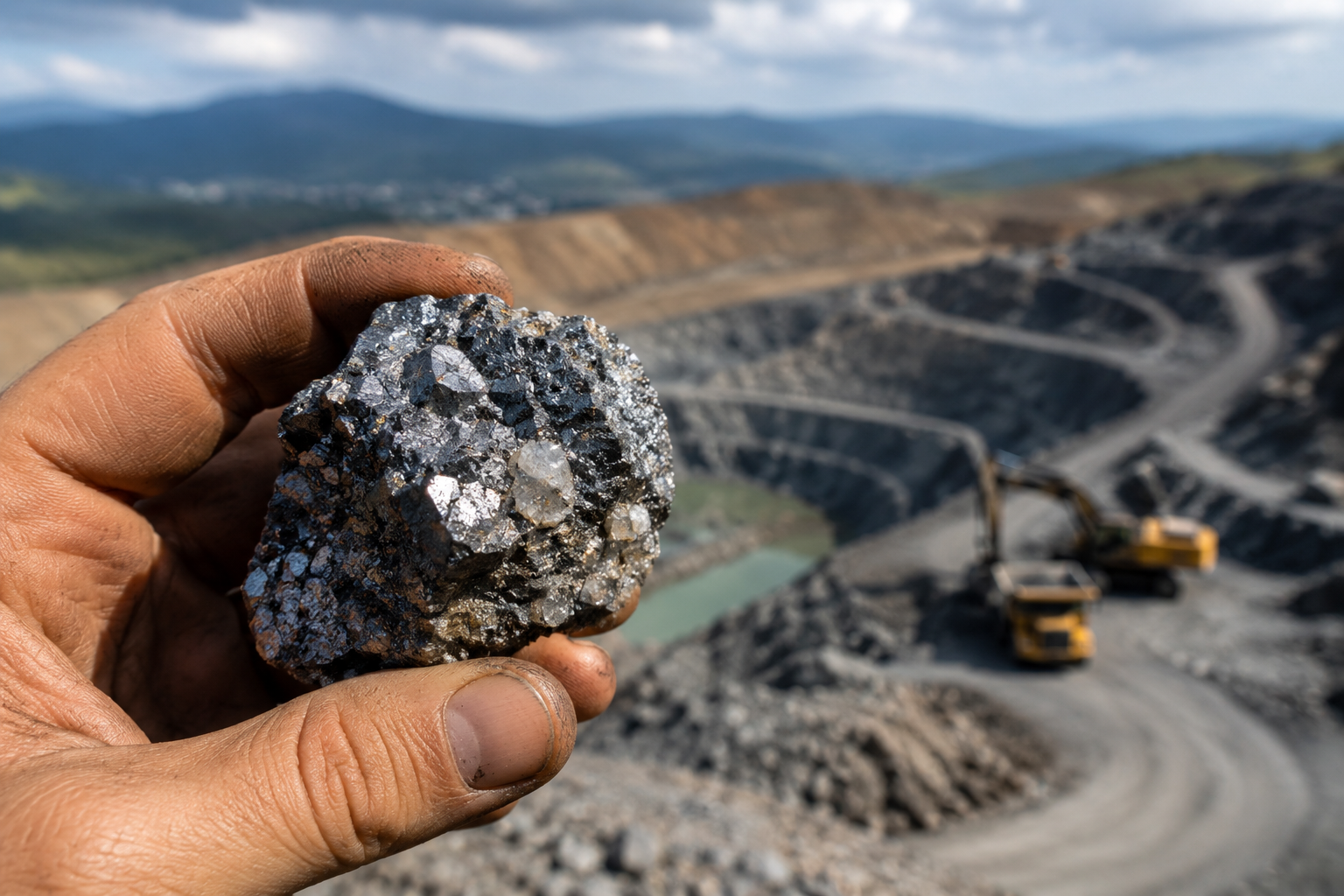
Replacing fossil fuels with low-carbon technologies means replacing combustion with minerals. Batteries, grids, solar systems, wind turbines, and electric mobility all require vast volumes of lithium, copper, graphite, nickel, cobalt, and rare earth elements. This is not a marginal input issue. It is a systemic question of material throughput. And unlike policy ambition, geology does not speed up on command.
The core of the paper focuses on this temporal mismatch. Bringing a mineral deposit from discovery to an operational production line typically takes 8 to 15 years. That lag is not a market inconvenience; it is a physical development timescale shaped through exploration, permitting, financing, extraction, processing, and infrastructure build-out. It creates a hard boundary on how quickly the material foundations of the energy transition can expand.
To formalize this constraint, I develop a mathematical framework around two concepts. The first is the Feasibility Frontier, a system-wide stress test that estimates the maximum plausible rate of green technology deployment from committed mineral supply capacity. The second is the Mineral-Constrained Carbon Budget, which translates these physical bottlenecks into a revised global carbon outlook.
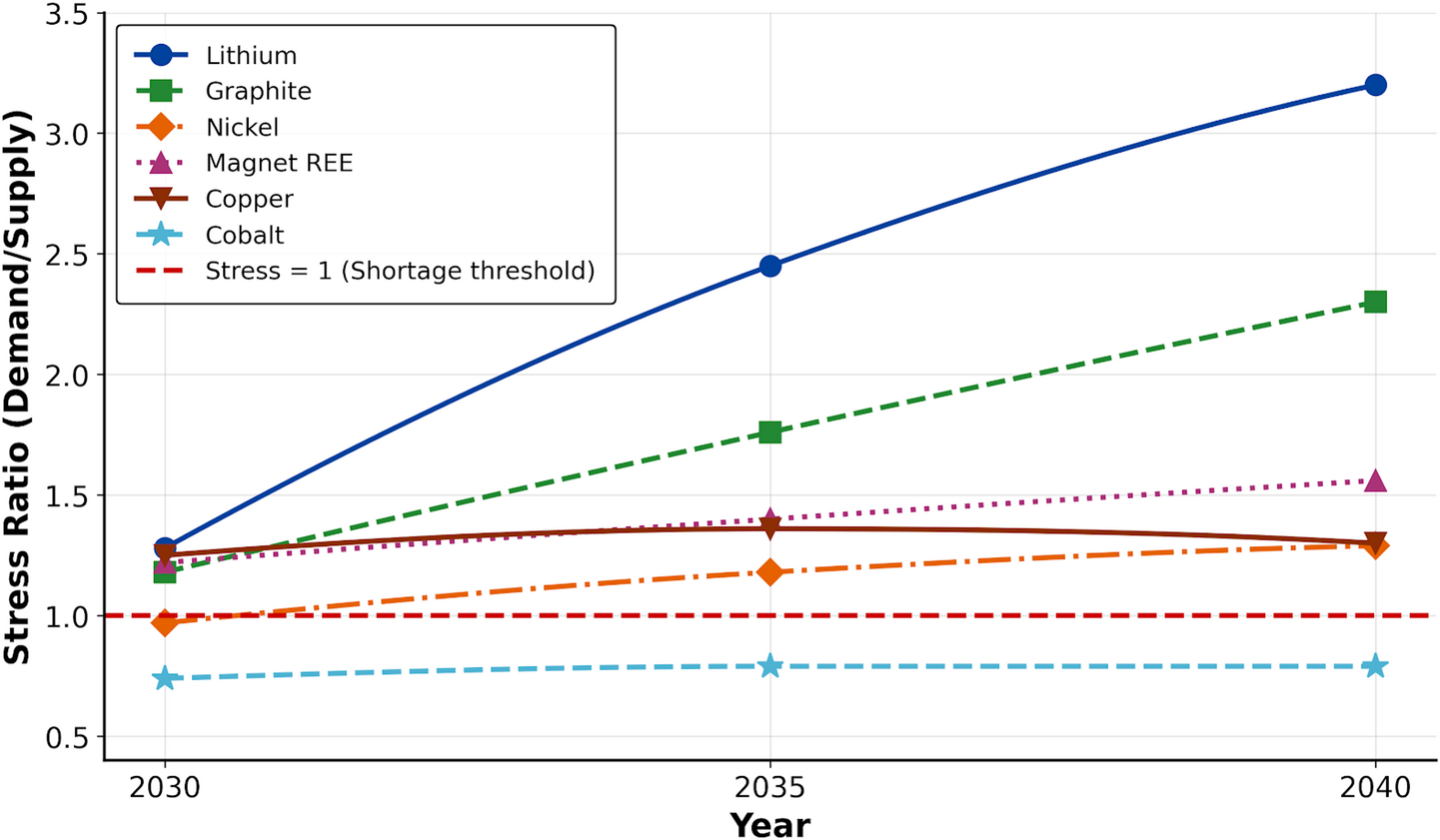
The results reveal a stark implication. When technology-specific mineral demand intersects with realistic supply pipelines, the transition shows a potential 355 Gt CO2 emissions slippage relative to nominal climate pathways. In practical terms, this means part of the carbon budget may already be structurally inaccessible, not because ambition is lacking, but because the Earth’s crust cannot move fast enough to support the assumed speed of deployment.
A particularly important finding is the role of lithium as a binding systemic constraint. In the scenarios examined, lithium emerges as the weakest link in the transition chain, shaping the overall pace at which electrification can scale. This raises the prospect of a “lost decade” in the 2030s, when mineral bottlenecks could materially delay progress even under strong policy commitment.
The broader argument of the paper is that the global debate has focused too heavily on the map and not enough on the crust. Geopolitics asks who controls critical minerals. This paper asks a prior question: can those minerals reach production in time? Ownership concentration is a political challenge; lead-time concentration is a physical one. Both matter, but the latter sets the deeper boundary.
This research introduces mineral supply timing directly into the logic of climate mitigation. It moves beyond demand-only decarbonization scenarios and reconnects the carbon budget to the physical realities of extraction, refinement, and industrial scale-up. The central message is simple: any realistic pathway to climate stabilization must begin not only with ambition above ground, but also with material feasibility below it.
Prof. Yassine Charabi is a climate scientist whose research examines the dynamics of climate change, carbon-budget constraints, mitigation pathways, energy-system transformation, and sustainable transitions. His work is concerned with one of the central questions of contemporary climate science: how societies can reconcile development, technological change, and energy demand with the finite limits of the global carbon budget.
He has been recognized among the Top 2% Scientists Worldwide in the Stanford University/Elsevier ranking since 2022 and served as a Lead Author for the Fifth Assessment Report of the Intergovernmental Panel on Climate Change, Working Group I. Across more than 100 scientific publications, his research has contributed to climate modelling, climate-impact assessment, mitigation analysis, energy transitions, resilience systems, and environmental sustainability.
Prof. Charabi’s work combines climate-system analysis with policy-relevant assessment. His research focuses on the timing, feasibility, and systemic consequences of climate action, particularly where emissions trajectories, energy infrastructure, technological deployment, and sustainability objectives intersect. A central theme of his scholarship is that climate action must be evaluated not only by its long-term promise, but also by its cumulative impact, temporal dynamics, and alignment with the remaining carbon budget.
His current research interests include climate modelling and simulation, carbon-budget accounting, mitigation pathways, energy transitions, climate-risk and resilience systems, sustainable development, and the climate implications of emerging technologies.
Follow the Topic
-
Climatic Change
This journal is dedicated to the totality of the problem of climatic variability and change - its descriptions, causes, implications and interactions among these.