Piezoelectric–Photocatalytic Coupling as a Versatile Strategy for Enhanced Solar Energy Conversion

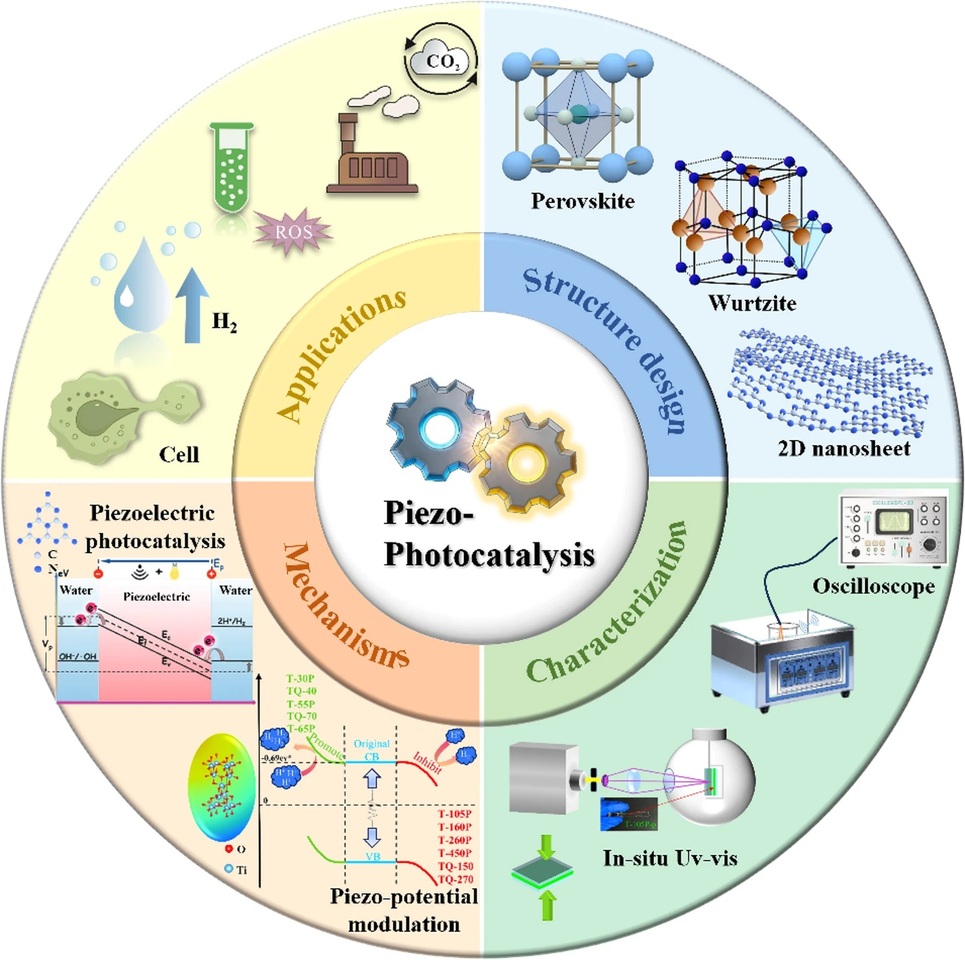
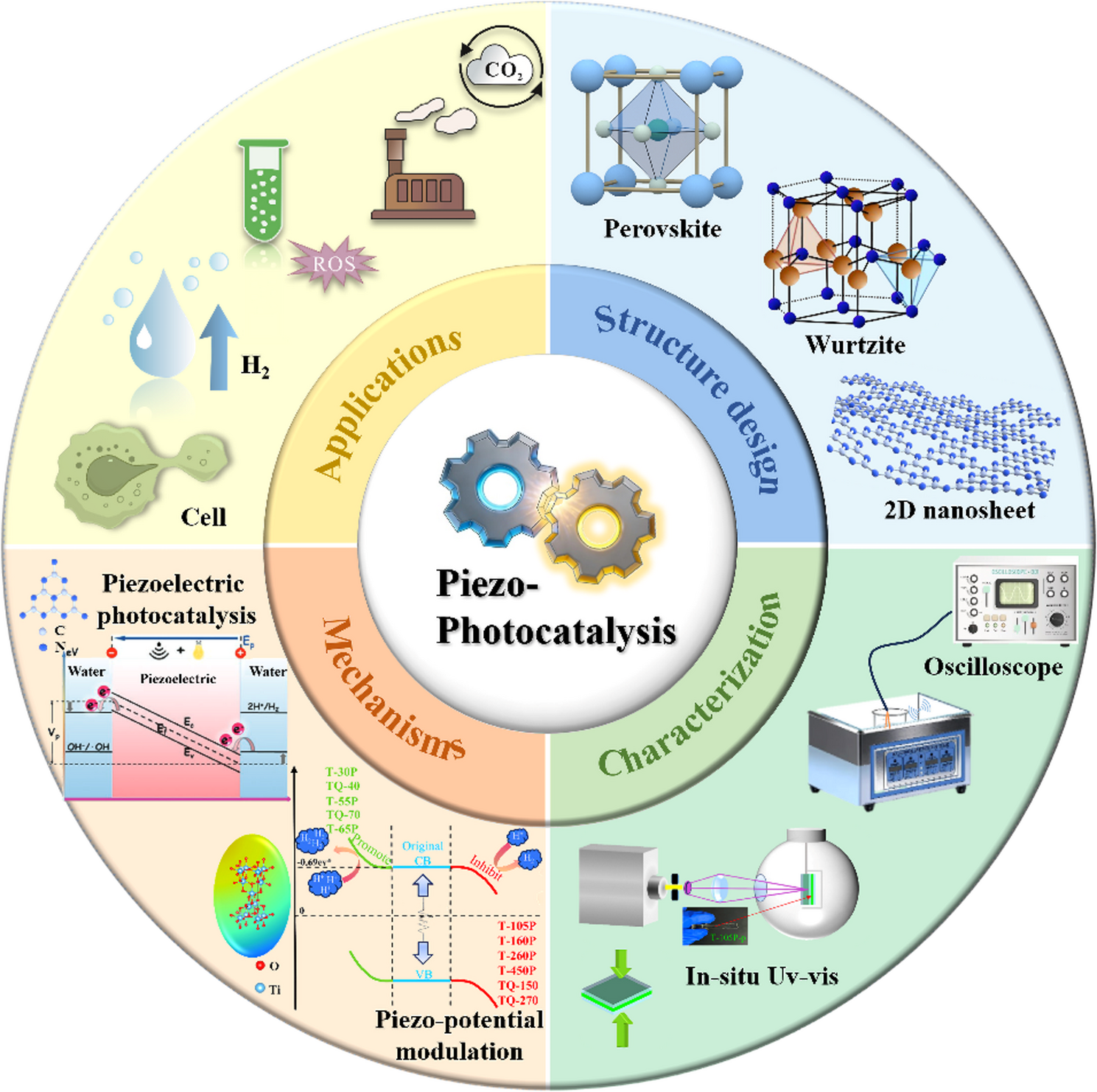

In this review, we summarize recent progress in piezoelectric effect–coupled photocatalytic systems, an emerging catalytic paradigm that integrates mechanical stimulation with light-driven processes. By converting external mechanical inputs into dynamic internal electric fields, piezoelectric materials effectively regulate charge separation, migration, and interfacial reactions—addressing key limitations of conventional photocatalysis, including rapid electron–hole recombination and low energy utilization. We highlight how this strategy enables efficient catalytic activity under mild conditions and broadens the design space for next‑generation energy conversion and environmental remediation technologies.
Key Insights
-
Piezoelectric fields promote efficient charge utilization
Mechanical deformation of piezoelectric components generates built‑in electric fields that direct photogenerated charge carriers, suppress recombination, and enhance surface redox kinetics. -
Multiple low‑grade energy sources can be exploited
Beyond ultrasound, piezo–photocatalytic systems can be activated by water flow, airflow, gravity, and natural vibrations, improving practicality and scalability. -
Wide application relevance demonstrated
Representative advances are reviewed in hydrogen evolution, CO₂ reduction, pollutant degradation, and biomedical antibacterial and regenerative applications, underscoring the interdisciplinary impact of the approach. -
Material and structural design are decisive
Performance enhancement is enabled through piezoelectric ceramics and polymers, two‑dimensional semiconductors, metal–organic frameworks, and advanced strategies such as defect engineering, heterojunction construction, Janus architectures, and single‑atom modification. -
New coupling mechanisms rationalize diverse observations
We discuss emerging concepts including piezoelectric potential switching effects, orthogonal charge‑transfer pathways, and piezoelectric‑dominated catalysis assisted by light, offering a unified framework to interpret both enhancement and inhibition phenomena.
Significance of This Work
By coupling mechanical and solar energy at the materials level, piezoelectric–photocatalytic systems provide a flexible, energy‑efficient, and sustainable platform for catalytic reactions. We identify key future directions, including reducing reliance on high‑frequency ultrasound, quantifying mechanical‑to‑chemical energy efficiency, decoupling complex coupling mechanisms, and leveraging artificial intelligence for materials discovery. These advances are expected to accelerate the translation of piezoelectric–photocatalysis from laboratory studies to practical energy and environmental technologies.
Authors & Affiliations
Peng Liu†, Limin Dong†, Zhiping Zhang, Jun Yu, Zheng Li, Zhenghua Qiao, Lige Gong, Shuai Lu, Xinxin Jin*, Feng‑Ming Zhang*
† These authors contributed equally.
Affiliations:
- School of Materials Science and Chemical Engineering, Harbin University of Science and Technology, Harbin, China
- School of Automation, Harbin University of Science and Technology, Harbin, China
Corresponding Authors:
- Xinxin Jin* (jinxinxin@hrbust.edu.cn)
- Feng‑Ming Zhang* (zhangfm80@163.com)
How to Cite This Article
Liu, P.; Dong, L.; Zhang, Z.; Yu, J.; Li, Z.; Qiao, Z.; Gong, L.; Lu, S.; Jin, X.; Zhang, F.‑M. (2026).
Recent progress of piezoelectric effect–coupled photocatalytic reactions: mechanisms, system design, characterization and applications.
Catal, 2, 11. https://doi.org/10.1007/s44422‑026‑00025‑x
Follow the Topic
-
Catal
Catal is an open access journal covering full spectrum of catalysis critical advances. From biocatalysts to heterogeneous catalysts, it integrates fundamental and applied sciences. Catal offers a primary platform for researchers and practitioners in the field.




Please sign in or register for FREE
If you are a registered user on Research Communities by Springer Nature, please sign in