Planar Lightsheet Optical Tweezer (pLOT) - A new tool for scientific discovery
Published in Bioengineering & Biotechnology, Physics, and Protocols & Methods
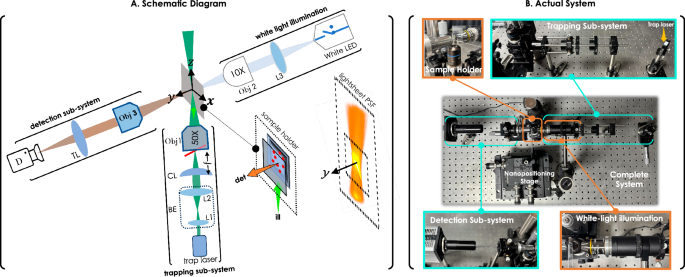

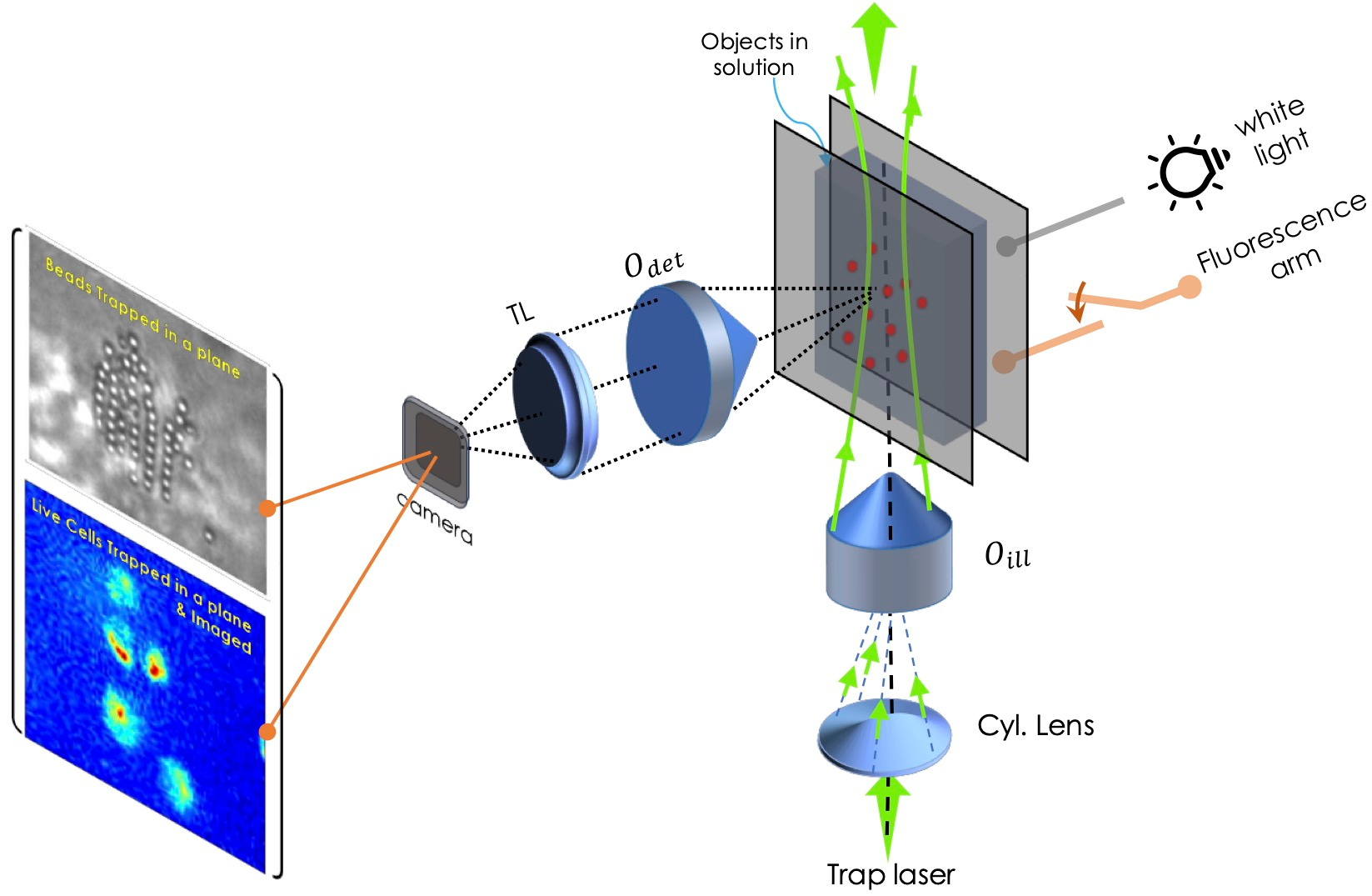
Being able to trap objects (both living and non-living) in a selective plane is fascinating and introduces new capabilities. This allows new ways to manipulate objects that are confined to a plane or need to have two degrees of freedom. Planar Lightsheet Optical Tweezer (pLOT) significantly differs from traditional optical tweezers, which are inherently point traps at their core.
The development reported in Comm Biol is a new technique that traps dielectric beads and cells in a plane illuminated by a sheet of light. Technically, this means the trap laser selectively traps objects in a desired plane, confining them to 2D. This is incredible in application, requiring investigation of objects in a selective single layer, i.e, 2D physics / biology. Fields benefiting from this technique encompass the entire natural and engineering sciences. Some of the futuristic possibilities include a single nano-layer deposition in nanotechnology, atom-atom interaction in atomic physics, quantum interaction between multiple objects, single-layer cell patterning in bioengineering, cell-cell interaction in disease biology, including Cancer, super-resolution imaging of live cells / organisms in a free environment, and many more. The future is likely to see many such applications that require investigation in a plane.
The newly developed optical tool (pLOT) is likely to create conditions restricted to two dimensions, facilitating new kinds of experiments that would otherwise be impossible.
Full Report: https://www.nature.com/articles/s42003-025-09147-9

Follow the Topic
-
Communications Biology
An open access journal from Nature Portfolio publishing high-quality research, reviews and commentary in all areas of the biological sciences, representing significant advances and bringing new biological insight to a specialized area of research.

Related Collections
With Collections, you can get published faster and increase your visibility.
Healthy Aging
Publishing Model: Open Access
Deadline: Dec 31, 2026
DNA repair and human disease
Publishing Model: Hybrid
Deadline: Oct 31, 2026