Poster Presentation: "Structural and Dynamic Basis of Phosphorylation-Mediated HSP90 Conformational Switching Controls Epichaperome Assembly and Cellular Proliferation" at The 2nd NextGen Conversation in Biomolecular Structure and Dynamics.
I have recently attended The NextGen Conversations-2026 at Louisiana Tech University, where I presented a poster which explores how post-translational modifications like phosphorylation drive the formation of stress-induced protein scaffold networks under diseased condition.
Published in Biomedical Research and Mathematical & Computational Engineering Applications
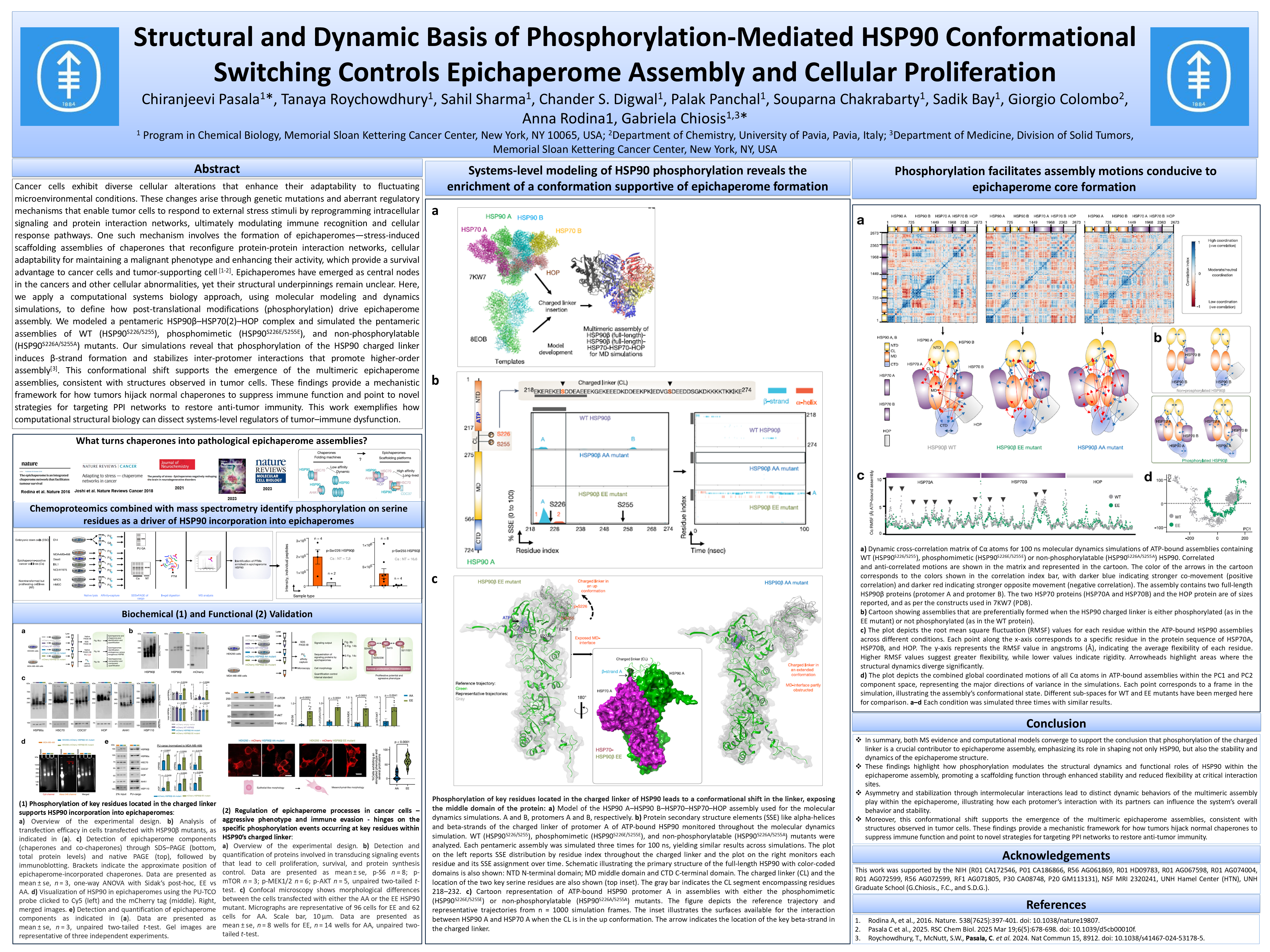
- Cancer cells adapt to fluctuating microenvironments by rewiring intracellular signaling and protein–protein interaction networks, including through stress-induced epichaperome assemblies that support malignant phenotypes and tumor-associated cells. However, the structural basis of epichaperome formation remains unclear.
- This research is important because it shows that HSP90 can shift from its normal role in protein folding to a broader protein-scaffolding function that helps cells adapt and proliferate.
- MD simulations reveal that phosphorylation at residues Ser226/Ser255 acts as a molecular switch, inducing conformational changes that drive the assembly of the HSP90β–HSP70–HOP pentameric epichaperome complex while comparing WT, phosphomimetic, and non-phosphorylatable variants.
- The results also show that phosphorylation of the HSP90 charged linker promotes β-strand formation and stabilizes inter-protomer contacts, enabling higher-order multimerization consistent with epichaperome complexes observed in tumor cells.
- It provides a mechanistic framework for how tumors hijack chaperone networks to modulate immune pathways and suggest new strategies to disrupt pathogenic PPI networks and restore anti-tumor immunity.
- The main take-home message is that cancer and stem-like cells can use this modified HSP90-centered network to reorganize cellular processes that support growth, plasticity, and survival.

Researcher, MSKCC
Follow the Topic
Biomedical Research
Life Sciences > Health Sciences > Biomedical Research
Computational Intelligence
Technology and Engineering > Mathematical and Computational Engineering Applications > Computational Intelligence
Spotlight on Research from the US
Research Publishing > Spotlight on Research from the US




Please sign in or register for FREE
If you are a registered user on Research Communities by Springer Nature, please sign in