Postpartum Basal Ganglia Hemorrhage After Cesarean Section Under Spinal Anesthesia: A Rare Neurological Emergency
Published in Neuroscience and Biomedical Research
Explore the Research
Brain intraparenchymal hemorrhage following urgent cesarean section: a case report
Case summary
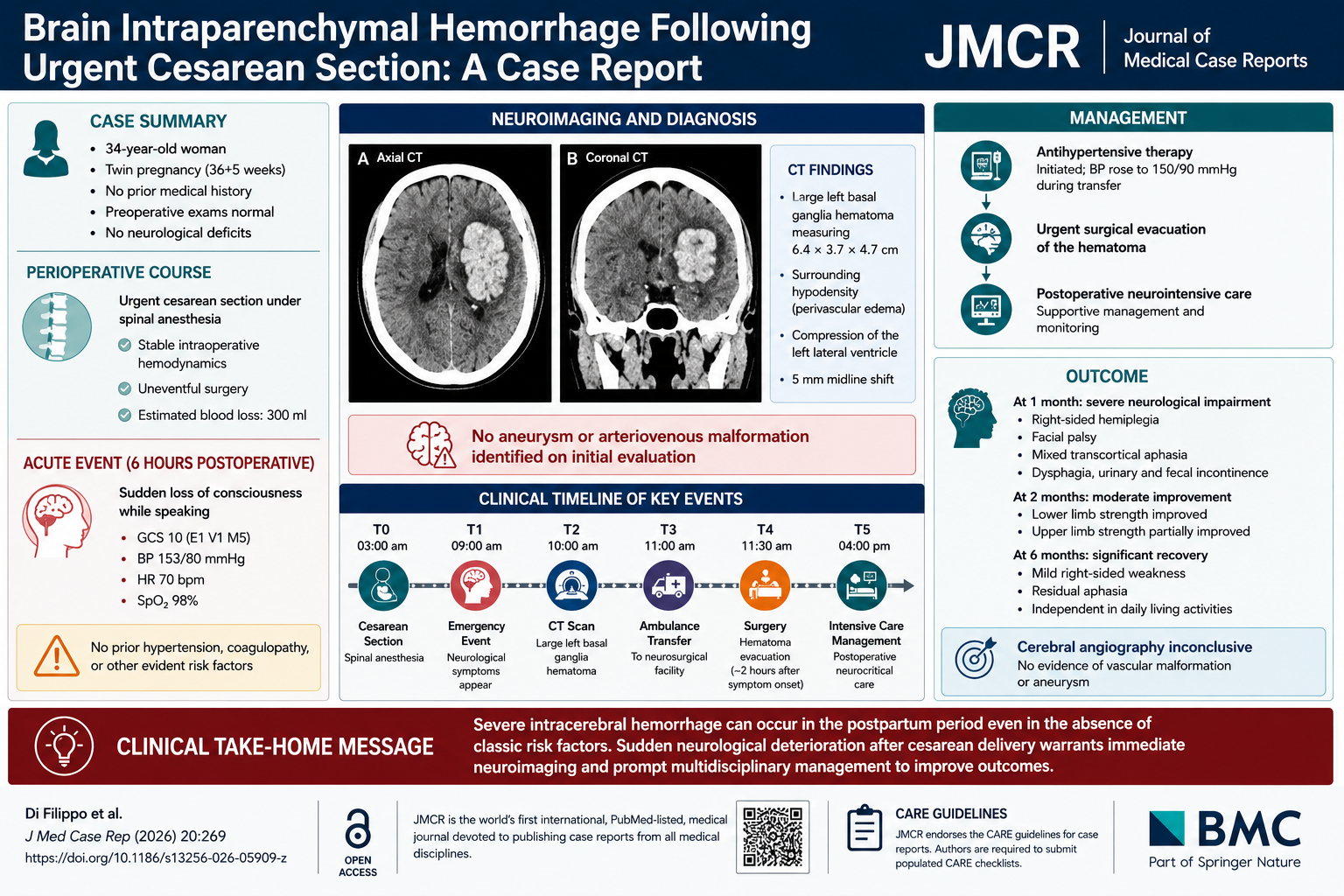
In this report, Di Filippo and colleagues describe a previously healthy 34-year-old woman with a twin pregnancy who underwent urgent cesarean section at 36 + 5 weeks under uncomplicated spinal anesthesia.
The perioperative course was initially uneventful. Preoperative laboratory studies, coagulation profile, neurological examination, and intraoperative hemodynamics were normal. Six hours after surgery, however, the patient experienced sudden loss of consciousness while speaking with her husband.
Emergency brain CT revealed a large left basal ganglia intraparenchymal hemorrhage measuring 6.4 × 3.7 × 4.7 cm with surrounding edema, ventricular compression, and 5 mm midline shift (Fig. 1, page 3). No aneurysm or vascular malformation was identified. During transfer for neurosurgical intervention, blood pressure rose to 150/90 mmHg despite antihypertensive treatment.
The patient underwent urgent surgical evacuation of the hematoma slightly more than 2 hours after symptom onset (Fig. 2, page 4). Postoperatively, she required neurointensive care and developed severe right-sided hemiplegia, facial nerve palsy, mixed transcortical aphasia, dysphagia, and sphincter dysfunction. Cerebral angiography remained inconclusive.
At 6-month follow-up, substantial neurological recovery had occurred, although mild right-sided weakness and residual aphasia persisted. The authors discuss the uncertain relationship between postpartum physiological changes, transient hypertensive surges, and possible neuraxial anesthesia–related mechanisms contributing to hemorrhage.
Why this case matters
Demonstrates severe postpartum intracerebral hemorrhage in the absence of classic risk factors
Highlights diagnostic challenges of acute neurological deterioration after cesarean delivery
Reinforces the importance of rapid neuroimaging and neurosurgical intervention
Explores the controversial association between neuraxial anesthesia and intracranial hemorrhage
Clinical Take-Home Message
Sudden neurological deterioration after cesarean delivery—even in normotensive patients with uncomplicated spinal anesthesia—should prompt immediate neuroimaging to exclude intracerebral hemorrhage and enable urgent neurosurgical management.
Question
What was the most critical factor enabling timely management in this case?
A. Prophylactic anticoagulation
B. Early recognition and emergent CT imaging
C. Absence of hypertension
D. Elective cesarean delivery
Correct answer: B. Early recognition and emergent CT imaging
Explanation:
Rapid recognition of neurological decline and immediate CT imaging allowed prompt neurosurgical intervention, likely improving survival and long-term neurological recovery.
Journal of Medical Case Reports is the world’s first international, PubMed-listed, medical journal devoted to publishing case reports from all medical disciplines and will consider any original case report that expands the field of general medical knowledge, and original research relating to case reports. The journal is open access, and strongly endorses the CARE guidelines for case reports, requiring authors to submit populated CARE checklists with submissions to improve transparency in reporting.
Richard Alan Rison is the interim Editor-in-Chief of Journal of Medical Case reports. He is also an associate neurology editor (editorial board) for BMC Neurology, and the former lead editor for case reports of BMC Research Notes (currently on the editorial board). His scholarly work focuses on medical case reporting, reporting standards, and editorial methodology. Dr. Rison participated in the development and dissemination of the CARE guidelines for clinical case reporting and has authored numerous publications addressing both neurological disorders and the role of case reports in advancing medical knowledge. Dr. Rison practices general neurology and served as the founding medical director of the PIH Health Hospital-Whittier Stroke Program and the PIH Health Hospital-Whittier Non-Invasive Vascular Laboratory, is a clinical assistant professor of neurology at the University of Southern California Keck School of Medicine and Los Angeles County Medical Center, and is a Fellow of the American Academy of Neurology, the American Neurological Association, and the American Association of Neuromuscular and Electrodiagnostic Medicine. Dr Rison is board-certified by the American Board of Psychiatry and Neurology in neurology and vascular neurology, and neurocritical care and neuroimaging by the United Council of Neurologic Subspecialties. He is also board-certified by the American Board of Electrodiagnostic Medicine in electrodiagnostic medicine. Dr. Rison is a former president of the Los Angeles Neurological Society.
Follow the Topic
-
Journal of Medical Case Reports
This journal will consider any original case report that expands the field of general medical knowledge, and original research relating to case reports.


Please sign in or register for FREE
If you are a registered user on Research Communities by Springer Nature, please sign in