Rapid cloning of antigen-specific T-cell receptors by leveraging the cis activation of T cells
Published in Bioengineering & Biotechnology
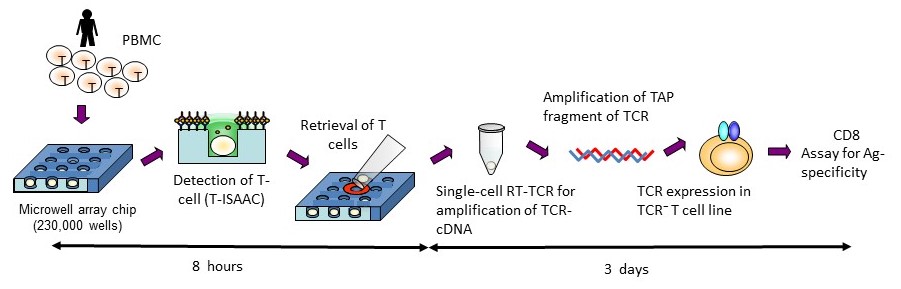



Previously we developed microwell array chips with 45,000 to 200,000 micro-wells that can capture single lymphocyte in it. By using them we can detect antigen-specific antibody-secreting cells at single cell levels, from which we produce antigen-specific antibodies. We call the system immunospot array assay on a chip (ISAAC). We then would like to use microwell array chips to detect antigen-specific T cells. Stimulation of T cells on a microwell array chip with antigen-presenting cells was difficult. We thought if single T cells can be activated by the interaction of T cell receptors (TCR) on a T cell and complex of antigenic peptide and MHC molecules (pMHC) on the same T cells and found we could it. We call the system “T-ISAAC” and the interaction of TCR and pMHC on the same T cell “cis-interaction”. In the article we showed that we can detect antigen-specific T cells with T-ISAAC and obtain antigen-specific TCRs.

Follow the Topic
-
Nature Biomedical Engineering
This journal aspires to become the most prominent publishing venue in biomedical engineering by bringing together the most important advances in the discipline, enhancing their visibility, and providing overviews of the state of the art in each field.

Related Collections
With Collections, you can get published faster and increase your visibility.
Neuroengineering
Publishing Model: Hybrid
Deadline: Oct 31, 2026
Medical Ultrasound: Emerging Techniques and Applications
Publishing Model: Hybrid
Deadline: Jan 29, 2027