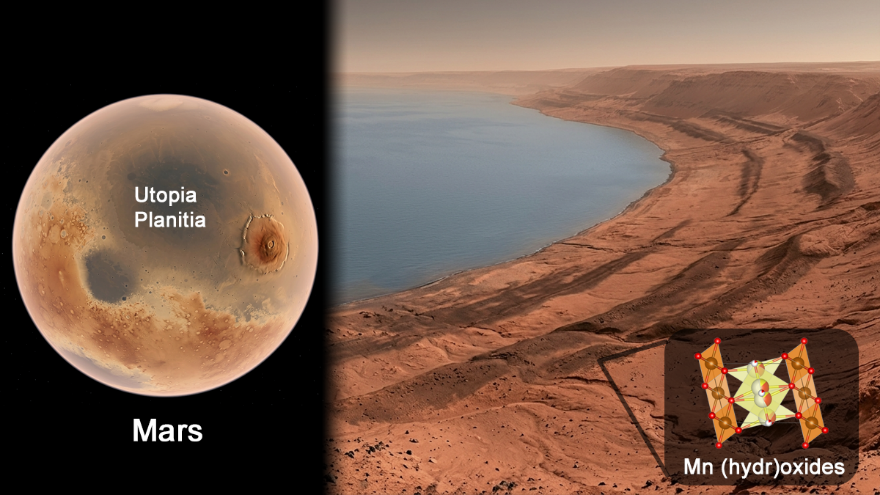

For decades, the question of whether Mars once hosted long-lived oceans has been one of the most tantalizing mysteries in planetary science. It goes to the heart of habitability: if there were oceans, could there have been life? Utopia Planitia, the largest impact basin on Mars, has long been a prime candidate. Yet, despite compelling geomorphological hints, the quantitative details that how long such an ocean might have lasted, how it evolved, and when it finally disappeared, remained stubbornly elusive.
Our journey to answer this question didn’t begin with Mars, but much closer to Earth. It started over a decade ago with a simple curiosity: could minerals do more than tell us what kind of environment existed? Could they tell us when, and for how long?
A Decade of Reading Minerals
Our team has been captivated by manganese (hydr)oxide minerals since around 2015. To most people, they are just black or brown stains on rocks. To us, they are exquisitely sensitive recorders of their environment. We have spent years investigating their genetic mineralogy–how they form, their characteristic defects, and, most importantly, their redox activity. By probing them at atomic and electronic scales, we discovered that the very structure of a manganese (hydr)oxide mineral is a dynamic archive of the environmental conditions under which it grew. A birnessite forming in a desert rock varnish looks and behaves very differently from one precipitating in a soil. Its crystal structure, its electronic band gap, its pathway of structural transformation–all of these are exquisitely sensitive to pH, to trace metals, to light, to microbes, to organics, and to the presence of other elements.
This deep understanding, forged on Earth, became the lens through which we would eventually look at Mars. When we saw reports of manganese-rich materials as potential Martian “rock varnish” detected by the Curiosity rover in Gale Crater, we saw a potential environmental recorder.
The Challenge of a Spectral Enigma
Mars presents a formidable obstacle: we don’t yet have the rocks in our labs. We have their spectra. Infrared spectroscopy is the primary tool for mineral identification from orbit and from rovers. Traditional analysis relies on identifying characteristic absorption peaks, which works beautifully for well-crystallized minerals with sharp, distinct fingerprints. For minerals like hydrous and poorly-crystallized manganese (hydr)oxides, however, it fails spectacularly.
In mineral mixtures, manganese (hydr)oxides are not cooperative. Rather than producing a single, sharp diagnostic peak, they behave as broadband absorbers, subtly and non-linearly suppressing the entire spectrum across the visible to short-wave infrared range. As our laboratory studies on Earth had shown, even a small amount can dramatically alter the spectral shape of a mixture, obscuring the signals of other minerals and confounding conventional linear unmixing methods.
In fact, our deep appreciation of this challenge predated our Martian ambitions. In 2019, we published a study in PNAS showing that the Mn-rich rock varnishes widespread on Earth’s surface function as natural photoelectric converters, efficiently transforming solar energy into electrical current. That discovery was exhilarating, and it naturally led to an even grander question: how much solar energy could all the manganese (hydr)oxide minerals on the global land surface actually convert? This ambition of compiling a “global energy budget” forced us to confront a critical bottleneck: quantitative analysis of remote sensing spectra.
As we investigated the infrared emission spectra of Earth’s weathering crust, we found that manganese (hydr)oxides typically form as thin, poorly crystallized mineral coatings on diverse rock surfaces. Their spectral contribution is profoundly non-linear. Their dark, opaque nature dramatically alters the overall reflectance continuum and suppresses internal scattering, such that even minor amounts can nonlinearly reduce reflectance and compress spectral contrast across the broad 0.7–2.0 μm wavelength range. This means that the spectral signature of manganese oxides is not confined to a single absorption feature, but is instead distributed across the entire spectrum. Conventional linear unmixing methods, when faced with the short-wave infrared spectra of these altered rocks, are virtually powerless.
It was precisely this Earth-borne ambition, born from a desire for global quantification, that forced us to fundamentally rethink how we interpret spectral information. We could no longer rely on traditional “peak-finding” approaches; we had to forge a new path. And this path, forged on Earth under the pressure of a grand question, ultimately became the key that unlocked the Martian spectra.
From Peaks to Full-Spectrum Understanding
We realized we needed a fundamentally new way of interpreting these spectra. We had to stop looking for a single peak and start understanding the full pattern. This is where our decade of foundational research met the power of modern deep learning.
This led us to develop Spectral Contrastive-Aware Network (SCANet), a deep learning model designed specifically for this purpose. SCANet doesn’t just look for specific wavelengths; it learns the entire spectral behavior. It is trained on over 13,000 laboratory and simulated spectra of Martian soil analogues, incorporating the spectral complexity we had spent years characterizing: crystallinity, hydration, mixture effects, and particle size distributions. The model learned to recognize the subtle, continuous changes in spectral shape that are the true signature of manganese (hydr)oxides.
Crucially, this was not a purely data-driven exercise. We grounded the model in mineral physics. The network was trained not only to recognize patterns, but to capture the underlying mechanisms: how high-absorption, poorly crystalline, and hydrated phases alter reflectance through non-linear interactions in mineral mixtures. SCANet also incorporates a spectral contrastive learning approach, which enhances the model’s sensitivity to small spectral variations caused by different Mn oxidation states or subtle changes in hydration. This combination allowed us to overcome the long-standing limitations of linear unmixing and peak-based methods, enabling robust identification and quantitative mapping of manganese (hydr)oxides even in complex Martian regolith.
Decoding the Ocean’s Bathtub Rings
When we finally applied SCANet to the wealth of data from the Zhurong rover, and the OMEGA and CRISM orbiters, the results were astonishing. The model revealed a clear, altitude-dependent pattern in manganese (hydr)oxide concentrations. The abundance of these minerals increased to form distinct “bathtub rings” at the marine basin margin. We were not just seeing an ocean; we were seeing its history, recorded as a series of former shorelines.
In that moment, all the years of studying these minerals on Earth paid off. On our planet, manganese (hydr)oxides are well-known to precipitate preferentially at redox boundaries in shallow water, where oxidizing conditions meet reducing, Mn-rich waters. The “bathtub rings” we saw on Mars were a perfect mineralogical analog. We were, for the first time, able to trace the ocean’s origin, its periods of expansion, its gradual regression, and its ultimate extinction. By combining these mineralogical patterns with depositional models, we estimated that this Hesperian ocean persisted for approximately 0.8 to 1.5 million years, a timescale long enough to have been meaningful for prebiotic chemistry and potentially the emergence of life.
The analysis also provided insights into the ocean’s environmental dynamics. The manganese (hydr)oxides patterns suggest repeated cycles of exposure and submersion, consistent with fluctuating water levels or episodic inflows. Furthermore, the spatial distribution indicates that certain regions of Utopia Planitia acted as persistent redox hotspots, potentially creating favorable niches for prebiotic chemistry or early habitability. This mineralogical record transforms our understanding of Martian water history from static snapshots to a dynamic, time-resolved process.
A Mineralogical Way of Reconstructing Mars’ Past
For us, this work is not just about Mars. It’s a testament to the power of a long-term, fundamental research program in mineralogy. By spending years understanding the minute structural details and electronic complexities of manganese (hydr)oxides on Earth, we were equipped to read their far more cryptic messages on another world. It also shows that the future of planetary science lies in interdisciplinary fusion, combining the deep physical understanding of mineralogy with the pattern-recognition power of advanced deep learning.
Beyond Mars, we believe this work points to a broader direction for planetary science. Mineralogy has always been central to interpreting planetary surfaces, but its full potential lies in quantitative and process-oriented analysis. By combining mineralogical insight with advanced deep learning methods, we can begin to extract not just what minerals are present, but what stories they tell about planetary evolution.
The Martian manganese (hydr)oxide minerals are not just a discovery; they are a message from the deep past. They tell us that an ancient ocean left behind a readable record, encoded in its chemistry and structure. Our job was to learn how to decode it.

Follow the Topic
-
Nature Communications
An open access, multidisciplinary journal dedicated to publishing high-quality research in all areas of the biological, health, physical, chemical and Earth sciences.

Related Collections
With Collections, you can get published faster and increase your visibility.
Women's Health
Publishing Model: Hybrid
Deadline: Ongoing
Biosensing
Publishing Model: Hybrid
Deadline: Sep 30, 2026
Please sign in or register for FREE
If you are a registered user on Research Communities by Springer Nature, please sign in